MunchkinCharacteristics, history, behaviour and care
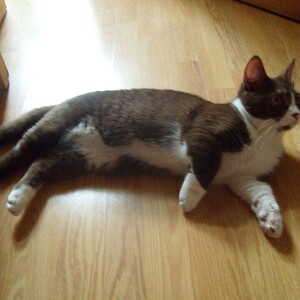
Munchkin cat. · Sasha Krotov / Wikimedia Commons, CC BY 3.0 (https://creativecommons.org/licenses/by/3.0). Cropped and resized.
The Munchkin is a cat breed with very short legs, caused by a genetic mutation called chondrodysplasia. It is considered the first dwarf cat breed. Its recognition by TICA, in 1997, caused a great deal of controversy. FIFe bans breeds based on dwarfism and even names the Munchkin as an example, and breeding it is banned in several countries. It is a sociable cat that stays as playful as a kitten.
Quick facts
| Common name | Munchkin |
| Scientific name | Felis catus |
| Country of origin | USA (Louisiana) |
| Official recognition | Rejected by FIFe, CFA and the GCCF; TICA since 1997; WCF, ACF |
| Lifespan | We found no data for the breed; pet cats live about 13 years on average |
| Weight | Males 2.7–4.1 kg, females 1.8–3.6 kg |
| Size | Small to medium |
| Body type | Moderate, with very short legs |
| Coat type | Short (plush) or semi-long (silky) |
| Common colours | All colours and patterns |
| Eye colour | We found no data in the sources |
| Activity level | Moderate |
| Temperament | Sociable, kitten-like and playful, gregarious |
| Good with children | We found no data in the sources |
| Good with other pets | Sociable |
| Genetic predispositions | Chondrodysplasia, lordosis, pectus excavatum, severe osteoarthritis |
- Primary category:Cat breeds
- Explore this animal's categories:
History and origin
Short-legged cats have been reported since the 1940s: a British veterinary report from 1944 described four generations. Others were seen in Russia in 1956 and in the USA in the 1970s.
In 1983, Sandra Hochenedel, a music teacher from Rayville, Louisiana, found two pregnant cats that a dog had chased under a truck. She kept one, Blackberry, and half of her kittens were born with short legs. Today's breed descends from Blackberry and her son Toulouse. The name comes from the little “Munchkins” in L. Frank Baum's “The Wizard of Oz”.
The breed was presented to the public in 1991, at a TICA show at Madison Square Garden. TICA accepted it into its new breed programme in 1994; the judge Katherine Crawford resigned in protest.
How the breed developed
- 1944 – a British veterinary report describes short-legged cats.
- 1983 – Sandra Hochenedel finds Blackberry.
- 1991 – presented at Madison Square Garden.
- 1994 – enters TICA's new breed programme.
- 1997 – recognised by TICA.
- 2014 – the Netherlands bans breeding animals with genetic defects.
At a glance: who is it right for?
First of all: FIFe considers the breed an unacceptable manipulation of a genetic disease, and several countries ban breeding it.
- If you are thinking of getting one: find out what bone problems it may have and what the law says in your country.
- Homes without many high jumps. Some sources say its jumping is limited.
- People who can pay for check-ups. Osteoarthritis can only be seen on an X-ray.
- Not for breeding. Several countries ban breeding dwarf cats.
Physical characteristics
It is a small to medium cat with a moderate body. Males weigh 2.7–4.1 kg, and females 1.8–3.6 kg. The hind legs may be slightly longer, so the back rises slightly from the shoulders to the rump.
General appearance
The legs may be slightly bowed, but too much curvature disqualifies a cat at shows. Apart from the legs, it looks like an ordinary house cat, because it has often been crossed with them.
| Feature | Munchkin |
|---|---|
| Size | Small to medium |
| Weight | Males 2.7–4.1 kg, females 1.8–3.6 kg |
| Legs | Very short |
| Body | Moderate |
| Coat | Short or semi-long |
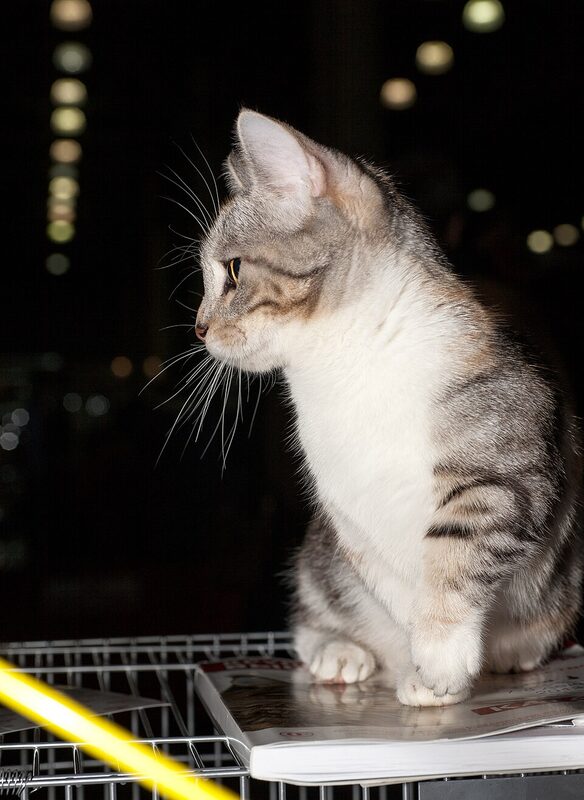
It comes in all colours and patterns. The shorthaired variety has a plush coat, and the longhaired one a semi-long, silky coat.
Related breeds and how to tell them apart
Short legs have also been bred into other breeds, for example the Bambino (with the Sphynx), which also face legal restrictions. The sources warn that Munchkins should not be crossed with other breeds with skeletal abnormalities, such as the Scottish Fold.
Behaviour and temperament
French Wikipedia says that, according to the breed's breeders, it keeps its kitten-like character as an adult and is very sociable and gregarious. Its traits, however, depend a lot on the individual cat.
Socialisation
A kitten gets used to new people, noises and other animals most easily in its first months of life.
Habits at home
Like all cats, it sleeps a lot: usually 12–16 hours a day. It is most active early in the morning and in the evening, but partly adapts to the family's routine.
Cats instinctively bury their droppings, so it quickly learns to use a litter tray. It scratches rough surfaces to shed the old outer layer of its claws, so it needs a scratching post or board.
Life at home and activity
Some sources say its short legs do not stop it running and jumping, others that its jumping is limited. Ramps and steps help it get up high without effort.
| Activity | How often | Why it matters |
|---|---|---|
| Ramps and steps to high places | always within reach | Its jumping may be limited |
| Play with toys (wand toys, balls) | daily | Play imitates hunting and uses up its energy |
| Scratching post or board | always available | It looks after its claws without damaging the furniture |
| High places (cat tree, shelves) | always available | It has somewhere to watch from and to rest |
Tips for a balanced life
- Watch whether it avoids jumping or moves stiffly: these may be signs of pain.
- Keep it at a healthy weight, so its joints are not overloaded.
- Play with it at floor level.
Care and health
Coat care
The short coat is brushed once a week, and the semi-long coat several times a week.
Common health problems
The mutation that shortens the legs is a chondrodysplasia. Wikipedia says the breed more often has lordosis (excessive curvature of the spine) and pectus excavatum, and a higher risk of severe osteoarthritis, because its short legs change the way it moves. Osteoarthritis can be diagnosed by X-ray.
| Condition | Description | Common symptoms |
|---|---|---|
| Osteoarthritis | Wear of the joints, with pain | Stiff gait, refuses to jump, moves little |
| Lordosis | The spine curves too far downwards | “Sagging” back, pain |
| Pectus excavatum | The breastbone is sunken inwards | Laboured breathing in severe cases |
Recommended genetic tests
There is no test required for the breed. X-rays can show osteoarthritis; also ask for the parents' health records.
Is it hypoallergenic?
Cat allergy is caused mainly by the Fel d 1 protein, found in saliva and skin glands; it is behind the allergy in 90% of people who are allergic to cats. Kittens, females and neutered males produce less of it, but still enough to trigger symptoms. No breed is completely hypoallergenic.
Other care
- A check-up at the vet once a year.
- Vaccinations and parasite treatment on the schedule set by the vet.
- Trim the claws if they do not wear down on their own.
- Clean its teeth or give it food that helps keep them clean.
Diet and nutrition
The cat is a carnivore: it needs animal protein. Unlike a dog, it must get vitamin A, arachidonic acid and taurine from its food. Water is very important, because cats usually drink little; several water bowls around the house encourage it to drink.
Tips for a healthy diet
The table gives a starting estimate, calculated with the formula from the Merck Veterinary Manual for a healthy adult cat. The last column shows what this means in dry food with 3,500–4,000 kcal per kilogram. If you also feed wet food, reduce the dry portion.
| Cat's weight | Calories per day (neutered) | Calories per day (not neutered) | Dry food per day (approximate) |
|---|---|---|---|
| 2 kg | 140 kcal | 160 kcal | 35–46 g |
| 2.5 kg | 170 kcal | 190 kcal | 42–54 g |
| 3 kg | 190 kcal | 220 kcal | 48–63 g |
| 4 kg | 240 kcal | 280 kcal | 60–80 g |
- Adjust the portion to its weight: neutered cats put on weight easily.
- Weigh it monthly; the ribs should be easy to feel under your fingers.
- Kittens need more calories: Merck recommends 2.5 times the resting energy requirement.
Dangerous foods and substances
Some common household items are dangerous for cats:
- Lilies (and daylilies): they can destroy a cat's kidneys. Even the pollen or the water in the vase is dangerous.
- Paracetamol: extremely toxic to cats, which lack the enzyme that breaks it down. Never give it human medicines.
- Flea spot-ons and collars for dogs containing permethrin: the concentration meant for dogs is dangerous for cats.
- Foods: chocolate, coffee, alcohol, onions, garlic, grapes and raisins.
Reproduction and development
Maturity
Females usually reach sexual maturity at 5–10 months, and males at 5–7 months. The age varies from breed to breed.
Mating and pregnancy
Pregnancy in cats lasts 64–67 days, 65 on average. A first litter usually has fewer kittens than later ones. Only healthy cats that match the breed standard are used for breeding.
Blood type
Cats have blood type A, B or AB. Type A is the most common: in a study from England, 87.1% of non-pedigree cats and 54.6% of pedigree cats had type A. This matters for breeding: if the mother is type B and the kittens are type A, the antibodies in her first milk (colostrum) can destroy their red blood cells. The condition is called neonatal isoerythrolysis. That is why breeders test the blood type of both parents.
We found no published data on how common type B is in this breed; the test is done before mating anyway.
Caring for the kittens
Kittens are weaned at 6–7 weeks. They are ready to go to their new home at about 12 weeks, when they can be separated from their mother.
Neutering
Neutering used to be done at 6–9 months, but it is more and more often done before puberty, at around 3–6 months. It prevents unwanted kittens, urine marking in males and the loud “calling” of females in heat. A 2024 study found that neutered cats live one year longer on average. After the operation, the metabolism slows down and appetite increases, so the portion has to be reduced.
How to choose a kitten
- Ask for the pedigree from a recognised cat association (for example, TICA).
- The kitten leaves its mother at about 12 weeks.
- Think carefully: in several countries breeding Munchkins is banned because of their health problems.
- Look at the mother and at the place where the kittens are raised: it should be clean, with kittens used to people.
- Ask about vaccinations, parasite treatment and the blood type of the parents.
Interesting facts
- The shortest cat. A Munchkin from Napa, California, was recognised by Guinness as the shortest living cat: 13.3 cm tall.
- A name from “The Wizard of Oz”. The breed is named after the little people in L. Frank Baum's book.
- Rescued from under a truck. The breed's ancestor, Blackberry, was found under a truck, chased there by a dog.
- A judge resigned. The judge Katherine Crawford left TICA in protest at the breed.
In popular culture
The Wizard of Oz
The breed's name comes from the “Munchkins”, the small inhabitants of Munchkin Country in L. Frank Baum's novel “The Wonderful Wizard of Oz” (1900).
Frequently asked questions
Why does it have short legs?
Because of a mutation called chondrodysplasia, which affects the growth of the leg bones.
Is it a healthy breed?
It has a higher risk of severe osteoarthritis, lordosis and pectus excavatum; that is why FIFe and other associations do not recognise it.
Can it jump?
The sources disagree: some say it jumps normally, others that its jumping is limited.
How much does it weigh?
Males 2.7–4.1 kg, females 1.8–3.6 kg.