DodoRaphus cucullatus — habitat, diet and reproduction
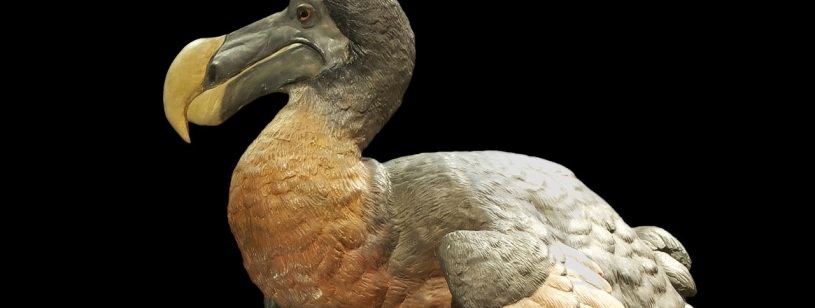
Museum reconstruction of the dodo (Raphus cucullatus). · Jebulon / CC0 (http://creativecommons.org/publicdomain/zero/1.0/deed.en).
The dodo was a large flightless bird from the island of Mauritius in the Indian Ocean. It stood about 70 centimetres tall, had a large hooked bill and was related to pigeons. It vanished less than a century after European sailors reached the island and became the world symbol of species lost because of humans.
Quick facts
| Common name | Dodo |
| Scientific name | Raphus cucullatus |
| Lifespan | Unknown |
| Height | About 63–75 cm |
| Weight | Estimated at about 10–18 kg |
| Diet | Probably fruit, seeds, nuts and roots |
| Predators | No predators before humans; then pigs, dogs, rats and monkeys brought by people |
| Conservation status | Extinct (EX), late seventeenth century |
| Distribution | Only the island of Mauritius |
| Habitat | Coastal and inland forests of the island |
| Family | Columbidae |
| Flight | Flightless |
- Primary category:Birds
- Explore this animal's categories:
Interesting facts
- The dodo’s closest living relative is the Nicobar pigeon.
- The last sighting accepted by researchers took place in 1662.
- The Oxford museum holds the only dodo head with preserved soft tissue.
- The dodo appears as a character in Lewis Carroll’s “Alice’s Adventures in Wonderland”.
Characteristics
The dodo had a round body, short yellow legs and small wings that could not lift it off the ground. Its plumage was probably grey-brown, with a tuft of pale tail feathers.
The bill was large with a hooked tip, and the face was partly bare. The image of a very fat bird comes from period paintings, sometimes based on overfed captive birds. Bone studies suggest a slimmer, more agile bird.
Behaviour
We know little about its behaviour because sailors’ accounts are short and sometimes contradictory. On an island without predators, dodos were not afraid of people.
Bone research suggests it lived on the ground, could run and used its strong bill for feeding and perhaps defence.
Habitat and distribution
The dodo lived only on Mauritius, in the Indian Ocean east of Madagascar. The volcanic island had no predatory mammals before people arrived.
It used coastal and inland forests. A close relative, the Rodrigues solitaire, lived on a nearby island and also went extinct.
Diet and feeding
Researchers believe it ate fallen fruit, seeds, nuts, bulbs and roots, and perhaps crabs or snails.
Like other birds, it swallowed grit to grind hard food in its stomach. The exact relationship between the dodo and certain Mauritian trees is still debated.
Reproduction and life cycle
The female is thought to have laid a single large egg in a ground nest. Bone studies show chicks grew quickly and birds moulted after the breeding season.
Ground nests were very vulnerable to pigs, rats and monkeys brought by people, which ate eggs and chicks.
Name and history
The name “dodo” may come from the Dutch “dodoor”, sluggard, or the Portuguese “doudo”, fool. Dutch sailors first described it in 1598.
The English phrase “dead as a dodo” means something gone for good. DNA studies in 2002 confirmed that the dodo was a giant pigeon.
Conservation and threats
The dodo became extinct in the late seventeenth century. The main causes were animals introduced by people, which destroyed nests, forest clearance and, to a lesser extent, hunting.
Its story is used as an example of how vulnerable island species are. Today Mauritius protects other rare species, such as the pink pigeon and Mauritius kestrel, saved at the last moment.
Frequently asked questions
Does the dodo still exist?
No. It became extinct in the late seventeenth century; the last accepted sighting was in 1662.
What bird was the dodo related to?
Pigeons. Its closest living relative is the Nicobar pigeon.
Why did the dodo go extinct?
Mainly because of animals brought by people, which ate eggs and chicks, and forest clearance.
How big was the dodo?
About 63–75 cm tall, probably weighing 10–18 kg.