PlatypusInteresting facts and information
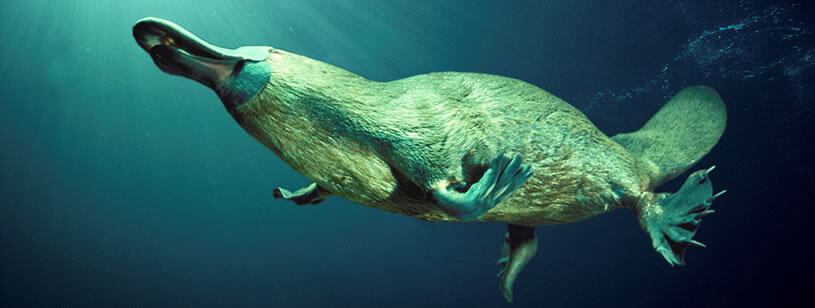
The platypus (Ornithorhynchus anatinus) is an egg-laying mammal native to eastern Australia, including Tasmania. It uses its sensitive bill to find aquatic prey. Males have venomous spurs on their hind legs.
The platypus is an excellent swimmer and spends much of its time in the water, hunting with electroreception, a sense that is very rare among mammals. It is a symbol of Australia's unique wildlife and is protected by law, because its numbers have declined.
Quick facts
| Common name | Platypus |
| Scientific name | Ornithorhynchus anatinus |
| Typical lifespan | Often about 10-15 years in the wild; over 20 years recorded |
| Maximum speed | A strong swimmer; slow on land |
| Height | Low to the ground, only about 15 cm tall |
| Length | About 40-60 cm (including tail) |
| Weight | About 0.7-2.4 kg |
| Diet type | Carnivore (insect larvae, crustaceans, worms, molluscs) |
| Main predators | Foxes, dogs, cats, snakes, eagles, owls, large fish and crocodiles |
| Conservation status | Near Threatened (IUCN) |
| Geographical distribution | Eastern Australia and Tasmania |
| Social behaviour | Solitary, mostly active at dawn, dusk and night |
| Special adaptations | Lays eggs, venomous spurs (males), electroreception for hunting underwater, waterproof fur |
- Primary category:Mammals
- Explore this animal's categories:
Interesting facts
- A mammal that lays eggs - The platypus belongs to the monotremes, an ancient group of mammals that lay eggs, together with the echidnas.
- Its bill senses electricity - The platypus finds prey underwater by detecting the tiny electric signals made by their muscles, an ability called electroreception.
- Males have venomous spurs - Male platypuses have a sharp spur on each hind leg that can inject a venom causing severe pain; they use it mainly in fights with other males.
- No true stomach - Unlike most mammals, the platypus has no stomach that makes acid; its food passes almost straight from the gullet to the intestine.
- Milk without nipples - Females have no nipples; their milk oozes from patches of skin on the belly, and the babies lap it up from the fur.
- Ten sex chromosomes - Most mammals have two sex chromosomes (X and Y), but the platypus has ten, five X and five Y.
- No teeth as adults - Young platypuses have tiny teeth, which fall out; adults crush their food with hard, horny pads in their bill.
Records and remarkable features
- The platypus (Ornithorhynchus anatinus) is an egg-laying mammal native to eastern Australia, including Tasmania. It uses its sensitive bill to find aquatic prey. Males have venomous spurs on their hind legs.
- It is one of only a handful of venomous mammals in the world.
- Its fur glows a blue-green colour under ultraviolet light, a discovery reported in 2020.
Characteristics
The platypus (Ornithorhynchus anatinus) is a monotreme mammal. Its bill, webbed feet, fur and egg-laying reproduction form a distinctive combination of adaptations.
Appearance
- Size and weight - The platypus is about 40-60 cm long, including the tail, and weighs about 0.7-2.4 kg; males are larger than females.
- Thick, waterproof fur - Keeps it warm in cold water, like the fur of an otter.
- A duck-like bill - Soft, rubbery and covered with thousands of touch and electric sensors that help it find prey underwater.
- Webbed feet - The front feet have large webs for swimming, which fold back on land so the claws can be used for walking and digging burrows.
- A broad, flat tail - Stores fat and helps the platypus steer in the water.
- No teeth as adults - Instead, adults have hard, horny pads in their bill to grind food.
Special adaptations
- Electroreception - Together with the echidnas, the platypus is one of the very few mammals that can sense electric fields, which helps it find prey underwater with its eyes, ears and nostrils closed.
- Venom in males - The venom is not deadly to humans, but it causes intense pain and swelling that may last for weeks or months.
- Egg-laying - The platypus is one of only five living species of egg-laying mammals; the female incubates her eggs in a burrow.
- No true stomach - Its gullet joins almost directly to the intestine.
Habits and behaviour
The platypus is a solitary animal that is mostly active at dawn, dusk and night. It spends much of its time in the water, hunting with its electric sense, and is very shy.
Social behaviour
- Solitary - Platypuses live alone, although their home ranges along rivers can overlap.
- Night activity - During the day, the platypus usually rests in a burrow dug into a riverbank.
- Fights between males - In the breeding season, males use their venomous spurs to fight rivals.
Moving and swimming
- Swimming - The platypus paddles with its front feet, while its hind feet and tail help it steer.
- Diving - Each dive usually lasts about half a minute to a minute or two, and then it returns to the surface to breathe.
- On land - It folds back the webbing on its front feet so it can walk and dig.
Defence and survival
- Avoiding predators - The platypus is secretive and is rarely seen out of the water.
- The venomous spur - Males use it in fights with other males and possibly for defence.
- Camouflage - Its dark brown fur helps it blend into the water.
Habitat and geographic distribution
The platypus lives only in Australia, in the east of the mainland and in Tasmania. It is a semi-aquatic mammal that needs freshwater rivers, streams and lakes with banks suitable for digging burrows.
| Region | Species | Preferred habitat |
|---|---|---|
| Eastern Australia | Ornithorhynchus anatinus | Rivers, streams, lakes, from tropical rainforests to snowy mountains |
| Tasmania | Ornithorhynchus anatinus | Mountain lakes, cold rivers and streams |
| Kangaroo Island | Ornithorhynchus anatinus (introduced) | Streams in protected forests |
Types of habitat
- Freshwater rivers and lakes - The platypus needs clean water and earthy banks covered with vegetation.
- Tropical and temperate forests - It lives along streams in rainforests and other forests.
- Alpine areas - It can survive in cold mountain streams, even in winter.
Human impact and threats
- Water pollution - Chemicals and rubbish harm the platypus and its food.
- Habitat destruction - Clearing land, dams and changes to rivers reduce the places where platypuses can live.
- Introduced predators - Foxes, dogs and cats kill platypuses, especially young ones.
- Climate change - Droughts and fires dry out streams and can wipe out local populations.
Diet and feeding
The platypus is a carnivore that feeds mainly on small water animals, which it catches by diving in rivers and lakes. It stores its catch in cheek pouches and chews it at the surface with the horny pads in its bill.
What do platypuses eat?
The platypus feeds mainly on insect larvae, small crustaceans and worms, but it also eats other small animals when they are available.
| Type of food | Examples |
|---|---|
| Water insects and larvae | Larvae of mayflies, caddisflies, stoneflies and midges |
| Small crustaceans | Freshwater shrimps, small crayfish (yabbies) |
| Molluscs | Freshwater snails, small mussels |
| Worms | Freshwater worms |
| Small vertebrates | Tadpoles, small fish (rarely) |
| Gravel | Small stones and grit are scooped up with the food and help grind it |
Feeding techniques
- Electroreception - The platypus sweeps its bill from side to side over the riverbed, sensing the electric signals and movements of prey.
- Cheek pouches - It does not eat its food at once, but stores it in its cheeks and chews it when it surfaces.
- Many dives - A feeding platypus may dive dozens of times an hour, spending up to about 12 hours a day foraging.
- Big appetite - It eats about 20% of its body weight every day, and much more when a mother is feeding young.
Adapting to the food supply
- Its diet changes with the seasons, depending on which insects and crustaceans are common.
- It feeds mainly at dawn, dusk and night.
- In droughts, it may travel along rivers to find pools with enough food.
Reproduction and life cycle
The platypus has a unique way of reproducing: it is one of the few mammals that lay eggs. The female digs a special burrow for her eggs and feeds her young with milk, although she has no nipples.
| Feature | Details |
|---|---|
| Age at maturity | About 2 years |
| Breeding season | Late winter and spring (about July to October) |
| Type of reproduction | Egg-laying |
| Incubation | About 10 days |
| Number of eggs | Usually 1-3 per year |
| Nursing | About 3-4 months |
| Lifespan | Often about 10-15 years in the wild; the record is over 20 years |
Breeding process
- Mating - Males and females meet only in the breeding season, and males use their spurs to fight rivals.
- Nesting - The female digs a long burrow in a riverbank and lines a nest chamber with wet leaves and grass; she blocks the entrance with soil to keep the eggs safe.
- Incubation - The female curls her body around the leathery eggs to keep them warm for about 10 days.
- Hatching - The babies, sometimes called "puggles", are tiny, blind and hairless.
- Milk - The young lap milk from the mother's belly fur, because she has no nipples.
Development of the young
- At hatching - The young are only about the size of a bean, blind and hairless.
- After a few weeks - They grow fur and become more active.
- At about 3-4 months - They leave the burrow for the first time and learn to swim and find food.
- Soon afterwards - They become independent and leave their mother.
Name and history
The platypus was first seen by European scientists in the late 18th century, and many at first thought it was a fake because its features seemed impossible.
Origin of the name
- "Platypus" comes from Greek and means "flat-footed"; the scientific name Ornithorhynchus anatinus means "duck-like bird-snout".
- When the first skin reached Britain, some scientists thought it was a hoax made by sewing a duck's bill onto the body of another animal.
The platypus in the history of science
- 1798 - The first platypus specimen was sent from Australia to Britain.
- 1799 - The naturalist George Shaw published the first scientific description.
- 1884 - The scientist William Caldwell confirmed in Australia that the platypus really lays eggs, announcing it in a famous telegram.
- 2008 - Scientists published the platypus genome, revealing a mix of features found in mammals, birds and reptiles.
The platypus in Aboriginal culture
- In a well-known Aboriginal story, the first platypus was born to a duck who was carried off by a water rat, which explains why it looks like both animals.
- Platypuses appear in the stories and art of several Aboriginal peoples of eastern Australia.
Cultural significance and mythology
The platypus is important in Aboriginal stories and fascinated European scientists. Today, it is a symbol of Australia's unique wildlife.
The platypus in Aboriginal traditions
- The duck and the water rat - A traditional story tells that the platypus was the child of a duck and a water rat, which is why it has a bill and fur.
- A special animal - Many Aboriginal peoples saw the platypus as a remarkable creature of rivers and waterholes.
- A mix of all animals - In one story, the animals of the land, the water and the sky all wanted the platypus in their group, because it shared something with each of them.
The platypus in modern culture
- A national symbol - The platypus appears on the Australian 20-cent coin and is the animal emblem of New South Wales.
- A scientific puzzle - The first specimens sent to Europe in the late 1700s were thought to be fakes.
- Nature's oddity - Because of its unusual features, the platypus is often used to explain evolution and the diversity of life.
Conservation status and threats
The platypus is not endangered, but the IUCN lists it as Near Threatened because its numbers have fallen as a result of habitat loss, drought and other threats.
| IUCN status | Population | Regions |
|---|---|---|
| Near Threatened (NT) | Declining; the exact number is not known | Eastern Australia, Tasmania |
Main threats
- Habitat loss - Land clearing and droughts made worse by climate change reduce the places where platypuses live and breed.
- River pollution - Chemicals and rubbish contaminate their food and can harm their health; many platypuses are injured by litter such as rubber bands and fishing line.
- Dams - They change the natural flow of rivers and block platypus movements.
- Introduced predators - Foxes, dogs and cats kill many platypuses, especially young ones.
- Fishing nets - Platypuses can drown in yabby traps and nets.
Conservation efforts
- River restoration - Projects in many parts of Australia replant riverbanks and improve water quality.
- Monitoring - Researchers survey platypuses, including by testing river water for their DNA, to understand how populations are changing.
- Return to the wild - In 2023, platypuses were returned to the Royal National Park near Sydney, where they had disappeared decades earlier.
- Education - Campaigns teach people to keep rivers clean and to use platypus-safe fishing gear.
In popular culture
Because of its unusual looks, the platypus is a popular character in cartoons, books and sport, often shown as quirky and lovable.
Literature and fables
- "Old Man Platypus" - A humorous poem by the famous Australian poet Banjo Paterson.
- Aboriginal stories - Traditional stories explain how the platypus came to look the way it does.
Films and cartoons
- Phineas and Ferb (Disney, 2007-2015) - Perry the Platypus, a pet who is secretly a spy, is one of the most famous platypus characters.
Sport and symbols
- Sydney 2000 Olympics - Syd the platypus was one of the three official mascots of the Games.
- The 20-cent coin - The platypus has appeared on the Australian 20-cent coin since 1966.
- Toys - Soft toys of Perry the Platypus and other platypuses are popular with children.