Bald eagleHaliaeetus leucocephalus — habitat, diet and reproduction
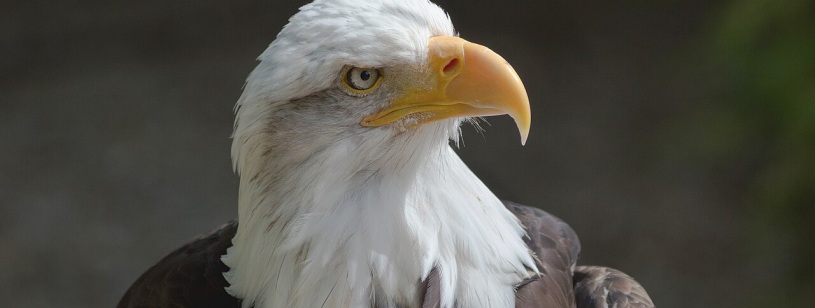
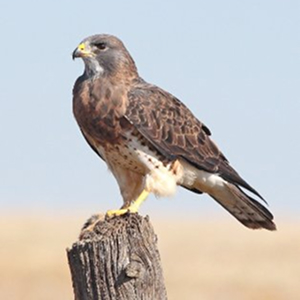
Adult bald eagle (Haliaeetus leucocephalus). · Lewis Hulbert / CC BY-SA 4.0 (https://creativecommons.org/licenses/by-sa/4.0). Cropped and resized.
The bald eagle is a large sea eagle of North America with a white head and tail and a yellow bill. Since 1782 it has appeared on the Great Seal of the United States and is the country’s national bird. It lives near lakes, rivers and coasts, where it catches mainly fish.
Quick facts
| Common name | Bald eagle |
| Scientific name | Haliaeetus leucocephalus |
| Lifespan | About 20 years in the wild; over 30 in captivity |
| Length | About 70–102 cm |
| Weight | About 3–6.3 kg; females are larger |
| Diet | Carnivore: fish, waterbirds, small mammals, carrion |
| Predators | Adults have no natural predators; raccoons and owls may take eggs and chicks |
| Conservation status | Least Concern (LC) |
| Distribution | Canada, Alaska, the United States and northern Mexico |
| Habitat | Near lakes, rivers, marshes and coasts with large trees |
| Family | Accipitridae |
| Wingspan | About 1.8–2.3 m |
Interesting facts
- The bald eagle builds the largest nests of any North American bird; one weighed about two tonnes.
- Its head is not bare but covered with white feathers, which appear only at 4–5 years.
- It sometimes steals fish caught by other birds, such as ospreys.
- In 1963 only about 417 pairs remained in the lower 48 US states.
Characteristics
Adults have dark brown bodies and wings with a white head and tail. The large hooked bill, eyes and feet are yellow, and strong talons grip slippery fish.
Juveniles are brown with irregular white mottling and a dark bill, gaining a white head only at 4–5 years. Females are about a quarter larger than males.
Behaviour
The bald eagle hunts from a tall perch overlooking water or while circling. It swoops and snatches fish from the surface with its talons without diving under.
In winter, hundreds may gather where water stays open or fish are plentiful. Pairs usually stay together for years and return to the same nest.
Habitat and distribution
The species lives across almost all of North America, from Alaska and Canada to Florida and northern Mexico. Northern populations move south in winter to find open water.
It needs large trees for nesting and fish-rich waters.
Diet and feeding
Its main food is fish such as salmon. It also catches waterbirds, ducks and gulls, rabbits and other small mammals.
It often eats carrion, for example salmon that die after spawning.
Reproduction and life cycle
The pair builds a nest of thick branches at the top of a large tree and enlarges it every year, so some nests reach several metres wide and deep.
The female usually lays 1–3 eggs, incubated by both parents for about 35 days. Chicks fly after about 10–12 weeks.
Name and history
The scientific name Haliaeetus leucocephalus means “white-headed sea eagle”. The English “bald” comes from an old word meaning “white”, not “hairless”.
In 1782 the bald eagle was chosen for the Great Seal of the United States. Benjamin Franklin reportedly preferred the wild turkey, which he called a “more respectable” bird.
Conservation and threats
In the twentieth century the bald eagle nearly vanished from the southern part of its range because of hunting and the insecticide DDT, which thinned eggshells. After DDT was banned in 1972 and strict protection began, the population recovered.
In 2007 it was removed from the US endangered species list and is now assessed as Least Concern. Lead poisoning and collisions with wind turbines remain problems.
Frequently asked questions
Why is it called bald if it has head feathers?
The name comes from an old English word “balde”, meaning white. The head has white feathers.
What does the bald eagle eat?
Mostly fish, plus waterbirds, small mammals and carrion.
Is the bald eagle endangered?
Not any more. It came close to disappearing but recovered and is now Least Concern.
At what age does it get a white head?
Around 4–5 years; young birds are brown with white mottling.