Maine CoonCharacteristics, history, behaviour and care
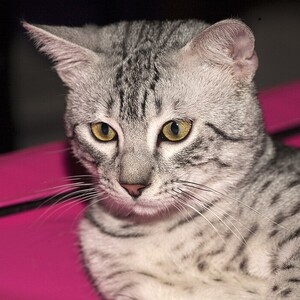
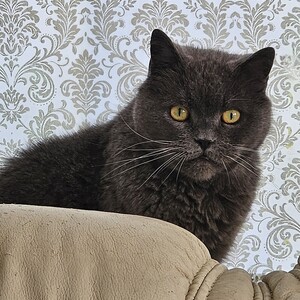
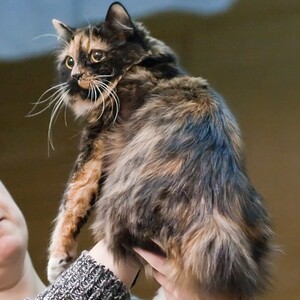
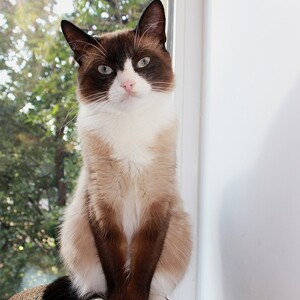
Maine Coon at a cat show. · Nickolas Titkov / Wikimedia Commons, CC BY-SA 2.0 (https://creativecommons.org/licenses/by-sa/2.0). Cropped and resized.
The Maine Coon is one of the largest breeds of domestic cat and the largest that does not come from crosses with wild cats. It comes from the US state of Maine, where it is the official state cat. It has a long, dense coat, suited to harsh winters, and a bushy, raccoon-like tail. It is called the “gentle giant”: it is sociable and friendly, with many “dog-like” traits.
Quick facts
| Common name | Maine Coon (Maine Coon Cat) |
| Scientific name | Felis catus |
| Country of origin | USA (state of Maine) |
| Official recognition | FIFe since 1982 (code MCO, category 2); CFA since 1976; TICA, GCCF |
| Lifespan | Median of over 12.5 years (insurance data from Sweden) |
| Weight | Males 8–10 kg, females 5–7 kg (on average) |
| Size | Very large |
| Body type | Rectangular, solid, muscular, broad chest |
| Coat type | Long or semi-long, double, silky, water-resistant |
| Common colours | Almost any colour; most often brown tabby |
| Eye colour | Any colour; blue or odd eyes only in white cats |
| Activity level | Moderate to high |
| Temperament | Gentle, sociable, playful, intelligent, “dog-like” |
| Good with children | Very good with children |
| Good with other pets | Gets on with everyone, including other animals |
| Genetic predispositions | Hypertrophic cardiomyopathy, hip dysplasia, spinal muscular atrophy |
- Primary category:Cat breeds
- Explore this animal's categories:
History and origin
The origin of the breed is wrapped in legends. One says it is a hybrid with the raccoon, another that it descends from the Vikings' cats, that is, from Norwegian Forest Cats. A third says that Queen Marie Antoinette of France sent six of her cats to America, and they reached Wiscasset, in Maine.
In the late 1860s, farmers in Maine held a contest at the Skowhegan fair for the “Maine State Champion Coon Cat”. At the first cat show in North America, at Madison Square Garden, on 8 May 1895, a tabby Maine Coon named Cosey won the title of most beautiful cat.
In the early twentieth century, when longhaired breeds arrived from abroad, the Maine Coon almost disappeared; in the 1950s it was declared, too early, extinct. Breeders' clubs saved it. CFA recognised it in 1976, FIFe in 1982, and in 1985 it became the official state cat of Maine.
How the breed developed
- Late 1860s – Maine Coon contests at the Skowhegan fair.
- 8 May 1895 – Cosey wins the first cat show in North America.
- The 1950s – the breed is declared, too early, extinct.
- 1976 – championship status at CFA.
- 1982 – recognised by FIFe.
- 1985 – official state cat of Maine.
At a glance: who is it right for?
- Families with children and other pets. It is gentle and gets on with everyone.
- Homes with space. It is a very large cat that needs room to play and sturdy cat trees.
- People who want a “dog-like” cat. It is playful and very attached to people.
- People who can pay for food and check-ups. A large cat eats more, and its heart and hips need checking.
Physical characteristics
Males weigh 8–10 kg on average, and females 5–7 kg. Adults stand 25–41 cm tall and can reach 97 cm in length including the tail, which alone can be 36 cm long. The body is rectangular, solid and muscular, with a broad chest. It grows slowly: it only reaches its final size at 3–5 years, compared with one year in other cats.
General appearance
The tail is long, tapers towards the tip and is very bushy, almost like a raccoon's. The large paws, with tufts of hair, help it walk on snow. The tail does not sink into the snow, and the cat can wrap it around its face and shoulders to shelter from the wind.
| Feature | Maine Coon |
|---|---|
| Size | Very large |
| Weight | Males 8–10 kg, females 5–7 kg |
| Length | Up to 97 cm including the tail |
| Body | Rectangular, muscular |
| Tail | Long, very bushy |
| Paws | Large, with tufts of hair |
| Coat | Long, double, water-resistant |
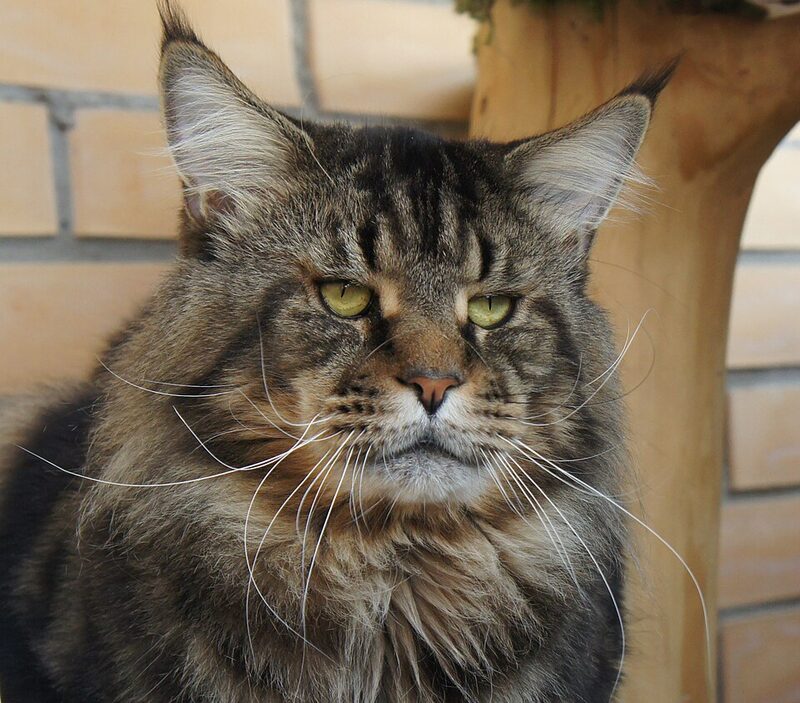
The coat is soft and silky, shorter on the head and shoulders and longer on the belly and flanks; some cats have a lion-like ruff. It is thicker in winter and thinner in summer. They can be almost any colour; the most common is brown tabby. Some standards do not accept chocolate, lilac or the point pattern. The eyes can be any colour, but blue or odd eyes occur only in white cats.
Related breeds and how to tell them apart
The Norwegian Forest Cat and the Siberian are also large, longhaired cold-climate cats. The Norwegian has a straight profile and almond-shaped eyes, the Siberian a rounder look. The Maine Coon was the largest breed until the Savannah hybrid appeared.
Behaviour and temperament
Wikipedia says it is a large, sociable cat, called the “gentle giant”, with many “dog-like” traits. German Wikipedia adds that it is intelligent and playful and a skilled hunter. It uses its paws a lot: it can open doors and taps and pick up small objects.
Socialisation
French Wikipedia says, citing the French registry LOOF, that it gets on well with everyone, even strangers and other animals.
A kitten gets used to new people, noises and other animals most easily in its first months of life.
Habits at home
Like all cats, it sleeps a lot: usually 12–16 hours a day. It is most active early in the morning and in the evening, but partly adapts to the family's routine.
Cats instinctively bury their droppings, so it quickly learns to use a litter tray. It scratches rough surfaces to shed the old outer layer of its claws, so it needs a scratching post or board.
Life at home and activity
It is moderately to very active and playful. It needs space, sturdy cat trees that can take its weight, and daily play.
| Activity | How often | Why it matters |
|---|---|---|
| Sturdy, tall cat tree | always available | It is heavy and needs stable structures |
| Play with toys (wand toys, balls) | daily | Play imitates hunting and uses up its energy |
| Scratching post or board | always available | It looks after its claws without damaging the furniture |
| High places (cat tree, shelves) | always available | It has somewhere to watch from and to rest |
Tips for a balanced life
- Choose a large litter tray and beds to match its size.
- Play with it every day, so it does not put on weight.
- Secure taps and doors: it learns to open them.
Care and health
Coat care
Wikipedia says that, compared with other longhaired breeds, it needs little grooming, because the undercoat is thin and the coat almost looks after itself. Brushing 1–2 times a week, more often during moulting, prevents tangles on the belly and the “trousers”.
Common health problems
A British study found a life expectancy of 9.7 years, while insurance data from Sweden give a median of over 12.5 years. A mutation of the MYBPC3 gene linked to hypertrophic cardiomyopathy has been found in the Maine Coon; about a third of the cats tested at Washington State University carried it. X-rays analysed in the USA showed hip dysplasia in 24.3% of cats. The breed is among those most affected by spinal muscular atrophy and can have entropion (an eyelid turned in towards the eye).
| Condition | Description | Common symptoms |
|---|---|---|
| Hypertrophic cardiomyopathy (HCM) | The heart wall thickens and the heart pumps less well. It is the most common heart disease in domestic cats | Often no signs at first; later rapid breathing, tiredness, sometimes sudden paralysis of the hind legs |
| Hip dysplasia | The hip joint forms incorrectly | Limping, jumps less easily, hip pain |
| Spinal muscular atrophy | The neurons that control the muscles gradually die | Weak hind legs, unsteady gait, from a few months of age |
| Entropion | The eyelid turns in towards the eye | Irritated eye, watering, frequent blinking |
Recommended genetic tests
For cardiomyopathy there is a DNA test for the MYBPC3 (A31P) mutation, but a negative result does not rule out the disease, so a heart ultrasound every 1–2 years is also recommended. There is a genetic test for spinal muscular atrophy, and the hips can be checked by X-ray.
Is it hypoallergenic?
Cat allergy is caused mainly by the Fel d 1 protein, found in saliva and skin glands; it is behind the allergy in 90% of people who are allergic to cats. Kittens, females and neutered males produce less of it, but still enough to trigger symptoms. No breed is completely hypoallergenic.
Other care
- A check-up at the vet once a year.
- Vaccinations and parasite treatment on the schedule set by the vet.
- Trim the claws if they do not wear down on their own.
- Clean its teeth or give it food that helps keep them clean.
Diet and nutrition
The cat is a carnivore: it needs animal protein. Unlike a dog, it must get vitamin A, arachidonic acid and taurine from its food. Water is very important, because cats usually drink little; several water bowls around the house encourage it to drink.
Tips for a healthy diet
The table gives a starting estimate, calculated with the formula from the Merck Veterinary Manual for a healthy adult cat. The last column shows what this means in dry food with 3,500–4,000 kcal per kilogram. If you also feed wet food, reduce the dry portion.
| Cat's weight | Calories per day (neutered) | Calories per day (not neutered) | Dry food per day (approximate) |
|---|---|---|---|
| 5 kg | 280 kcal | 330 kcal | 70–94 g |
| 6 kg | 320 kcal | 380 kcal | 80–109 g |
| 7 kg | 360 kcal | 420 kcal | 90–120 g |
| 8 kg | 400 kcal | 470 kcal | 100–134 g |
| 10 kg | 470 kcal | 550 kcal | 118–157 g |
- Adjust the portion to its weight: neutered cats put on weight easily.
- Weigh it monthly; the ribs should be easy to feel under your fingers.
- Kittens need more calories: Merck recommends 2.5 times the resting energy requirement.
Dangerous foods and substances
Some common household items are dangerous for cats:
- Lilies (and daylilies): they can destroy a cat's kidneys. Even the pollen or the water in the vase is dangerous.
- Paracetamol: extremely toxic to cats, which lack the enzyme that breaks it down. Never give it human medicines.
- Flea spot-ons and collars for dogs containing permethrin: the concentration meant for dogs is dangerous for cats.
- Foods: chocolate, coffee, alcohol, onions, garlic, grapes and raisins.
Reproduction and development
Maturity
Females usually reach sexual maturity at 5–10 months, and males at 5–7 months. The age varies from breed to breed.
Mating and pregnancy
Pregnancy in cats lasts 64–67 days, 65 on average. A first litter usually has fewer kittens than later ones. Only healthy cats that match the breed standard are used for breeding.
Blood type
Cats have blood type A, B or AB. Type A is the most common: in a study from England, 87.1% of non-pedigree cats and 54.6% of pedigree cats had type A. This matters for breeding: if the mother is type B and the kittens are type A, the antibodies in her first milk (colostrum) can destroy their red blood cells. The condition is called neonatal isoerythrolysis. That is why breeders test the blood type of both parents.
We found no published data on how common type B is in this breed; the test is done before mating anyway.
Caring for the kittens
Kittens are weaned at 6–7 weeks. They are ready to go to their new home at about 12 weeks, when they can be separated from their mother.
Neutering
Neutering used to be done at 6–9 months, but it is more and more often done before puberty, at around 3–6 months. It prevents unwanted kittens, urine marking in males and the loud “calling” of females in heat. A 2024 study found that neutered cats live one year longer on average. After the operation, the metabolism slows down and appetite increases, so the portion has to be reduced.
How to choose a kitten
- Ask for the pedigree from a recognised cat association (for example, a FIFe member).
- The kitten leaves its mother at about 12 weeks.
- Ask for the parents' MYBPC3 DNA test and heart ultrasound, the spinal muscular atrophy test and, if possible, hip X-rays.
- Look at the mother and at the place where the kittens are raised: it should be clean, with kittens used to people.
- Ask about vaccinations, parasite treatment and the blood type of the parents.
Interesting facts
- The longest cat. In 2010, Guinness World Records recognised a Maine Coon named Stewie as the longest cat: 123 cm, from nose to tail tip.
- Extra toes. Many of the first Maine Coons had extra toes (polydactyly).
- It grows until 5 years. It only reaches its final size at 3–5 years.
- A cushion tail. On ice, it can tuck its tail under itself, like a cushion that keeps out the cold.
In popular culture
The official state cat of Maine
Since 1985, the Maine Coon has been the official state cat of the US state of Maine.
The first show star
Cosey won the first cat show in North America in 1895; her silver collar is kept in the CFA library.
Frequently asked questions
How big does a Maine Coon get?
Males average 8–10 kg and females 5–7 kg; including the tail, they can reach almost 1 m.
Until what age does it grow?
Until 3–5 years.
Is it good with children?
Yes, it is gentle and sociable with everyone.
What diseases does the breed have?
Mainly hypertrophic cardiomyopathy, hip dysplasia and spinal muscular atrophy; there are genetic tests for some of them.
Is it hard to groom?
Less than other longhaired breeds; brushing 1–2 times a week is enough.