Dutch SmoushondCharacteristics, history, training and care
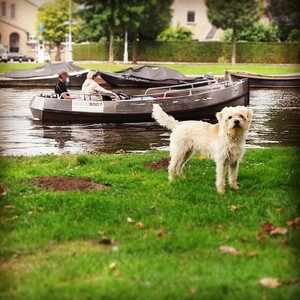
Dutch Smoushond in Amsterdam · ZeppWeb / Wikimedia Commons, CC BY 2.0. Cropped and resized.
The Dutch Smoushond is a small, yellow dog with a rough, “unkempt” coat, a moustache and a beard. In the 19th century it caught rats in the stables of the Netherlands and was sold in Amsterdam as the “gentlemen's stable dog”. It is affectionate, cheerful, friendly and free-spirited.
Quick facts
| Common name | Dutch Smoushond (Hollandse Smoushond) |
| Scientific name | Canis lupus familiaris |
| Country of origin | Netherlands |
| Official recognition | FCI, definitively since 11 March 1981 (group 2, pinscher and schnauzer type; standard no. 308) |
| Lifespan | No published data for the breed; small breeds usually live 12–15 years |
| Size (males) | about 37–42 cm at the withers |
| Size (females) | about 35–40 cm at the withers |
| Weight | 7–11 kg |
| Coat type | Rough, wiry, straight, 4–7 cm long, with undercoat; moustache, beard and eyebrows |
| Common colours | Solid yellow, preferably dark straw |
| Energy level | Moderate |
| Suited to an apartment? | Yes |
| Temperament | Affectionate, cheerful, friendly, lively but not restless |
| Tendency to aggression | Low |
| Good with children | Good |
| Good with other animals | Good with dogs; a rodent hunter |
| Genetic predispositions | No breed-specific diseases are known |
- Primary category:Dog breeds
- Explore this animal's categories:
History and origin
The FCI standard says that in the mid-19th century it was fashionable among well-to-do Dutch people to have a dog that would accompany the carriage and catch the rats in the stable. The origin of the breed is uncertain, but the yellow schnauzer is believed to have been one of its ancestors. A dog dealer in Amsterdam sold them to visitors to the stock exchange as “gentlemen's stable dogs”.
They were soon called “Smous”, meaning “bearded”, to distinguish them from the Brussels Griffon. The first standard was written in 1905. After a period of changing popularity, the last litter was registered in 1949. In 1973, Mrs H.M. Barkman van der Weel began rebuilding the breed, starting from dogs that resembled the old Smoushond.
How the breed developed
- Mid-19th century – The dogs catch rats in Dutch stables.
- 1905 – The first standard is written and the breed club is founded.
- 1949 – The last litter of puppies is registered.
- 1973 – H.M. Barkman van der Weel begins rebuilding the breed.
- 11 March 1981 – The FCI recognises the rebuilt breed.
- 2 June 2010 – The current FCI standard is published.
Breed rating
| Feature | Stars |
|---|---|
| Training and intelligence | ★★★★☆ |
| Easy to train | ★★★★☆ |
| Intelligence | ★★★★☆ |
| Independence | ★★★☆☆ |
| Stubbornness | ★★★☆☆ |
| Behaviour and temperament | ★★★★☆ |
| Affectionate with family | ★★★★★ |
| Friendly with children | ★★★★☆ |
| Good with other dogs | ★★★★☆ |
| Good with cats and other animals | ★★☆☆☆ |
| Loyalty | ★★★★★ |
| Tendency to be aggressive | ★☆☆☆☆ |
| Tendency to bark | ★★★☆☆ |
| Needs and care | ★★★★☆ |
| Shedding | ★★☆☆☆ |
| Needs frequent grooming | ★★★☆☆ |
| Activity and lifestyle | ★★★★☆ |
| Energy level | ★★★☆☆ |
| Daily exercise needs | ★★★☆☆ |
| Suited to apartment life | ★★★★☆ |
| Health and longevity | ★★★★☆ |
| Life expectancy | ★★★★☆ |
| Predisposition to genetic diseases | ★★☆☆☆ |
| Working abilities and uses | ★★★☆☆ |
| Good watchdog | ★★★★☆ |
| Good companion dog | ★★★★★ |
Indicative rating: 5 stars means the highest level. The breed has no AKC profile; the rating is based on the FCI standard (“affectionate, cheerful, friendly and free-spirited”).
Physical characteristics
It is a small, sturdy and compact dog with a rough coat that gives it an “unkempt” look. The broad, short head, with moustache, beard and eyebrows, is very characteristic.
General appearance
The large, round, dark brown eyes have a friendly, lively expression. The small, high-set ears hang down and tip forward when the dog is alert. The fairly short tail is carried cheerfully, but not curled over the back.
| Feature | Dutch Smoushond |
|---|---|
| Size | Small |
| Height at the withers | males: about 37–42 cm; females: 35–40 cm |
| Weight | 7–11 kg |
| Coat | Rough, 4–7 cm long, with undercoat |
| Eyes | Large, round, dark brown |
| Ears | Small, hanging |
The coat is solid yellow, in any shade, preferably dark straw yellow. The ears, moustache, beard and eyebrows may be darker. Any other colour is not wanted.
Training and socialisation
The standard describes it as affectionate, cheerful, friendly and free-spirited, with a lively nature, but not restless or fearful.
It learns well with rewards and patience. As a former ratter, it has a strong instinct to chase rodents.
Tips for effective training
- Use rewards. Praise and play motivate it.
- Be consistent. It is free-spirited and tests the limits.
- Watch out with rodents. It was bred to catch rats.
- Socialise it from an early age. This helps it stay friendly with everyone.
Activity needs and lifestyle
It needs daily walks and play. As a small, adaptable dog, it also copes well in the city, as long as it goes out enough.
| Activity | How often | Why it matters |
|---|---|---|
| Walks | twice a day | Exercise and scents |
| Play | daily | Burns off energy |
| Search games | several times a week | Its hunting instinct |
Tips for a balanced life
- It fits in well with family life.
- Keep it on a lead near roads.
- Its coat helps it cope well with bad weather.
Care and health
Coat and skin care
The rough coat should be brushed once a week. The standard calls for an “unkempt” look, so it is not clipped; the dead hair can be lightly plucked out a few times a year. The moustache and beard should be cleaned after meals.
Common health problems
There are no published health studies for the breed. As with any small dog, it is worth watching for:
| Condition | Description | Common symptoms |
|---|---|---|
| Patellar luxation | The kneecap slips out of place | Suddenly holds a hind leg up for a few steps, then uses it again |
| Hip dysplasia | The hip joint forms incorrectly and, over time, arthritis develops | Limping, difficulty getting up or jumping, hip pain |
Other care
- Clean the beard after meals.
- Brush its teeth regularly.
- Trim the nails when they start to touch the floor.
Diet and nutrition
A small dog needs small portions. Keep an eye on its weight, as the thick coat easily hides extra kilos.
Tips for a healthy diet
The table gives a starting estimate, calculated with the formula from the Merck Veterinary Manual. The first two calorie columns show the calories per day for a healthy adult dog. The last column shows what this means in dry food with 3,500–4,000 kcal per kilogram.
| Dog's weight | Calories per day (neutered) | Calories per day (not neutered) | Dry food per day (approximate) |
|---|---|---|---|
| 7 kg | 480 kcal | 540 kcal | 120–150 g |
| 9 kg | 580 kcal | 650 kcal | 140–190 g |
| 11 kg | 680 kcal | 760 kcal | 170–220 g |
- Give it its food in two meals a day.
- Training treats count towards the daily portion.
- Feel its ribs under the coat: you should be able to feel them without pressing hard.
Foods to avoid
Some human foods are dangerous for dogs: chocolate, coffee, grapes and raisins, onions, garlic, xylitol (a sweetener used in chewing gum), macadamia nuts and alcohol.
Reproduction and development
Physical and emotional maturity
In dogs, sexual maturity usually comes between 6 and 12 months. Small breeds become adults faster than large ones, usually at around one year.
Mating and pregnancy
Pregnancy lasts about 63 days, counted from ovulation. Mating a female on her first heat is not recommended. The FCI standard requires that only healthy dogs of typical breed appearance are used for breeding.
Caring for the puppies
In small breeds, a litter has 3–4 puppies on average. The puppies are very small and fragile in the first weeks, so they must be kept warm and handled with care. Socialisation starts early: gentle handling, everyday noises and new people.
Interesting facts
- The “gentlemen's stable dog”. That is how a dog dealer sold it at the Amsterdam stock exchange.
- “Smous” means bearded. The name comes from its beard and rough coat.
- Always yellow. The only desired colour is yellow.
- Rebuilt from scratch. The breed was rebuilt after 1973, from dogs that resembled the old Smoushond.
- An “unkempt” look. The standard requires the coat to look slightly tousled.
Frequently asked questions
Where does the Dutch Smoushond come from?
From the Netherlands, where it caught rats in stables.
How big does it get?
Males measure about 37–42 cm and females 35–40 cm; they weigh 7–11 kg.
What colour is it?
It is yellow, preferably dark straw.
Is it a family dog?
Yes, it is affectionate, cheerful and friendly.