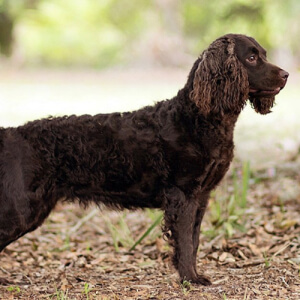
Wirehaired Pointing GriffonCharacteristics, history, training and care
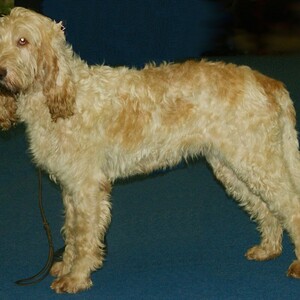
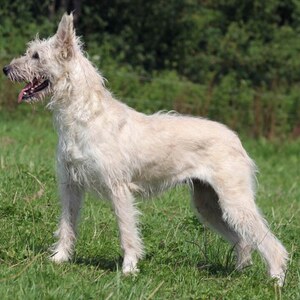
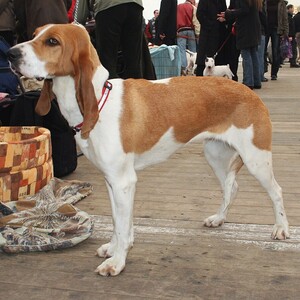
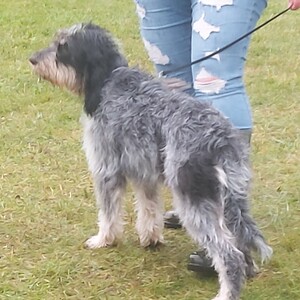
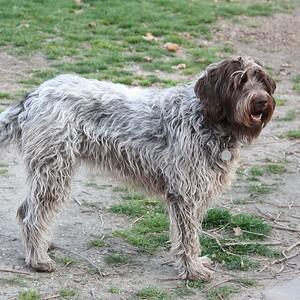
Wirehaired Pointing Griffon. · Liv klesta / Wikimedia Commons, CC BY-SA 3.0. Cropped and resized.
The Wirehaired Pointing Griffon, or Korthals Griffon (Griffon d’arrêt à poil dur Korthals), is a versatile, rustic, medium-sized pointing dog with a harsh coat, moustache, beard and bushy eyebrows. The FCI standard, under the patronage of France, describes it as gentle and proud, an excellent hunter, very attached to its owner and to the territory it guards vigilantly, and very gentle with children.
Quick facts
| Common name | Wirehaired Pointing Griffon |
| Scientific name | Canis lupus familiaris |
| Country of origin | France |
| Official recognition | FCI, definitively since 7 December 1954 (group 7, pointing dogs; standard no. 107); also recognised by the AKC |
| Lifespan | 12–15 years, according to the AKC |
| Size (males) | about 55–60 cm at the withers; 23–32 kg according to the AKC |
| Size (females) | about 50–55 cm at the withers; 16–23 kg according to the AKC |
| Coat type | Harsh, like boar bristles, with a fine, dense undercoat |
| Common colours | Steel grey with brown patches, brown, brown roan, white and brown or orange |
| Energy level | Very high |
| Suited to an apartment? | Only with a great deal of exercise |
| Temperament | Gentle, proud, devoted, vigilant |
| Tendency to aggression | Low |
| Good with children | Very good, according to the standard and the AKC |
| Good with other animals | Moderate |
| Genetic predispositions | Hip and elbow dysplasia, eye diseases, ear infections |
- Primary category:Dog breeds
- Explore this animal's categories:
History and origin
The FCI standard says a dog of this kind was already mentioned by Xenophon and that, used for bird hunting, it was widespread throughout Europe under various names. In the second half of the 19th century, the breed was reconstituted and improved by E.K. Korthals, through inbreeding, selection and training, without the addition of foreign blood.
Wikipedia says Eduard Karel Korthals was Dutch, and his kennel, Ipenwoud, was at Biebesheim am Rhein, in Germany, where the type of the breed was fixed before it reached France. This is why the breed is sometimes regarded as Dutch or German, although the FCI places it under the patronage of France.
How the breed developed
- Antiquity – Mentioned by Xenophon.
- Second half of the 19th century – E.K. Korthals reconstitutes the breed.
- 7 December 1954 – The FCI recognises the breed.
Breed rating
| Feature | Stars |
|---|---|
| Training and intelligence | ★★★★☆ |
| Easy to train | ★★★★★ |
| Intelligence | ★★★★★ |
| Independence | ★★★★★ |
| Stubbornness | ★★★★★ |
| Behaviour and temperament | ★★★★☆ |
| Affectionate with family | ★★★★★ |
| Friendly with children | ★★★★★ |
| Good with other dogs | ★★★☆☆ |
| Good with cats and other animals | ★★★☆☆ |
| Loyalty | ★★★★★ |
| Tendency to be aggressive | ★★★☆☆ |
| Tendency to bark | ★★★★☆ |
| Needs and care | ★★★★☆ |
| Shedding | ★★★★★ |
| Needs frequent grooming | ★★★☆☆ |
| Activity and lifestyle | ★★★★★ |
| Energy level | ★★★★★ |
| Daily exercise needs | ★★★★★ |
| Suited to apartment life | ★★★☆☆ |
| Health and longevity | ★★★★☆ |
| Life expectancy | ★★★★☆ |
| Predisposition to genetic diseases | ★★★☆☆ |
| Working abilities and uses | ★★★☆☆ |
| Good hunting dog | ★★★★★ |
| Good companion dog | ★★★★☆ |
Indicative rating: 5 stars means the highest level. It is based on the ratings the American Kennel Club gives the breed and on the FCI standard.
Physical characteristics
The standard describes it as a vigorous, rustic, medium-sized dog, longer than it is tall, with a long, square muzzle. The dark yellow or brown eyes are shaded by bushy eyebrows, and the moustache and beard give it a firm, confident expression. The AKC says it moves with an easy, cat-like grace.
General appearance
The hair is harsh and coarse, “like wild boar bristles” to the touch, never curly or woolly. Beneath it is a fine, dense undercoat that insulates and repels water.
| Feature | Wirehaired Pointing Griffon |
|---|---|
| Size | Large |
| Height at the withers | males: ~55–60 cm; females: ~50–55 cm |
| Weight | 16–32 kg (AKC) |
| Coat | Harsh, with a beard |
| Colour | Steel grey with brown |
| Type | Pointing dog |
The standard prefers steel grey with brown patches or solid brown, often brown roan or a close mixture of brown and white hairs. White and brown and white and orange are also allowed.
Training and socialisation
The standard describes it as gentle and proud, an excellent hunter, very attached to its owner and its territory, which it guards vigilantly. The AKC gives it the top score for ease of training and openness to strangers.
The AKC says it excels both at pointing in the field and at retrieving from water. It needs plenty of mental stimulation, so training and hunting work keep it content.
Tips for effective training
- Give it a job. It needs stimulation.
- Use rewards. It is easy to train.
- Let it swim. It is a good water retriever.
- Do not leave it alone for long. It is very attached to its owner.
Activity needs and lifestyle
The AKC gives it the top score for energy. It needs serious daily exercise: running, long walks, swimming and, ideally, hunting or working sports.
| Activity | How often | Why it matters |
|---|---|---|
| Running or long walks | daily | Energy |
| Swimming and retrieving | weekly | Instinct |
| Hunting or working training | weekly | A busy mind |
Tips for a balanced life
- Suited to very active owners.
- Check the ears often.
- Wipe its beard after meals.
Care and health
Coat and skin care
The AKC says the coat is one of the breed's hallmarks and gives it an unkempt look. It should be brushed weekly, and dead hair stripped out from time to time. The drop ears need regular checks, as they easily become infected.
Common health problems
The AKC says the breed is generally healthy; hip dysplasia is relatively rare, but the parents should be tested. Some breeders also check the eyes, heart, elbows and thyroid. Things to watch for:
| Condition | Description | Common symptoms |
|---|---|---|
| Hip dysplasia | The hip joint forms incorrectly and, over time, arthritis develops | Limping, difficulty getting up or jumping, hip pain |
| Elbow dysplasia | The elbow joint develops incorrectly and arthritis appears | Limping on the front legs, especially after exercise |
| Eye diseases | Inherited conditions | Poor vision |
| Ear infections | Infections of the drop ears | Head shaking, unpleasant smell |
Other care
- Ask for the parents' hip tests.
- Clean the ears regularly.
- Go for yearly check-ups.
Diet and nutrition
The AKC recommends good-quality food suited to the dog's age, and attention to its weight.
Tips for a healthy diet
The table gives a starting estimate, calculated with the formula from the Merck Veterinary Manual. The first two calorie columns show the calories per day for a healthy adult dog. The last column shows what this means in dry food with 3,500–4,000 kcal per kilogram.
| Dog's weight | Calories per day (neutered) | Calories per day (not neutered) | Dry food per day (approximate) |
|---|---|---|---|
| 16 kg | 900 kcal | 1,010 kcal | 220–290 g |
| 24 kg | 1,210 kcal | 1,370 kcal | 300–390 g |
| 32 kg | 1,510 kcal | 1,700 kcal | 380–490 g |
- Adjust the portion to its level of effort.
- Do not let it run right after a meal.
- A dog is at the right weight when you can feel its ribs under the coat without pressing hard.
Foods to avoid
Some human foods are dangerous for dogs: chocolate, coffee, grapes and raisins, onions, garlic, xylitol (a sweetener used in chewing gum), macadamia nuts and alcohol.
Reproduction and development
Physical and emotional maturity
In dogs, sexual maturity usually comes between 6 and 12 months, but in large breeds it can be delayed until about two years. The body also reaches its adult form later than in small breeds.
Mating and pregnancy
Pregnancy lasts about 63 days, counted from ovulation. Mating a female on her first heat is not recommended. The FCI standard requires that only healthy dogs of typical breed appearance are used for breeding.
Caring for the puppies
In large breeds, a litter has around 7 puppies on average. Socialisation starts in the first weeks: gentle handling, everyday noises and new people.
Interesting facts
- Hair like a wild boar's. That is how the standard describes it.
- Mentioned by Xenophon. The standard traces its origins back to antiquity.
- A Dutchman in Germany. Korthals developed the breed at Biebesheim.
- A cat-like gait. The AKC praises its grace.
- Very gentle with children. The standard says so explicitly.
Frequently asked questions
Who created the breed?
E.K. Korthals, in the second half of the 19th century.
Is it good with children?
Yes; the standard describes it as very gentle with children.
Does it need a lot of exercise?
Yes, a great deal.
How long does it live?
The AKC gives 12–15 years.