Standard SchnauzerCharacteristics, history, training and care
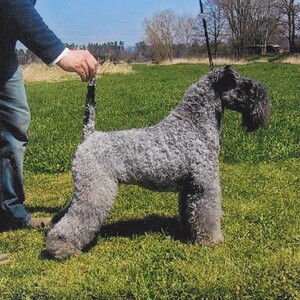
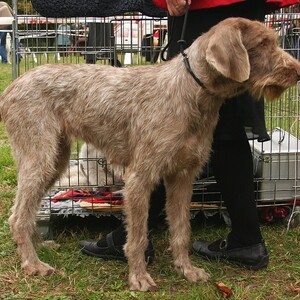
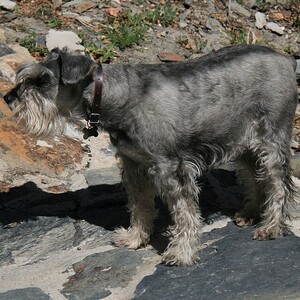
Standard Schnauzer. · Tamorlan / Wikimedia Commons, CC BY-SA 3.0. Cropped and resized.
The Standard Schnauzer (Mittelschnauzer) is the middle one of the three Schnauzer breeds, larger than the Miniature and smaller than the Giant. It has a harsh coat, black or “pepper and salt”, a beard and bushy eyebrows. The FCI standard describes it as lively yet calm, good-natured, playful, proverbially devoted to its owner, fond of children, incorruptible and alert, but not noisy.
Quick facts
| Common name | Standard Schnauzer (Mittelschnauzer) |
| Scientific name | Canis lupus familiaris |
| Country of origin | Germany |
| Official recognition | FCI, definitively since 13 July 1955 (group 2, Pinscher and Schnauzer; standard no. 182); also recognised by the AKC |
| Lifespan | 13–16 years, according to the AKC |
| Size (males) | 45–50 cm at the withers; 14–20 kg |
| Size (females) | 45–50 cm at the withers; 14–20 kg |
| Coat type | Wiry, harsh and dense, with a dense undercoat |
| Common colours | Black, pepper and salt |
| Energy level | High |
| Suited to an apartment? | Yes, with enough exercise |
| Temperament | Lively, calm, good-natured, playful, devoted, alert |
| Tendency to aggression | Low |
| Good with children | Very good, according to the standard and the AKC |
| Good with other animals | Moderate |
| Genetic predispositions | Hip dysplasia, eye diseases |
- Primary category:Dog breeds
- Explore this animal's categories:
History and origin
The FCI standard says that originally the Schnauzer was used in southern Germany as a stable dog, as it felt very much at home among horses. It watched for all rodents so as to catch them in an instant, hence the nickname “Rattler” (rat catcher). When the Pinscher-Schnauzer-Club was founded in 1895, it was registered under the name “wire-haired Pinscher”.
Wikipedia says its development as a breed began in the 1880s in southern Germany and that, although it is known all over the world, in Germany it is an endangered breed, on the Red List of old domestic breeds.
How the breed developed
- 1880s – The breed begins to take shape in southern Germany.
- 1895 – Registered as the “wire-haired Pinscher” with the Pinscher-Schnauzer-Club.
- 13 July 1955 – The FCI recognises the breed.
Breed rating
| Feature | Stars |
|---|---|
| Training and intelligence | ★★★★☆ |
| Easy to train | ★★★★★ |
| Intelligence | ★★★★★ |
| Independence | ★★★★☆ |
| Stubbornness | ★★★☆☆ |
| Behaviour and temperament | ★★★☆☆ |
| Affectionate with family | ★★★★☆ |
| Friendly with children | ★★★★★ |
| Good with other dogs | ★★★★★ |
| Good with cats and other animals | ★☆☆☆☆ |
| Loyalty | ★★★★☆ |
| Tendency to be aggressive | ★★☆☆☆ |
| Tendency to bark | ★★★☆☆ |
| Needs and care | ★★★★☆ |
| Shedding | ★★★★☆ |
| Needs frequent grooming | ★★★☆☆ |
| Activity and lifestyle | ★★★★★ |
| Energy level | ★★★★★ |
| Daily exercise needs | ★★★★☆ |
| Suited to apartment life | ★★★★★ |
| Health and longevity | ★★★★☆ |
| Life expectancy | ★★★☆☆ |
| Predisposition to genetic diseases | ★★★☆☆ |
| Working abilities and uses | ★★★☆☆ |
| Good guard dog | ★★★★☆ |
| Good companion dog | ★★★☆☆ |
Indicative rating: 5 stars means the highest level. It is based on the ratings the American Kennel Club gives the breed and on the FCI standard.
Physical characteristics
The standard describes it as a medium-sized, powerful dog, stocky rather than slender, wire-haired and square-built. The head is about half the length of the back. The AKC says all three Schnauzer breeds have the same coat, the same square body and the same long head with arched eyebrows.
General appearance
The coat is wiry, harsh and dense, with a dense undercoat and a close-lying, fairly long topcoat. The not-too-soft beard on the muzzle and the bushy eyebrows, which lightly shade the eyes, are typical features.
| Feature | Standard Schnauzer |
|---|---|
| Size | Medium |
| Height at the withers | 45–50 cm |
| Weight | 14–20 kg |
| Coat | Wiry, harsh |
| Head | With beard and eyebrows |
| Body | Square |
The standard accepts pure black, with a black undercoat, and pepper and salt, in shades from dark iron grey to silver grey. All varieties must have a dark mask.
Training and socialisation
The standard says its highly developed senses, intelligence, trainability, courage, stamina and robustness make it an excellent family, guard and companion dog. It loves children, is incorruptible and alert, but not noisy.
The AKC says it learns an idea or an exercise after very few repetitions; the big problem is overdoing it: after a few repetitions it gets bored. Being intelligent, it needs training; if the owner does not teach it, it will teach itself, but perhaps not what the owner would want.
Tips for effective training
- Do not repeat too much. It gets bored quickly.
- Be consistent. It teaches itself if you do not teach it.
- Include it in the family. It does not like being left alone.
- Try dog sports. It excels at agility.
Activity needs and lifestyle
The AKC says it is an energetic breed that loves playing with people and other dogs. It insists on taking part in family activities and cannot bear being left alone or tied up in the garden. It loves long hikes and excels at agility, barn hunt, herding and lure coursing.
| Activity | How often | Why it matters |
|---|---|---|
| Walks or hikes | daily | Energy |
| Play | daily | A busy mind |
| Agility or barn hunt | weekly | Instinct |
Tips for a balanced life
- Do not leave it alone in the garden.
- Wash its beard often.
- Hand-strip the coat, do not clip it.
Care and health
Coat and skin care
The AKC says it needs regular grooming: washing the beard and leg hair, caring for the teeth, cleaning the paws and trimming the nails are weekly tasks. If the harsh coat is clipped instead of hand-stripped, it loses its resistance to dirt, thorns and water and sheds more.
Common health problems
The AKC says the health surveys carried out every five years by the American breed club show a very healthy breed. Breeders test their dogs for:
| Condition | Description | Common symptoms |
|---|---|---|
| Hip dysplasia | The hip joint forms incorrectly and, over time, arthritis develops | Limping, difficulty getting up or jumping, hip pain |
| Eye diseases | Inherited conditions | Poor vision |
Other care
- Ask for the parents' hip and eye tests.
- Brush its teeth regularly.
- Clean foreign bodies from the paws.
Diet and nutrition
The AKC recommends good-quality food suited to the dog's age, and attention to its weight.
Tips for a healthy diet
The table gives a starting estimate, calculated with the formula from the Merck Veterinary Manual. The first two calorie columns show the calories per day for a healthy adult dog. The last column shows what this means in dry food with 3,500–4,000 kcal per kilogram.
| Dog's weight | Calories per day (neutered) | Calories per day (not neutered) | Dry food per day (approximate) |
|---|---|---|---|
| 14 kg | 810 kcal | 910 kcal | 200–260 g |
| 17 kg | 940 kcal | 1,050 kcal | 240–300 g |
| 20 kg | 1,060 kcal | 1,190 kcal | 260–340 g |
- Treats count towards the daily portion.
- Split the food into two meals a day.
- A dog is at the right weight when you can feel its ribs under the coat without pressing hard.
Foods to avoid
Some human foods are dangerous for dogs: chocolate, coffee, grapes and raisins, onions, garlic, xylitol (a sweetener used in chewing gum), macadamia nuts and alcohol.
Reproduction and development
Physical and emotional maturity
In dogs, sexual maturity usually comes between 6 and 12 months. Most breeds become adults at around 13–15 months.
Mating and pregnancy
Pregnancy lasts about 63 days, counted from ovulation. Mating a female on her first heat is not recommended. The FCI standard requires that only healthy dogs of typical breed appearance are used for breeding.
Caring for the puppies
In dogs, a litter has 5–6 puppies on average, and the number rises with the size of the breed. Socialisation starts in the first weeks: gentle handling, everyday noises and new people.
Interesting facts
- A stable dog. It lived among horses and caught rodents.
- Once the “wire-haired Pinscher”. That is how it was registered in 1895.
- The middle one. It is larger than the Miniature Schnauzer and smaller than the Giant.
- Rare in Germany. It is on the Red List of endangered breeds.
- It gets bored with repetition. The AKC says it learns very quickly.
Frequently asked questions
How does it differ from the Miniature and Giant Schnauzers?
Its size: it is the middle one.
Does it shed?
Little; the AKC gives it 1 out of 5.
Is it good with children?
Yes; the standard says it loves children.
How long does it live?
The AKC gives 13–16 years.