Smooth CollieCharacteristics, history, training and care
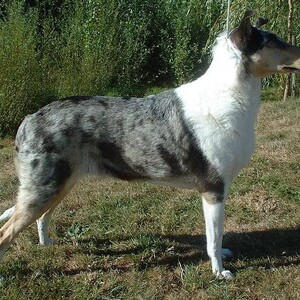
Smooth Collie. · Jacklab72 / Wikimedia Commons, CC BY-SA 3.0. Cropped and resized.
The Smooth Collie is a Scottish herding dog, the short-coated version of the Rough Collie, the one made famous by Lassie. The FCI standard describes it as a dog that shows intelligence, alertness and activity, stands with dignity and has a friendly disposition, with no trace of nervousness or aggression. In the United States and Canada, the two varieties are considered the same breed.
Quick facts
| Common name | Smooth Collie |
| Scientific name | Canis lupus familiaris |
| Country of origin | United Kingdom (Scotland) |
| Official recognition | FCI, definitively since 18 December 1974 (group 1, herding dogs; standard no. 296); the AKC treats it as a variety of the Collie |
| Lifespan | 12–14 years, according to the AKC |
| Size (males) | 56–61 cm at the withers; 20.5–29.5 kg |
| Size (females) | 51–56 cm at the withers; 18–25 kg |
| Coat type | Short, flat, harsh, with a very dense undercoat |
| Common colours | Sable and white, tricolour, blue merle |
| Energy level | Medium |
| Suited to an apartment? | Only with enough exercise |
| Temperament | Friendly, intelligent, alert, free of nervousness |
| Tendency to aggression | Very low |
| Good with children | Very good, according to the AKC |
| Good with other animals | Good |
| Genetic predispositions | Collie eye anomaly, sensitivity to medicines (MDR1), bloat |
- Primary category:Dog breeds
- Explore this animal's categories:
History and origin
Wikipedia says the early history of the Smooth Collie is uncertain, as is the origin of the name: it may come from the dark colour of the old sheepdogs (“coaly”), from a Scottish breed of black-faced sheep (“colley”) or from an Anglo-Saxon word meaning “useful”.
The breed's transformation began in the reign of Queen Victoria, who took an interest in the shepherds' dogs at Balmoral Castle and, in 1860, bought several for her kennel. In the United Kingdom, the Kennel Club allowed the smooth and rough varieties to be interbred until 1993. The British breed club was founded in 1955, and the FCI accepted the breed definitively in 1974.
How the breed developed
- 1860 – Queen Victoria buys sheepdogs from Balmoral.
- 1955 – The Smooth Collie Club of Great Britain is founded.
- 18 December 1974 – The FCI recognises the breed.
- 1993 – The Kennel Club stops interbreeding with the rough variety.
Breed rating
| Feature | Stars |
|---|---|
| Training and intelligence | ★★★★☆ |
| Easy to train | ★★★★☆ |
| Intelligence | ★★★★★ |
| Independence | ★★★☆☆ |
| Stubbornness | ★★★☆☆ |
| Behaviour and temperament | ★★★★☆ |
| Affectionate with family | ★★★★☆ |
| Friendly with children | ★★★★☆ |
| Good with other dogs | ★★★★☆ |
| Good with cats and other animals | ★★★★★ |
| Loyalty | ★★★☆☆ |
| Tendency to be aggressive | ★★☆☆☆ |
| Tendency to bark | ★★★☆☆ |
| Needs and care | ★★★★☆ |
| Shedding | ★★★☆☆ |
| Needs frequent grooming | ★★★☆☆ |
| Activity and lifestyle | ★★★★☆ |
| Energy level | ★★★★☆ |
| Daily exercise needs | ★★★☆☆ |
| Suited to apartment life | ★★★☆☆ |
| Health and longevity | ★★★★☆ |
| Life expectancy | ★★★☆☆ |
| Predisposition to genetic diseases | ★★☆☆☆ |
| Working abilities and uses | ★★★★☆ |
| Good companion dog | ★★★☆☆ |
| Good companion dog | ★★★☆☆ |
Indicative rating: 5 stars means the highest level. It is based on the ratings the American Kennel Club gives the breed and on the FCI standard.
Physical characteristics
The standard says it looks intelligent, alert and active and stands with dignity. The head resembles a smooth wedge with a rounded tip, and Wikipedia says the “sweet” expression is considered very important. The body is slightly longer than it is tall, with a level back and a deep chest.
General appearance
The coat is short and flat, with a harsh topcoat and a very dense undercoat. It is not clipped or shaved.
| Feature | Smooth Collie |
|---|---|
| Size | Large |
| Height at the withers | males: 56–61 cm; females: 51–56 cm |
| Weight | males: 20.5–29.5 kg; females: 18–25 kg |
| Coat | Short, double |
| Head | Wedge-shaped |
| Type | Herding dog |
The standard accepts three colours: sable and white (from light gold to mahogany), tricolour (mainly black, with tan markings on the legs and head) and blue merle. Straw or cream colour is undesirable.
Training and socialisation
The standard describes it as having a friendly disposition, with no trace of nervousness or aggression. The AKC says it is very clever and easy to train, enjoys lessons and learning, and excels at obedience, agility and herding.
The AKC recommends puppy classes and positive methods. It can be quite vocal, so it is worth teaching it from an early age when to be quiet.
Tips for effective training
- Use positive methods. The AKC says that is how it thrives.
- Keep training. It loves to learn.
- Teach it “quiet”. It can bark a lot.
- Do not leave it alone in the garden. It wants to be with the family.
Activity needs and lifestyle
The AKC says that, in general, the Collie is fairly active and needs regular aerobic exercise, with the chance to run and play. Fetch, a fenced garden and daily walks help. It should not be left alone in the garden.
| Activity | How often | Why it matters |
|---|---|---|
| Walks | daily | Fitness |
| Running and fetch | several times a week | Energy |
| Agility or obedience | weekly | Keeps its mind busy |
Tips for a balanced life
- Keep it close to the family.
- Brush it more often during shedding.
- Tell your vet about MDR1.
Care and health
Coat and skin care
The AKC says the Smooth Collie's coat does not tangle, but it needs regular grooming, as it is double and the undercoat has to be brushed out during moulting periods.
Common health problems
The AKC says the Collie is a healthy, robust breed. Puppies should be checked at 6–8 weeks by a veterinary ophthalmologist. Watch for:
| Condition | Description | Common symptoms |
|---|---|---|
| Collie eye anomaly | Inherited eye disease | Poor vision, detected in puppies |
| MDR1 mutation | Sensitivity to some medicines | Tell the vet before any treatment |
| Gastric dilatation-volvulus (bloat) | The stomach fills with gas and may twist; this is a veterinary emergency | Swollen belly, trying to vomit without success, drooling, restlessness |
Other care
- Ask for the puppy's eye test.
- Have the dog tested for MDR1.
- Go for yearly check-ups.
Diet and nutrition
The AKC says the Collie does well on a good-quality diet based mainly on meat, with fewer cereals; many specialists avoid maize and soya. The breed is at risk of bloat.
Tips for a healthy diet
The table gives a starting estimate, calculated with the formula from the Merck Veterinary Manual. The first two calorie columns show the calories per day for a healthy adult dog. The last column shows what this means in dry food with 3,500–4,000 kcal per kilogram.
| Dog's weight | Calories per day (neutered) | Calories per day (not neutered) | Dry food per day (approximate) |
|---|---|---|---|
| 18 kg | 980 kcal | 1,100 kcal | 240–310 g |
| 24 kg | 1,210 kcal | 1,370 kcal | 300–390 g |
| 29.5 kg | 1,420 kcal | 1,590 kcal | 360–450 g |
- Split the food into two meals a day.
- Do not let it run right after a meal.
- A dog is at the right weight when you can feel its ribs without pressing hard.
Foods to avoid
Some human foods are dangerous for dogs: chocolate, coffee, grapes and raisins, onions, garlic, xylitol (a sweetener used in chewing gum), macadamia nuts and alcohol.
Reproduction and development
Physical and emotional maturity
In dogs, sexual maturity usually comes between 6 and 12 months, but in large breeds it can be delayed until about two years. The body also reaches its adult form later than in small breeds.
Mating and pregnancy
Pregnancy lasts about 63 days, counted from ovulation. Mating a female on her first heat is not recommended. The FCI standard requires that only healthy dogs of typical breed appearance are used for breeding.
Caring for the puppies
In large breeds, a litter has around 7 puppies on average. Socialisation starts in the first weeks: gentle handling, everyday noises and new people.
Interesting facts
- Lassie's cousin. It is the smooth-coated version of Lassie's Collie.
- The Queen's dog. Queen Victoria made it fashionable.
- A mysterious name. It may come from “coaly” or “colley”.
- The same breed in America. In the United States and Canada it is a variety of the Collie.
- Separate only since 1993. Until then it was bred with the rough variety.
Frequently asked questions
How does it differ from the Rough Collie?
Only in its short coat; in the United States they are the same breed.
What colours does it come in?
Sable and white, tricolour and blue merle.
Is it good with children?
Yes; the AKC gives it the top score for being good with children.
How long does it live?
The AKC gives 12–14 years.