TonkineseCharacteristics, history, behaviour and care
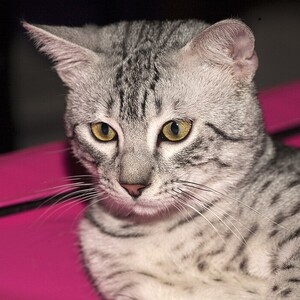
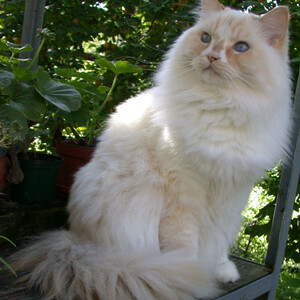
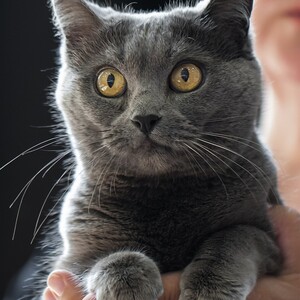
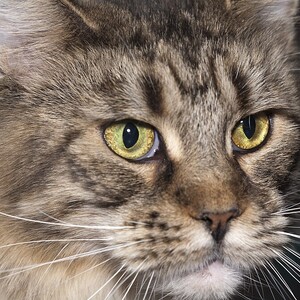
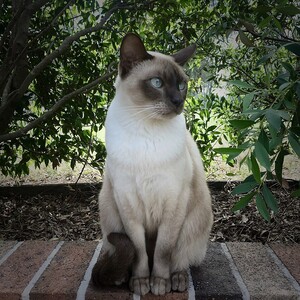
Tonkinese cat. · Luigi Leahy / Wikimedia Commons, CC BY-SA 4.0 (https://creativecommons.org/licenses/by-sa/4.0). Cropped and resized.
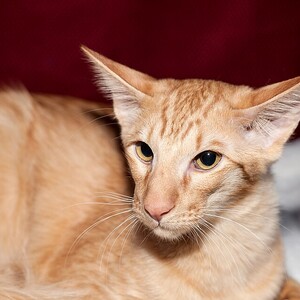
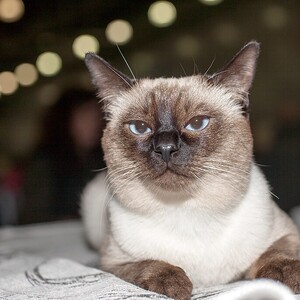
The Tonkinese is a breed created from the Siamese and the Burmese, as a perfect middle ground between them. Its best-known variety, “mink”, has a body slightly lighter than its “points” and aquamarine eyes, between blue and green. It is intelligent, sociable, playful and talkative, with a softer voice than the Siamese; CFA says it seems convinced that people exist to love and pamper it.
Quick facts
| Common name | Tonkinese (Tonk; semi-longhaired variety: Tibetan) |
| Scientific name | Felis catus |
| Country of origin | Canada and USA (from cats brought from South-East Asia) |
| Official recognition | Not recognised by FIFe; Canada (1960s), CFA (1982, championship 1984), GCCF 1991, TICA, WCF |
| Lifespan | We found no data for the breed; pet cats live about 13 years on average |
| Weight | Females 2.5–3.5 kg, males 5–6 kg (French Wikipedia) |
| Size | Medium |
| Body type | Muscular, heavier than it looks, between the Siamese and the Burmese |
| Coat type | Short (a semi-long variety also exists) |
| Common colours | Black (natural), blue, chocolate (champagne), lilac (platinum); point, mink or solid pattern |
| Eye colour | Aquamarine in mink, blue in point, golden-green in solid |
| Activity level | High |
| Temperament | Intelligent, sociable, playful, talkative, very attached to people |
| Good with children | Friendly with children |
| Good with other pets | Open towards other animals |
| Genetic predispositions | We found no specific diseases in the sources |
- Primary category:Cat breeds
- Explore this animal's categories:
History and origin
Cats first called “chocolate Siamese” were brought to the West as early as the nineteenth century; they had aquamarine eyes and a darker coat than the Siamese. The Siamese Cat Club recognised them in 1901 as Siamese of the “chocolate” type.
Most Tonkinese descend from Wong Mau, the cat brought to the USA in 1930, who was also the foundation of the Burmese breed. Wong Mau was in fact a natural “mink” Tonkinese: her matings with Siamese produced kittens like her, pointed kittens and completely brown kittens (from which the Burmese was created).
The breeders Margaret Conroy (Canada) and Jane Barletta (USA) recreated the breed by crossing Siamese with Burmese. The breed was recognised first in Canada, in the 1960s, then by CFA (registration 1982, championship 1984) and by the GCCF (1991).
How the breed developed
- 1901 – recognised as “chocolate Siamese”.
- 1930 – Wong Mau arrives in the USA.
- The 1960s – recognised in Canada, where it gets its name.
- 1984 – championship status at CFA for the mink pattern.
- 1991 – recognised by the GCCF.
- 2002 – CFA also accepts the point and solid patterns.
At a glance: who is it right for?
- People who spend a lot of time at home. It gets bored and lonely easily.
- Families with children and other pets. It is friendly and open.
- Anyone who wants a cat “on their shoulder”. CFA says it takes over your lap or shoulder.
- Homes with another cat. It helps it not to get bored.
Physical characteristics
It is a medium-sized cat, between the slender Siamese and the cobby Burmese. Like the Burmese, it is surprisingly muscular and feels much heavier when you pick it up. The tail and legs are slim, with oval paws. French Wikipedia gives 2.5–3.5 kg for females and 5–6 kg for males.
General appearance
The head is slightly rounded, a moderate wedge, with a blunt muzzle, slightly almond-shaped eyes and ears set towards the outside.
| Feature | Tonkinese |
|---|---|
| Size | Medium |
| Weight | Females 2.5–3.5 kg, males 5–6 kg |
| Body | Muscular, heavy for its size |
| Head | Moderate wedge, blunt muzzle |
| Eyes | Aquamarine (in mink) |
| Coat | Short, glossy |
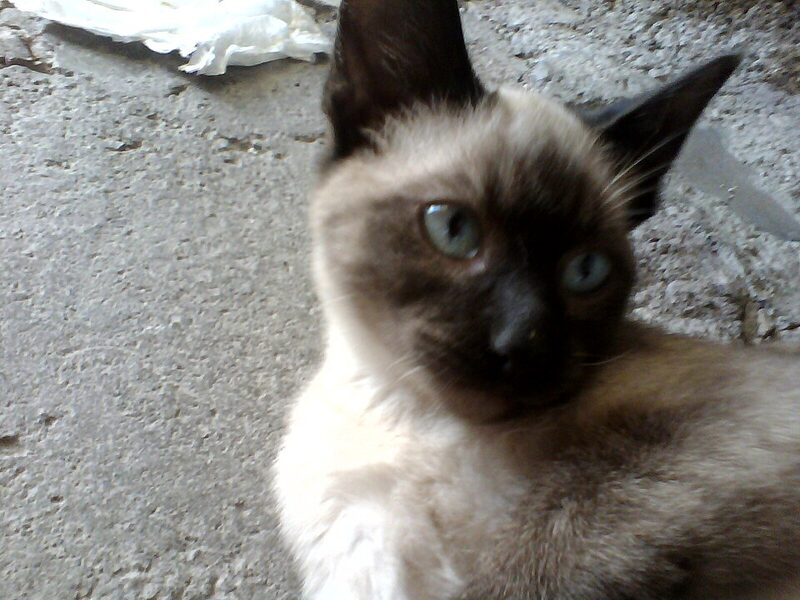
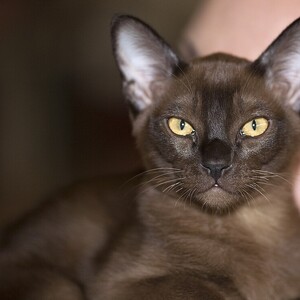
Each colour has three patterns: “point” (dark face, ears, paws and tail on a light background, blue eyes), “solid” or sepia (almost uniform, golden-green eyes) and “mink”, in between, with aquamarine eyes. CFA and WCF accept four basic colours: black (natural), blue, chocolate (champagne) and lilac (platinum); the GCCF and TICA accept more.
Related breeds and how to tell them apart
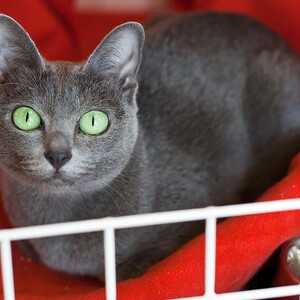
The Siamese and the Burmese are its parent breeds. The semi-longhaired variety, sometimes called the Tibetan, is more popular in Europe (the Netherlands, Germany, Belgium, Luxembourg, France).
Behaviour and temperament
CFA describes it as intelligent, gregarious and very outgoing. It takes over your lap or shoulder and supervises your every activity. It has an excellent memory and quickly learns what you would rather it did not do (although, CFA jokes, for it “no” means “allowed, as long as the owner is at work”).
Wikipedia says that, like its parent breeds, it is active, talkative and people-oriented, interested in everything that goes on. Its voice is like the Burmese's, insistent but softer than the Siamese's, like the gentle quacking of a duck. Some fetch toys and jump very high.
Socialisation
German Wikipedia describes it as open towards other animals and friendly with children.
A kitten gets used to new people, noises and other animals most easily in its first months of life.
Habits at home
Like all cats, it sleeps a lot: usually 12–16 hours a day. It is most active early in the morning and in the evening, but partly adapts to the family's routine.
Cats instinctively bury their droppings, so it quickly learns to use a litter tray. It scratches rough surfaces to shed the old outer layer of its claws, so it needs a scratching post or board.
Life at home and activity
It is active and playful and jumps very high. Because it gets bored easily, it needs daily play and company.
| Activity | How often | Why it matters |
|---|---|---|
| Fetch, jumping | daily | It is active and gets bored easily |
| Play with toys (wand toys, balls) | daily | Play imitates hunting and uses up its energy |
| Scratching post or board | always available | It looks after its claws without damaging the furniture |
| High places (cat tree, shelves) | always available | It has somewhere to watch from and to rest |
Tips for a balanced life
- Change its toys from time to time, so it does not get bored.
- Play with it in short sessions, several times a day.
- If it goes outside, let it do so in a fenced area or on a balcony with a safety net.
Care and health
Coat care
The short, glossy coat is easy to look after: a weekly polish is enough.
Common health problems
The sources we consulted do not describe diseases specific to the breed. Because it comes from the Siamese and the Burmese, ask about tests done for the diseases known in those breeds.
Recommended genetic tests
Ask the breeder which tests the parents have had for the diseases known in the Siamese and the Burmese.
Is it hypoallergenic?
Cat allergy is caused mainly by the Fel d 1 protein, found in saliva and skin glands; it is behind the allergy in 90% of people who are allergic to cats. Kittens, females and neutered males produce less of it, but still enough to trigger symptoms. No breed is completely hypoallergenic.
Other care
- A check-up at the vet once a year.
- Vaccinations and parasite treatment on the schedule set by the vet.
- Trim the claws if they do not wear down on their own.
- Clean its teeth or give it food that helps keep them clean.
Diet and nutrition
The cat is a carnivore: it needs animal protein. Unlike a dog, it must get vitamin A, arachidonic acid and taurine from its food. Water is very important, because cats usually drink little; several water bowls around the house encourage it to drink.
Tips for a healthy diet
The table gives a starting estimate, calculated with the formula from the Merck Veterinary Manual for a healthy adult cat. The last column shows what this means in dry food with 3,500–4,000 kcal per kilogram. If you also feed wet food, reduce the dry portion.
| Cat's weight | Calories per day (neutered) | Calories per day (not neutered) | Dry food per day (approximate) |
|---|---|---|---|
| 2.5 kg | 170 kcal | 190 kcal | 42–54 g |
| 3 kg | 190 kcal | 220 kcal | 48–63 g |
| 4 kg | 240 kcal | 280 kcal | 60–80 g |
| 5 kg | 280 kcal | 330 kcal | 70–94 g |
| 6 kg | 320 kcal | 380 kcal | 80–109 g |
- Adjust the portion to its weight: neutered cats put on weight easily.
- Weigh it monthly; the ribs should be easy to feel under your fingers.
- Kittens need more calories: Merck recommends 2.5 times the resting energy requirement.
Dangerous foods and substances
Some common household items are dangerous for cats:
- Lilies (and daylilies): they can destroy a cat's kidneys. Even the pollen or the water in the vase is dangerous.
- Paracetamol: extremely toxic to cats, which lack the enzyme that breaks it down. Never give it human medicines.
- Flea spot-ons and collars for dogs containing permethrin: the concentration meant for dogs is dangerous for cats.
- Foods: chocolate, coffee, alcohol, onions, garlic, grapes and raisins.
Reproduction and development
Maturity
Females usually reach sexual maturity at 5–10 months, and males at 5–7 months. The age varies from breed to breed.
Mating and pregnancy
Pregnancy in cats lasts 64–67 days, 65 on average. A first litter usually has fewer kittens than later ones. Only healthy cats that match the breed standard are used for breeding.
Blood type
Cats have blood type A, B or AB. Type A is the most common: in a study from England, 87.1% of non-pedigree cats and 54.6% of pedigree cats had type A. This matters for breeding: if the mother is type B and the kittens are type A, the antibodies in her first milk (colostrum) can destroy their red blood cells. The condition is called neonatal isoerythrolysis. That is why breeders test the blood type of both parents.
We found no published data on how common type B is in this breed; the test is done before mating anyway.
Caring for the kittens
Kittens are weaned at 6–7 weeks. They are ready to go to their new home at about 12 weeks, when they can be separated from their mother.
Neutering
Neutering used to be done at 6–9 months, but it is more and more often done before puberty, at around 3–6 months. It prevents unwanted kittens, urine marking in males and the loud “calling” of females in heat. A 2024 study found that neutered cats live one year longer on average. After the operation, the metabolism slows down and appetite increases, so the portion has to be reduced.
How to choose a kitten
- Ask for the pedigree from a recognised cat association (for example, CFA or the GCCF).
- The kitten leaves its mother at about 12 weeks.
- Look at the mother and at the place where the kittens are raised: it should be clean, with kittens used to people.
- Ask about vaccinations, parasite treatment and the blood type of the parents.
Interesting facts
- A duckling's voice. Its voice is compared to the gentle quacking of a duck.
- On the stamps of over 30 countries. More than 30 countries have put the Tonkinese on their stamps.
- Wong Mau, again. The same cat is the foundation of both the Tonkinese and the Burmese.
- Three patterns. Point, mink and solid, each with a different eye colour.
In popular culture
On stamps
More than 30 countries have put the Tonkinese on their postage stamps.
Frequently asked questions
What does “mink” mean?
A pattern between those of the Siamese and the Burmese: a body slightly lighter than the points, and aquamarine eyes.
Does it meow a lot?
Yes, it is talkative, but its voice is softer than the Siamese's.
Can it be left alone?
It does not like it; it gets bored and lonely easily.
How much does it weigh?
Females 2.5–3.5 kg, males 5–6 kg.