Mediterranean horse mackerelTrachurus mediterraneus — habitat, diet and reproduction
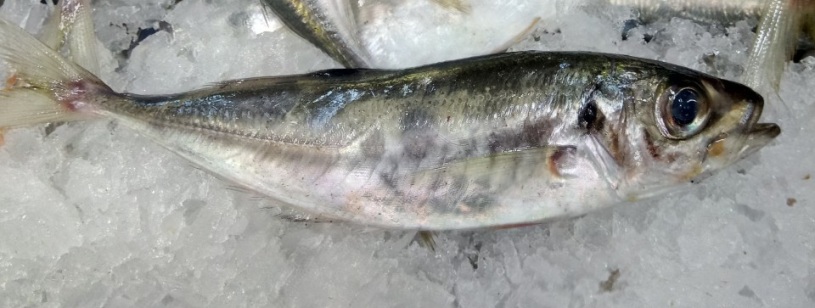
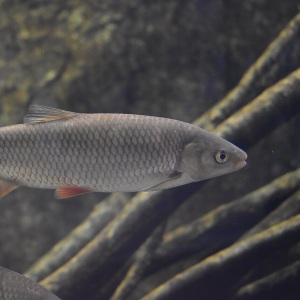
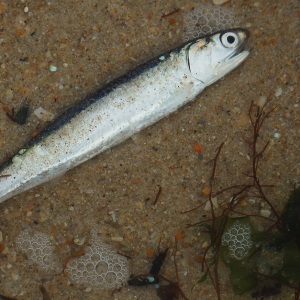
Mediterranean horse mackerel (Trachurus mediterraneus), freshly caught. · karimhaddad / CC BY 4.0 (https://creativecommons.org/licenses/by/4.0). Cropped and resized.
The Mediterranean horse mackerel is a silvery marine fish with an elongated body and large eyes that lives in schools in the Black Sea and the Mediterranean. It is easy to recognise by the line of bony scutes running along the middle of its side, from head to tail. It is a fast predator that hunts small fish such as anchovy.
Quick facts
| Common name | Mediterranean horse mackerel, Black Sea scad |
| Scientific name | Trachurus mediterraneus |
| Lifespan | A few years; matures at about 2 years |
| Length | Usually about 30 cm; up to about 60 cm |
| Diet | Carnivore: small fish, small crustaceans |
| Predators | Dolphins, larger fish, seabirds |
| Conservation status | Least Concern (LC) |
| Distribution | Eastern Atlantic, Mediterranean, Black Sea, Sea of Azov |
| Habitat | Coastal waters, usually 5–250 m deep |
| Family | Carangidae |
| Lifestyle | In schools, migratory |
Interesting facts
- The bony plates along the side, called scutes, are a hallmark of the jack family.
- In the Black Sea, horse mackerel has become one of the largest fish catches.
- A distinct subspecies, the Black Sea scad, lives in the Black Sea.
- Young horse mackerel sometimes shelter under jellyfish to escape predators.
Characteristics
The horse mackerel has an elongated, slightly flattened body, a large head and a projecting lower jaw. The back is bluish-grey or greenish, and the sides and belly are silvery.
A line of bony scutes runs along the side, rising behind the head and dropping towards the tail. A small dark spot sits on the edge of the gill cover. Large eyes help it see in darker water.
Behaviour
Horse mackerel live in fast-moving schools that follow food. They often stay near the bottom but also rise towards the surface, especially at night.
They are migratory. In spring and summer they approach the Romanian coast, and in autumn they retreat to warmer, deeper waters for the winter.
Habitat and distribution
The species lives in the eastern Atlantic from the Bay of Biscay to Mauritania, the Mediterranean, the Black Sea and the Sea of Azov.
The subspecies Trachurus mediterraneus ponticus lives in the Black Sea, in the waters of every bordering country, including Romania.
Diet and feeding
The horse mackerel is a predator, eating small fish, especially anchovy and sprat, as well as small crustaceans and other plankton animals.
Young fish first eat plankton. In turn, horse mackerel are prey for dolphins, larger fish and seabirds.
Reproduction and life cycle
Horse mackerel breed in summer. Females release eggs that float in the water, and larvae first live among the plankton.
The fish mature at about two years, at around 16 cm long. Males and females mature at the same age.
Name and history
In Turkish it is called “istavrit”, a name very similar to the Romanian “stavrid”. In English it is called “horse mackerel”, although it is not a true mackerel.
It belongs to the jack family, alongside large ocean fish such as trevallies.
Conservation and threats
The species is assessed as Least Concern. However, it is heavily fished and must be monitored, especially in the Black Sea, where it forms a large share of the catch.
Like the anchovy, the horse mackerel depends on healthy plankton. Pollution and invasive species that eat eggs and larvae can reduce its numbers.
Frequently asked questions
How do you recognise a horse mackerel?
By the line of bony scutes along the middle of its side, from head to tail, and its large eyes.
What does it eat?
Small fish, especially anchovy and sprat, and small crustaceans.
How big does it grow?
Usually about 30 cm; the largest reach about 60 cm.
Is the horse mackerel a mackerel?
No. It belongs to a different family, the jacks, despite its English name.