Brown bearInteresting facts and information
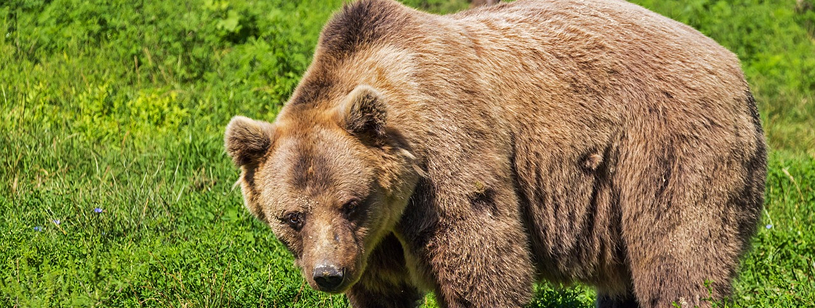
The brown bear (Ursus arctos) is a large mammal found in parts of North America, Europe and Asia. Its diet includes both plants and animals. Body size, seasonal activity and food vary greatly between populations.
The brown bear is an omnivore that eats berries, roots, nuts, fish, meat and insects. It is known for its great strength, excellent sense of smell and good memory. The species as a whole is not threatened, but some small populations, such as the Gobi bear and the bears of the Apennines and Pyrenees, are very rare.
Quick facts
| Common name | Brown bear |
| Scientific name | Ursus arctos |
| Typical lifespan | About 20-30 years in the wild, up to about 40 years in captivity |
| Maximum speed | About 50-56 km/h over short distances |
| Height | About 1.5-3 m standing on the hind legs |
| Weight | About 80-600 kg or more (by sex and region) |
| Diet type | Omnivore (fruit, roots, nuts, fish, meat, insects) |
| Main predators | Adults have few; cubs may be killed by adult male bears, wolves and tigers; people |
| Conservation status | Least Concern (IUCN); some small populations are threatened |
| Distribution | North America, Europe, Asia |
| Living environment | Forests, mountains, tundra, steppes and semi-deserts |
- Primary category:Mammals
- Explore this animal's categories:Animals of AsiaAnimals of EuropeAnimals of North AmericaAnimals of RomaniaAnimals of Romania’s forestsBBearsDangerous animalsForest animalsFurry animalsHibernating animalsInsect-eating animalsLive-bearing animalsMammalsMammals of RomaniaMountain animalsMountain animals of RomaniaOmnivoresProtected animals of RomaniaSolitary animalsVertebratesWild animals
Interesting facts
- Giants of Alaska - Kodiak bears (Ursus arctos middendorffi), which live on Alaska's Kodiak Islands, are the largest brown bears: big males can weigh more than 600 kg and stand about 3 m tall on their hind legs.
- An amazing nose - Brown bears have a far better sense of smell than people and can detect food from kilometres away.
- Winter dormancy - In winter, brown bears rest in dens for months without eating or drinking; their heart rate slows, but they can wake up if disturbed.
- Standing up to look - Bears often stand on their hind legs to see and smell better; it is usually a sign of curiosity, not aggression.
- Fast runners - Over short distances, brown bears can reach about 50-56 km/h.
- Salmon makes them big - The largest brown bears live in Alaska and Kamchatka, where they feast on salmon.
- Excellent memory - Bears remember where and when they found food, even years later.
- Mostly plants - In many areas, plants such as berries, roots, grass and nuts make up most of a brown bear's diet.
Records and remarkable features
- The brown bear (Ursus arctos) is a large mammal found in parts of North America, Europe and Asia. Its diet includes both plants and animals. Body size, seasonal activity and food vary greatly between populations.
- The most widespread bear - The brown bear has the largest range of any bear, from western Europe to Alaska.
- One of the largest land carnivores - Kodiak bears rival polar bears as the largest land carnivores.
- Close relatives - Brown bears and polar bears are so closely related that they can produce hybrids, sometimes called "pizzly" or "grolar" bears.
Physical characteristics and adaptations
The brown bear is a large, powerful mammal with a hump of muscle on its shoulders, strong legs and adaptations that let it live in many different environments.
Essential physical adaptations
- Thick fur - A dense underfur and long guard hairs protect it against cold and rain.
- Long, strong claws - Front claws up to about 10 cm long are used for digging roots, dens and burrowing animals.
- A shoulder hump - This mass of muscle gives the front legs great power for digging.
- A large head with strong jaws - Can crush bones and chew tough plants.
- A very sensitive nose - Smell is its most important sense, used to find food and detect danger.
- Fat for the winter - In autumn, brown bears eat huge amounts and build up a thick layer of fat to survive the winter.
- Large feet - Like people, bears walk on the soles of their feet, which gives them stability on rough ground.
Habits and behaviour
Brown bears mostly live alone, but they have a complex social life, especially where food is plentiful.
Way of life
- Bears are often most active in the early morning and evening, but where people are around they may become more nocturnal.
- They spend the winter in dens, but in mild climates some bears stay active for most of the year.
- Brown bears have large home ranges that often overlap; males may roam over hundreds or even thousands of square kilometres.
- They mark trees by rubbing and scratching them, leaving their scent.
Social interactions
- Although they usually live alone, many bears gather at rich food sources, such as salmon rivers, and form a temporary hierarchy.
- Mothers are very protective of their cubs and can be dangerous if they feel threatened.
- Bears recognise one another and avoid or challenge others depending on their size and status.
Defence and survival techniques
- Standing up - They stand on their hind legs to get a better view or smell, not necessarily as a threat.
- Avoiding fights - Bears usually avoid serious fights, but males can fight fiercely over females or food.
- Dens - They dig dens on slopes, under tree roots or in caves, where they spend the winter.
Habitat and geographic distribution
The brown bear is the most widespread bear in the world, living on three continents. There are about 200,000 brown bears in the world.
Species distribution
| Region | Population Estimate |
|---|---|
| Russia | More than 100,000 - the largest population |
| North America (Alaska, Canada, northern USA) | About 55,000-60,000, most of them in Alaska and western Canada |
| Europe (excluding Russia) | About 15,000-17,000, especially in the Carpathians (Romania), the Balkans and Scandinavia |
| Other parts of Asia (Central Asia, Himalayas, Japan, China) | Scattered, often small populations |
Habitats
- Forests - Boreal and temperate forests in Europe, Canada and Russia.
- Mountains - The Carpathians, the Alps, the Rocky Mountains and the Himalayas.
- Tundra - The open tundra of Alaska, northern Canada and Siberia.
- Dry regions - The Gobi Desert in Mongolia, where the rare Gobi bear lives.
Impact of climate change and human activities
- Habitat loss - Logging, roads and settlements reduce and break up bear habitat.
- Changes in the seasons - In some areas, warmer winters make bears leave their dens earlier, before much food is available.
- More contact with people - Bears looking for food come into villages, farms and towns more often.
Diet and feeding
The brown bear is an opportunistic omnivore that eats many different foods depending on the season and region. In some areas it eats mainly plants, while in others meat and fish are very important.
What does the brown bear eat?
| Food type | Specific examples |
|---|---|
| Fruit and plants | Blueberries, raspberries, acorns, beech nuts, roots, grass |
| Honey and bee larvae | From wild bees' nests and beehives |
| Fish | Salmon and trout |
| Meat and carrion | Young deer, moose and elk calves, carcasses |
| Insects | Ants, larvae, moths (in the Rocky Mountains) |
| Human food | Rubbish, crops such as maize and oats, fruit from orchards |
Feeding methods
- Catching salmon - Brown bears in Alaska and Kamchatka catch salmon in rivers, sometimes snatching them in mid-air as they leap up waterfalls.
- Digging - They use their long claws to dig up roots, bulbs and burrowing animals.
- Hunting and scavenging - They catch young deer and other animals, eat carrion and sometimes take kills from wolves.
- Hiding food - They cover large carcasses with soil and leaves and return to them later.
Reproduction and life cycle
Brown bears have an unusual breeding cycle called delayed implantation: the embryo only starts to develop if the mother has stored enough fat before winter.
Breeding season
- Mating takes place from about May to July, and males may travel long distances to find females.
- Males sometimes fight fiercely over females.
- After mating, the embryo does not develop straight away; it implants in late autumn only if the female is in good condition.
Pregnancy and birth
| Characteristic | Details |
|---|---|
| Duration of pregnancy | About 6-8 months (including delayed implantation) |
| Number of cubs per birth | Usually 1-3, sometimes 4 |
| Cubs at birth | About 300-500 g, blind and almost hairless |
| Nursing period | About 1.5-2 years |
Raising cubs
- The cubs are born in midwinter in the den, while their mother is in her winter sleep.
- They stay with their mother for about 2-3 years, learning how to find food and avoid danger.
- The mother protects them fiercely, especially from adult males, which sometimes kill cubs.
- After leaving their mother, young bears look for their own home range.
Survival rate
- Many cubs die in their first years, killed by other bears, starvation or accidents.
- Bears that reach adulthood can live about 20-30 years in the wild.
Name and history
Origin of name
- The English word "bear" comes from Old English bera, probably meaning "the brown one"; it may have been a nickname used to avoid saying the animal's real name.
- In Norse tradition, berserkers were warriors said to fight in bear skins with the fury of a bear.
Taxonomic Classification
| Classification | Name |
|---|---|
| Kingdom | Animalia |
| Phylum | Chordata |
| Class | Mammalia |
| Order | Carnivora |
| Family | Ursidae |
| Genus | Ursus |
| Species | Ursus arctos |
Important subspecies and populations
| Subspecies / population | Region | Notes |
|---|---|---|
| Kodiak bear (Ursus arctos middendorffi) | Kodiak Archipelago, Alaska | The largest brown bears |
| Grizzly bear (Ursus arctos horribilis) | Inland North America | Named for the grizzled, silver-tipped fur |
| Siberian brown bear (Ursus arctos collaris) | Siberia, northern Mongolia | Thick fur for cold winters |
| Eurasian brown bear (Ursus arctos arctos) | Europe and western Russia | Romania has the largest population in the European Union |
| Gobi bear | Gobi Desert, Mongolia | One of the rarest bears, adapted to the desert |
Evolution and fossils
- Brown bears evolved in Eurasia from earlier bears of the genus Ursus.
- The oldest brown bear fossils are about half a million years old or more, and the species soon spread across Europe and Asia.
- Brown bears crossed into North America over the Bering land bridge during the last ice age.
Cultural significance and mythology
The brown bear has been admired and feared for thousands of years and is a symbol of strength in many cultures.
- National symbols - The brown bear is the national animal of Finland and a symbol of Russia; the grizzly appears on the flag of California.
- City emblems - Bears appear on the coats of arms of Berlin and Bern, and a statue of a bear and a strawberry tree is the symbol of Madrid.
- The Ainu of Japan - For the Ainu of Hokkaido, the brown bear was a god that visited the human world.
- Wojtek - During the Second World War, a Syrian brown bear named Wojtek was adopted by Polish soldiers and even helped carry ammunition.
Conservation status and threats
The brown bear is listed as Least Concern by the IUCN, but some small populations are threatened by habitat loss, poaching and conflict with people.
Conservation status
| Population | Status | Population Estimate |
|---|---|---|
| Brown bear (species as a whole) | Least Concern (IUCN) | About 200,000 |
| Grizzly bears of the lower 48 US states | Threatened under US law | About 2,000 |
| Cantabrian brown bears (northern Spain) | Endangered in Spain; recovering | About 300-400 |
| Marsican brown bears (central Italy) | Critically endangered locally | About 50-60 |
| Gobi bear (Mongolia) | Extremely rare | About 50 |
Main threats
- Habitat loss - Settlements, roads and logging reduce and fragment bear habitat.
- Poaching and hunting - In some regions, bears are still poached for their gall bladders, paws or skins, or overhunted.
- Conflict with people - Bears that raid crops, beehives or rubbish bins are often killed.
- Climate change - May affect the food bears depend on, such as salmon and berries.
- Disturbance - Too many tourists in some parks can change bears' behaviour.
Protection measures
- National parks and reserves - Protected areas such as Yellowstone National Park and Kamchatka's reserves are vital for brown bears.
- Hunting rules - In many European countries, hunting brown bears is banned or strictly controlled.
- Reintroduction - Bears from Slovenia have been released in the Pyrenees and the Italian Alps to restore lost populations.
- GPS tracking and prevention - Bears are followed with GPS collars, and bear-proof bins and electric fences help reduce conflicts with people.
In popular culture
- The Bear (1988) - Jean-Jacques Annaud's film tells the story of an orphaned bear cub and a grizzly in British Columbia.
- Grizzly Man (2005) - Werner Herzog's documentary about Timothy Treadwell, who lived among the grizzly bears of Alaska.
- The Revenant (2015) - Features a famously realistic attack by a mother grizzly bear.
- Brother Bear (Disney, 2003) - An animated film in which a young man is turned into a bear.