Arctic hareInteresting facts and information
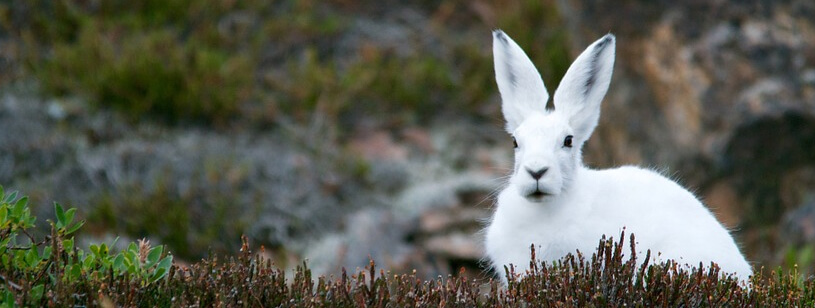
The Arctic hare (Lepus arcticus) lives in cold, open habitats in Greenland and northern Canada. Thick fur and compact ears help it cope with the cold. It feeds mainly on plants.
This large hare is a fast runner that can reach about 60 km/h to escape predators. In most of its range it changes colour with the seasons, white in winter and grey-brown in summer, but in the far north it stays white all year.
The Arctic hare is an important part of the tundra food chain, providing food for Arctic wolves, Arctic foxes, snowy owls and other predators.
Quick facts
| Common name | Arctic hare |
| Scientific name | Lepus arcticus |
| Typical lifespan | Usually about 3-5 years in the wild |
| Maximum speed | About 60 km/h |
| Dimensions | About 43 - 70 cm long (without tail) |
| Weight | About 3 - 5.5 kg |
| Diet type | Herbivore (mainly willow, plus lichens, mosses, grasses, berries) |
| Main predators | Arctic wolves, Arctic foxes, ermines, snowy owls, gyrfalcons |
| Conservation status | Least Concern (IUCN) |
| Distribution | Arctic tundra of northern Canada and Greenland |
| Habitat | Open tundra, rocky slopes, coastal areas |
- Primary category:Mammals
- Explore this animal's categories:
Interesting facts
- Snow shelters - Arctic hares dig hollows and dens in the snow, where they can shelter from the freezing wind.
- Thick, warm fur - Its dense coat traps heat and keeps it warm even at -40 °C.
- Short ears - Its ears are shorter than those of hares in warmer places, which helps reduce heat loss.
- Standing still - To avoid predators, an Arctic hare often crouches motionless and relies on its camouflage.
- Huge groups - Although they often live alone, in winter Arctic hares may gather in groups of hundreds of animals.
- Hopping like a kangaroo - When frightened, Arctic hares sometimes run on their hind legs only, bounding along upright.
Records and remarkable features
- The Arctic hare (Lepus arcticus) lives in cold, open habitats in Greenland and northern Canada. Thick fur and compact ears help it cope with the cold. It feeds mainly on plants.
- One of the largest hares - It is one of the biggest hares in the world, weighing up to about 5.5 kg or more.
- White all year - In the far north, such as Ellesmere Island and northern Greenland, Arctic hares stay white even in summer.
Characteristics
The Arctic hare (Lepus arcticus) is a large hare that is perfectly adapted to the harsh climate of the Arctic tundra. Its dense fur, large furry feet and short ears help it save heat and move across the snow.
Main physical characteristics:
| Characteristic | Details |
|---|---|
| Size | About 43 - 70 cm long (without tail) |
| Weight | About 3 - 5.5 kg |
| Winter colour | White, with black tips to the ears |
| Summer colour | Grey-brown in southern areas; white all year in the far north |
| Ear length | Relatively short for a hare |
| Tail | Short and white, about 4 - 8 cm |
| Feet | Large and covered with thick fur, like snowshoes |
Special adaptations:
- Dense fur - Works like a thick blanket, keeping in body heat.
- Wide, furry feet - Work like snowshoes, stopping the hare from sinking into the snow and giving grip on ice.
- Short ears and limbs - Reduce heat loss.
- Seasonal camouflage - In southern areas, it turns grey-brown in summer to match the rocky tundra, and white in winter to blend in with the snow.
- Fat reserves - A layer of fat helps keep it warm and gives it energy in winter.
Habits and behaviour
Arctic hares often live alone, but in winter they may gather in large groups. They are alert and fast, using both camouflage and speed to escape predators.
Social behaviour:
- Alone or in small groups - In the breeding season, they often live alone or in pairs.
- Winter groups - In winter, they may gather in groups of tens or even hundreds, which helps them spot predators.
- Quiet animals - Arctic hares rarely make sounds and communicate mainly with body language and scent.
Feeding and survival methods:
- Plant-eating mammals adapted to cold conditions; food can include woody plants, grasses, mosses and lichens.
- Digging - In winter, they dig through the snow with their front paws to find plants underneath.
- Eating snow - Where there is no liquid water, Arctic hares eat snow to get water.
Defense and Survival Strategies:
- Speed - Arctic hares can run at about 60 km/h, with long leaps, to escape predators.
- Freezing - When a predator is near, they often stay perfectly still, almost invisible in the snow.
- Snow shelters - To escape wind and cold, they dig dens in the snow.
Habitat and geographic distribution
The Arctic hare lives in some of the coldest places on Earth, on the tundra of northern Canada and Greenland.
Habitat types:
| Habitat | Predominant regions |
|---|---|
| Arctic tundra | Northern Canada, Greenland, Arctic islands |
| Rocky slopes | Hills and mountains of the Arctic |
| Tundra meadows | Arctic islands with summer vegetation |
| Coastal areas | Grassy and lichen-covered areas along Arctic coasts |
Geographic distribution:
- Northern Canada - The tundra of Nunavut, the Northwest Territories, northern Quebec and Labrador.
- Arctic islands - It lives on Baffin, Victoria, Ellesmere and many other islands.
- Greenland - It lives along the ice-free coasts of Greenland.
- Newfoundland - A population also lives in the mountains of Newfoundland.
Impact of climate change and human activities:
- Arctic warming - Shorter snowy seasons may leave white hares standing out against brown ground.
- New competitors and predators - As the climate warms, red foxes and other animals are moving north.
- Human activity - Mining and other industry can disturb some Arctic habitats.
Arctic hares are tough and adaptable, but climate change could affect them in the future.
Diet and feeding
The Arctic hare is mainly a herbivore, eating the plants of the Arctic tundra. Its diet changes with the seasons.
Types of food consumed:
| Food group | Examples |
|---|---|
| Woody plants | Arctic willow, the most important food |
| Lichens and mosses | Eaten especially in winter |
| Grasses and flowers | Grasses, sedges and Arctic flowers in summer |
| Berries and roots | Crowberries and other berries, roots |
| Animal food (rarely) | Occasionally carrion or fish caught in traps |
Feeding methods:
- Digging in the snow - Arctic hares dig down to reach willow, lichens and mosses under the snow.
- Special teeth - Their straight, strong front teeth help them nibble frozen plants.
- Eating snow - Without liquid water, they eat snow to stay hydrated.
Its varied diet and its ability to eat tough, frozen plants help it survive even when food is scarce.
Reproduction and life cycle
Arctic hares breed once a year during the short Arctic summer.
Life cycle stages:
| Stage | Approximate duration | Characteristics |
|---|---|---|
| Mating | April - May | Males chase and box with each other for females. |
| Gestation | About 50 days | The female makes a shallow nest, often hidden behind a rock. |
| Birth | June - July | Each female has about 2-8 young, called leverets. |
| Leverets | First weeks | They are born with fur and open eyes, and can move soon after birth. |
| Young hares | About 2-3 weeks | They start to leave the nest and soon become independent. |
| Sexual maturity | About 1 year | They are ready to breed the next spring. |
| Lifespan | Usually about 3-5 years in the wild | Many are killed by predators. |
Reproductive behavior:
- Competition - In spring, males chase each other and may "box" with their front paws.
- One litter a year - Because the Arctic summer is so short, females usually have just one litter a year.
- Well-developed young - Leverets are born with fur and open eyes; the mother visits them only briefly to feed them.
- Fast growth - The young grow quickly and can look after themselves within a few weeks.
Their large litters help Arctic hares keep their numbers up, despite the many predators that hunt them.
Name and history
The Arctic hare has long been known to the Inuit and other peoples of the Arctic, who hunted it for food and fur.
Origin and etymology of the name:
- "Arctic hare" - The name refers to its Arctic home.
- The scientific name Lepus arcticus - comes from Latin: Lepus means "hare" and arcticus means "of the Arctic".
- Other names - In Inuktitut, the language of the Inuit of Canada, it is called ukaliq; it is also sometimes called the polar hare.
Taxonomic classification:
| Taxonomic category | Name |
|---|---|
| Kingdom | Animalia |
| Phylum | Chordata |
| Class | Mammalia |
| Order | Lagomorpha |
| Family | Leporidae |
| Genus | Lepus |
| Species | Lepus arcticus |
The Arctic hare in history and culture:
- Inuit life - The Inuit hunted Arctic hares for meat and used their soft fur to line boots and mittens.
- Polar expeditions - European explorers of the 19th century described Arctic hares in their reports from the far north.
- Science - Biologists study the Arctic hare to understand how animals survive extreme cold.
The Arctic hare is one of the best-adapted mammals of the Arctic.
Cultural significance and mythology
For the peoples of the Arctic, the Arctic hare was an important source of food and warm fur, and it appears in their stories and art.
The Arctic hare in mythology and popular beliefs:
- Inuit stories - Hares appear in Inuit stories and in modern Inuit art, such as prints and stone carvings.
- Warm clothing - Hare fur was used to make soft linings and socks for winter clothing.
- Camouflage - People of the Arctic have long admired how the white hare almost disappears in the snow.
The symbolism of the Arctic hare:
- Camouflage and survival - It is seen as a symbol of adaptability.
- Speed and alertness - It stands for quick reactions to danger.
- The seasons - Its changing coat makes it a symbol of the changing seasons.
Conservation status and threats
The Arctic hare is not considered threatened, but climate change and human activities in the Arctic could affect it in the future.
Conservation status
| Region | Status |
|---|---|
| Whole range | Least Concern (IUCN) |
| Northern Canada and Greenland | Widespread; numbers can rise and fall from year to year |
| Southern edge of the range | May be affected by warming and by competition with other hares |
Main threats:
- Global warming - Shorter snowy seasons can make the hares' white coats stand out.
- Changes in predators - Warmer weather lets red foxes and other predators move north.
- Industry - Mining and oil exploration can disturb some Arctic habitats.
- Changes in vegetation - Warming changes the plants of the tundra, which may affect the hares' food.
- Hunting - Hunting by local people is usually small-scale and is not a major threat.
Conservation efforts:
- Monitoring - Researchers study how climate change affects Arctic hares and their habitat.
- Protected areas - National parks in the Arctic, such as Quttinirpaaq on Ellesmere Island, protect their habitat.
- Research - Biologists study how Arctic hares adapt to changing conditions.
Arctic hare populations are currently stable, but scientists keep watching for the effects of global warming.
In popular culture
The Arctic hare in literature:
- Nature books - Books about polar wildlife often describe the Arctic hare and its adaptations.
- Children's books - Many picture books show the white hare as a friendly character that teaches children about camouflage and the seasons.
The Arctic hare on screen:
- Nature documentaries - Arctic hares running upright on their hind legs are a popular sight in documentaries about the Arctic.
The Arctic hare as a cultural symbol:
- A symbol of the cold - It is often linked with survival in extreme environments.
- Art and souvenirs - Its image appears on postcards, crafts and Inuit art from the Arctic.