Castor bean tickIxodes ricinus — habitat, diet and reproduction
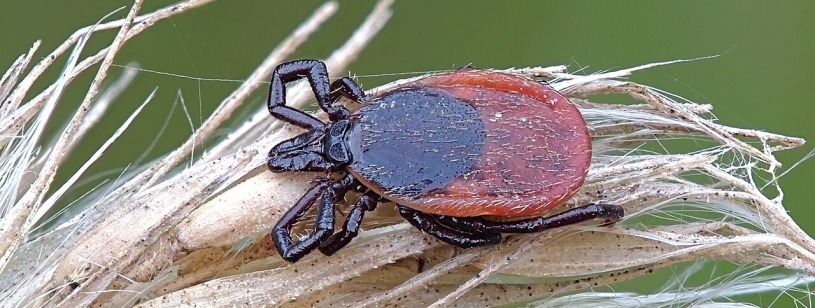
Female Ixodes ricinus tick on a dry grass stem. · W.alter / Wikimedia Commons / CC BY-SA 4.0 (https://creativecommons.org/licenses/by-sa/4.0/). Cropped and resized. Source: https://commons.wikimedia.org/wiki/File:Ixodes_ricinus_on_dry_grass.jpg
The castor bean tick (Ixodes ricinus) is an external parasite that feeds on vertebrate blood. It is an arachnid, related to spiders. It waits on vegetation and attaches to a passing host. This account focuses on the widespread European species.
Quick facts
| Common name | Castor bean tick; sheep tick |
| Scientific name | Ixodes ricinus |
| Lifespan | The cycle often takes 2–3 years, sometimes longer |
| Size | A few millimetres before feeding; females enlarge after a blood meal |
| Appearance | Oval body, dorsal shield and eight legs in nymphs and adults |
| Diet | Vertebrate blood |
| Hosts | Mammals, birds and reptiles; humans may also be bitten |
| Species situation | Widespread and monitored as a vector of pathogens |
| Distribution | Much of Europe, North Africa and adjacent regions |
| Habitat | Woodland, dense vegetation, grassland and parks with humid microclimates |
| Family | Ixodidae, the hard ticks |
| Reproduction | Eggs laid in the environment, followed by larva, nymph and adult |
- Primary category:Arachnids
- Explore this animal's categories:
Interesting facts
- Larvae have six legs; the fourth pair appears in nymphs.
- Ticks neither jump nor fly onto their hosts.
- Much of the life cycle is spent off the host.
- Females expand substantially during a blood meal.
Records and extremes
The life cycle commonly spans two or three years and may last longer. Cold, dryness and host shortages can delay development.
ECDC reports egg production reaching around 2,000 per female. Many offspring fail to survive or find subsequent hosts.
Body expansion reflects the blood meal. Length and volume change differently, so unfed and engorged ticks can look strikingly unlike each other.
Characteristics
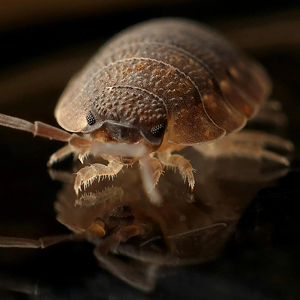
The roughly oval body has a hardened dorsal shield, the scutum. It covers most of the male’s back but only the front part of the female’s.
Larvae have three pairs of legs, while nymphs and adults have four. Six larval legs do not make ticks insects.
Ixodes ricinus lacks eyes. Sensory structures on the front legs detect environmental cues, and specialised mouthparts attach to the host.
Behaviour
A tick climbs a stem and holds out its front legs while waiting for contact. This behaviour is called questing.
Odours, carbon dioxide, warmth and vibrations help signal an approaching animal. After climbing aboard, the tick may move before finding a feeding site.
Dry conditions limit time spent exposed. Retreating to damp leaf litter helps maintain moisture, but reduces opportunities to encounter a host.
Habitat and distribution
Ixodes ricinus occurs across much of Europe and North Africa. Local abundance depends on vegetation, humidity and available animals.
Deciduous and mixed woodland often provide damp litter, but grasslands, parks and dense urban-edge vegetation can also be suitable.
The microclimate near the ground matters. Host movement can carry ticks between locations, while habitat changes affect both parasite and hosts.
Diet and feeding
Larvae and nymphs frequently feed on small animals, including rodents and birds. Adult females often use larger mammals.
Attachment may last several days. Saliva supports feeding, the body expands and the tick eventually drops back into the environment.
Infected ticks can transmit pathogens, including Lyme-associated bacteria and tick-borne encephalitis virus. A bite does not automatically result in infection.
Reproduction and life cycle
There are four stages: egg, larva, nymph and adult. Feeding stages seek a host and then return to the environment, producing a three-host cycle.
A fed larva moults into a nymph; another meal and moult produce the adult. Hosts need not belong to different species.
After mating and feeding, females lay eggs near ground level and die. Males are often on hosts for mating; environmental conditions influence development speed.
Name and history
Linnaeus described the species in 1758 as Acarus ricinus. It now belongs to Ixodes, family Ixodidae and order Ixodida, within the mites.
Tick is a broad name covering many species. Hard and soft ticks differ in shields and feeding cycles. Like other arthropods, they have jointed limbs and an external covering.
Conservation and threats
Surveillance focuses on distribution and carried pathogens. Host numbers, humidity and vegetation shape populations; one day’s temperature cannot explain local abundance.
Covering skin and checking the body after outdoor activity help reduce exposure. Remove an attached tick promptly with fine-tipped tweezers close to the skin, pulling steadily without twisting, then clean skin and hands.
Do not apply oil, nail polish or heat. Seek medical assessment if a rash or fever develops in the following days or weeks, mentioning when and where the bite occurred.
Frequently asked questions
Is it an insect?
No. It is an arachnid; nymphs and adults have eight legs.
Does it jump from grass?
No. It attaches when a host brushes past vegetation.
Why does it swell?
The body expands as blood accumulates.
Does it remain on one animal?
Ixodes ricinus spends much time in the environment and seeks hosts between stages.
Does every bite cause Lyme disease?
No. Transmission requires an infected tick and does not occur after every bite.
How many legs does a larva have?
Six; nymphs and adults have eight.