BombayCharacteristics, history, behaviour and care
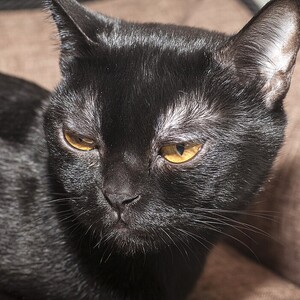
Bombay cat at a cat show. · Nickolas Titkov / Wikimedia Commons, CC BY-SA 2.0 (https://creativecommons.org/licenses/by-sa/2.0). Cropped and resized.
The Bombay is a breed of completely black cats, with a short coat as glossy as patent leather and large copper eyes. It was created in the USA to look like a miniature black panther. It is a sociable, affectionate cat, very attached to its family and well suited to homes with children.
Quick facts
| Common name | Bombay |
| Scientific name | Felis catus |
| Country of origin | USA (Louisville, Kentucky) |
| Official recognition | FIFe: preliminary recognition (code BOM); CFA since 1970, TICA since 1979 |
| Lifespan | 15 years on average, some up to 20 |
| Weight | 2.5–5 kg (females 2.5–3.5 kg, males 3.5–5 kg) |
| Size | Medium |
| Body type | Muscular, heavier than it looks |
| Coat type | Short, fine, glossy, close-lying |
| Common colours | Solid black only, including whiskers, nose and paw pads |
| Eye colour | Copper, from bright orange to warm gold |
| Activity level | Moderate |
| Temperament | Sociable, affectionate, playful, attention-seeking |
| Good with children | Very good with gentle children |
| Good with other pets | Lives well with animals that respect it, including dogs |
| Genetic predispositions | Nose and sinus problems, gingivitis |
- Primary category:Cat breeds
- Explore this animal's categories:
History and origin
The breed has nothing to do with India: the name comes from the city of Bombay (Mumbai), with the Indian black leopard in mind. It was created by breeder Nikki Horner of Louisville, Kentucky, who crossed sable Burmese cats with black American Shorthairs.
The first Bombay-type cats appeared in 1958, but Wikipedia says it was only the second attempt, in 1965, that succeeded. CFA recognised the breed in 1970, and it gained championship status in 1976. Today it is recognised by almost all the major associations; at FIFe it has preliminary recognition.
In Britain there is also a “British” variety, registered with the GCCF as the Asian Self, created from European Burmese cats.
How the breed developed
- 1958 – the first Bombay-type cats appear.
- 1965 – Nikki Horner's first successful attempt.
- 1970 – recognised by CFA.
- 1976 – championship status at CFA.
- 1979 – recognised by TICA.
At a glance: who is it right for?
- Families with children. FIFe says it is an excellent choice for families with gentle children and cat-friendly dogs.
- Apartments. It is happy indoors only, even in a small apartment, if it has everything it needs.
- People who spend a lot of time at home. It demands a lot of attention.
- Watch the portions. Wikipedia recommends controlled feeding, so it does not put on weight.
Physical characteristics
The FIFe profile says it looks a lot like the Burmese, but has a slightly larger and longer body, longer legs and a straight tail. It is medium-sized, but surprisingly heavy for its size. It matures slowly: males reach their final size and musculature only at about 2 years.
General appearance
The head is round, without sharp angles, with a short muzzle. The ears are medium-sized, set wide apart and rounded at the tips. The eyes are large, round and set wide apart; they are always copper, from bright orange to warm gold. Green eyes are not accepted.
| Feature | Bombay |
|---|---|
| Size | Medium |
| Weight | 2.5–5 kg |
| Body | Muscular, heavy for its size |
| Head | Round, short muzzle |
| Eyes | Large, round, copper |
| Tail | Straight, of medium length |
| Coat | Short, black, glossy |
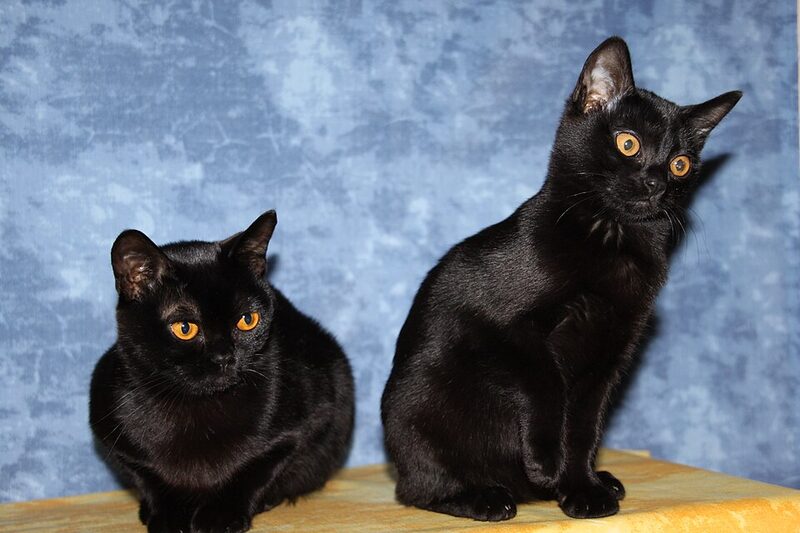
Only solid black is accepted: coat, whiskers, skin, nose and paw pads. In adult cats each hair is black right down to the root; in cats under 2 years a lighter shade is accepted. French Wikipedia says that, unlike other black cats, the coat does not turn reddish in the sun.
Related breeds and how to tell them apart
The Burmese has the same body and head type, but different colours. In Britain, the black cats of the “Asian” group are also called Bombay. Any black house cat can look like one, but only the pedigree shows the breed.
Behaviour and temperament
Wikipedia says it is very sociable, strongly attached to its family and always seeking attention. The FIFe profile describes it as outgoing and affectionate.
French Wikipedia adds that, according to Christiane Sacase, it is a homebody, very playful and agile, less talkative than the Burmese, and learns to fetch.
Socialisation
It enjoys the attention of gentle children and lives peacefully with other animals that respect its “authority”.
A kitten gets used to new people, noises and other animals most easily in its first months of life.
Habits at home
Like all cats, it sleeps a lot: usually 12–16 hours a day. It is most active early in the morning and in the evening, but partly adapts to the family's routine.
Cats instinctively bury their droppings, so it quickly learns to use a litter tray. It scratches rough surfaces to shed the old outer layer of its claws, so it needs a scratching post or board.
Life at home and activity
It is an indoor cat that adapts well to apartment life. It loves throw-and-fetch games.
| Activity | How often | Why it matters |
|---|---|---|
| Playing fetch | daily | Many Bombays learn to bring back a toy |
| Play with toys (wand toys, balls) | daily | Play imitates hunting and uses up its energy |
| Scratching post or board | always available | It looks after its claws without damaging the furniture |
| High places (cat tree, shelves) | always available | It has somewhere to watch from and to rest |
Tips for a balanced life
- Change its toys from time to time, so it does not get bored.
- Play with it in short sessions, several times a day.
- If it goes outside, let it do so in a fenced area or on a balcony with a safety net.
Care and health
Coat care
The short coat is polished once a week with a grooming glove, to keep it glossy. During moulting it needs regular brushing.
Common health problems
Wikipedia says a healthy Bombay lives 15 years on average, and some reach 20. The breed is prone to nose and sinus problems and to gingivitis (inflammation of the gums). Because it comes from the Burmese, it can also inherit some of that breed's diseases.
| Condition | Description | Common symptoms |
|---|---|---|
| Nose and sinus problems | Inflammation of the upper airways | Sneezing, blocked nose, noisy breathing |
| Gingivitis | Inflammation of the gums | Red gums, bad breath, difficulty chewing |
Recommended genetic tests
Ask the breeder which tests the parents have had, including for the diseases known in the Burmese, from which the breed descends.
Is it hypoallergenic?
Cat allergy is caused mainly by the Fel d 1 protein, found in saliva and skin glands; it is behind the allergy in 90% of people who are allergic to cats. Kittens, females and neutered males produce less of it, but still enough to trigger symptoms. No breed is completely hypoallergenic.
Other care
- A check-up at the vet once a year.
- Vaccinations and parasite treatment on the schedule set by the vet.
- Trim the claws if they do not wear down on their own.
- Clean its teeth or give it food that helps keep them clean.
Diet and nutrition
Wikipedia recommends portion control, because the Bombay puts on weight easily if it gets too much food.
The cat is a carnivore: it needs animal protein. Unlike a dog, it must get vitamin A, arachidonic acid and taurine from its food. Water is very important, because cats usually drink little; several water bowls around the house encourage it to drink.
Tips for a healthy diet
The table gives a starting estimate, calculated with the formula from the Merck Veterinary Manual for a healthy adult cat. The last column shows what this means in dry food with 3,500–4,000 kcal per kilogram. If you also feed wet food, reduce the dry portion.
| Cat's weight | Calories per day (neutered) | Calories per day (not neutered) | Dry food per day (approximate) |
|---|---|---|---|
| 2.5 kg | 170 kcal | 190 kcal | 42–54 g |
| 3 kg | 190 kcal | 220 kcal | 48–63 g |
| 4 kg | 240 kcal | 280 kcal | 60–80 g |
| 5 kg | 280 kcal | 330 kcal | 70–94 g |
- Adjust the portion to its weight: neutered cats put on weight easily.
- Weigh it monthly; the ribs should be easy to feel under your fingers.
- Kittens need more calories: Merck recommends 2.5 times the resting energy requirement.
Dangerous foods and substances
Some common household items are dangerous for cats:
- Lilies (and daylilies): they can destroy a cat's kidneys. Even the pollen or the water in the vase is dangerous.
- Paracetamol: extremely toxic to cats, which lack the enzyme that breaks it down. Never give it human medicines.
- Flea spot-ons and collars for dogs containing permethrin: the concentration meant for dogs is dangerous for cats.
- Foods: chocolate, coffee, alcohol, onions, garlic, grapes and raisins.
Reproduction and development
Maturity
Females usually reach sexual maturity at 5–10 months, and males at 5–7 months. The age varies from breed to breed.
Mating and pregnancy
Pregnancy in cats lasts 64–67 days, 65 on average. A first litter usually has fewer kittens than later ones. Only healthy cats that match the breed standard are used for breeding.
Blood type
Cats have blood type A, B or AB. Type A is the most common: in a study from England, 87.1% of non-pedigree cats and 54.6% of pedigree cats had type A. This matters for breeding: if the mother is type B and the kittens are type A, the antibodies in her first milk (colostrum) can destroy their red blood cells. The condition is called neonatal isoerythrolysis. That is why breeders test the blood type of both parents.
We found no published data on how common type B is in this breed; the test is done before mating anyway.
Caring for the kittens
Kittens are weaned at 6–7 weeks. They are ready to go to their new home at about 12 weeks, when they can be separated from their mother.
Neutering
Neutering used to be done at 6–9 months, but it is more and more often done before puberty, at around 3–6 months. It prevents unwanted kittens, urine marking in males and the loud “calling” of females in heat. A 2024 study found that neutered cats live one year longer on average. After the operation, the metabolism slows down and appetite increases, so the portion has to be reduced.
How to choose a kitten
- Ask for the pedigree from a recognised cat association (for example, a FIFe member).
- The kitten leaves its mother at about 12 weeks.
- Look at the mother and at the place where the kittens are raised: it should be clean, with kittens used to people.
- Ask about vaccinations, parasite treatment and the blood type of the parents.
Interesting facts
- “The patent leather kid”. The American standard describes it as the “patent leather kid with the new penny eyes”.
- Black to the tips of its whiskers. The whiskers, nose and paw pads must all be black too.
- It does not turn red in the sun. Unlike other black cats, its coat keeps its colour.
- Heavy for its size. When you pick it up, it is heavier than it looks.
In popular culture
A miniature black panther
The breed was designed from the start as a “miniature black panther”, and its name recalls the black leopard of India.
Frequently asked questions
Is every black cat a Bombay?
No. The Bombay is a pedigree breed with copper eyes and a Burmese-type body; only the pedigree papers show the breed.
Is it good with children?
Yes. FIFe recommends it for families with gentle children and cat-friendly dogs.
How long does it live?
15 years on average, some as long as 20.
How much does it weigh?
Females 2.5–3.5 kg, males 3.5–5 kg.