European tree frogHyla arborea — habitat, diet and reproduction
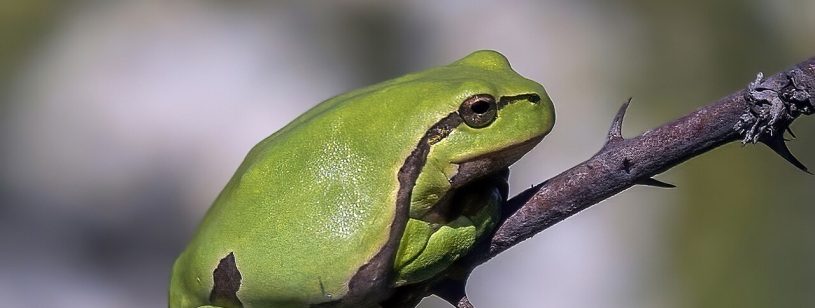
European tree frog (Hyla arborea) on a twig. · Charles J. Sharp / CC BY-SA 4.0 (https://creativecommons.org/licenses/by-sa/4.0). Cropped and resized.
The European tree frog is a small, bright green frog that lives in bushes and trees rather than in water. Its toes end in sticky pads that help it climb even smooth leaves. In spring, males call in loud evening choruses, surprisingly loud for their size.
Quick facts
| Common name | European tree frog |
| Scientific name | Hyla arborea |
| Lifespan | A few years in the wild; up to about 15 in captivity |
| Length | About 3–5 cm |
| Diet | Carnivore: flying insects and spiders |
| Predators | Birds and snakes; fish and water insects take tadpoles |
| Conservation status | Least Concern (LC); strictly protected in the EU |
| Distribution | Europe and western Asia |
| Habitat | Shrubs, reedbeds and trees near sunny ponds |
| Family | Hylidae |
| Reproduction | Eggs laid in water in small clumps |
- Primary category:Amphibians
- Explore this animal's categories:AmphibiansAnimals of AsiaAnimals of EuropeAnimals of RomaniaAnimals of the Danube DeltaAnimals that change colourAquatic animalsArboreal animalsCamouflaged animalsCarnivoresEEgg-laying animalsFreshwater animalsGreen animalsHibernating animalsInsect-eating animalsNocturnal animalsReptiles and amphibians of RomaniaVertebratesWetland animalsWild animals
Interesting facts
- A tree frog chorus can be heard over a kilometre away on quiet nights.
- It can change shade from bright green to grey or brown.
- The male has a vocal sac under the chin that inflates like a balloon when calling.
- Its sticky toe pads hold it even to windows.
Characteristics
The tree frog has smooth, bright green skin and a dark stripe running from the nose through the eye and along the flank. The belly is white or yellowish.
Toe tips are widened into sticky discs. Males have a yellowish or brownish throat containing the vocal sac. Colour can change with temperature, humidity and the animal’s state.
Behaviour
Outside the breeding season, the tree frog lives in shrubs, reeds and tree canopies. By day it sits still on leaves, even in sunshine, and hunts in the evening.
In spring, males gather at ponds and give a fast, loud “crek-crek-crek”, and females choose males by their calls. In winter it hibernates on land, under leaves, in crevices or in the soil.
Habitat and distribution
The species lives across much of Europe, from Iberia to the Caucasus and western Asia. It is absent from Britain, Ireland and northern Scandinavia.
In Romania it is widespread in lowlands and hills, especially near sunny, vegetated ponds, and is common in the Danube Delta and river floodplains.
Diet and feeding
The tree frog eats flying insects such as flies, mosquitoes and moths, as well as spiders and small beetles.
It waits on leaves and leaps at prey, catching it with its mouth and sticky tongue. Tadpoles eat algae and plant debris.
Reproduction and life cycle
Breeding takes place in spring in shallow, sunny ponds without fish. The female lays a few hundred eggs in small clumps attached to plants.
Tadpoles have a tall tail fin and eyes set on the sides of the head. After about two to three months, tiny green froglets leave the water and climb into vegetation.
Name and history
The scientific name Hyla arborea means “tree frog”. Hylas was a figure in Greek mythology, and “arborea” comes from the Latin for tree.
People once kept tree frogs in jars with a little ladder, believing that if the frog climbed, good weather would follow. This is a superstition, not a forecasting method.
Conservation and threats
The species is assessed as Least Concern, but populations are declining in many countries. In the EU it is strictly protected under Annex IV of the Habitats Directive.
Main threats include ponds drying out, pesticides, fish stocked in ponds and clearing of bankside shrubs. Small, sunny, fish-free ponds are essential for it.
Frequently asked questions
Where does the European tree frog live?
In shrubs, reeds and trees near sunny ponds. It goes into water mainly in spring to breed.
What does it sound like?
Males give a fast, loud “crek-crek-crek”, especially on spring evenings.
Is the tree frog poisonous?
It is not dangerous to people. Its skin has mild secretions, so wash your hands after touching one.
Can I keep one at home?
No. It is a strictly protected wild species, and capturing it is illegal.