WallabyInteresting facts and information
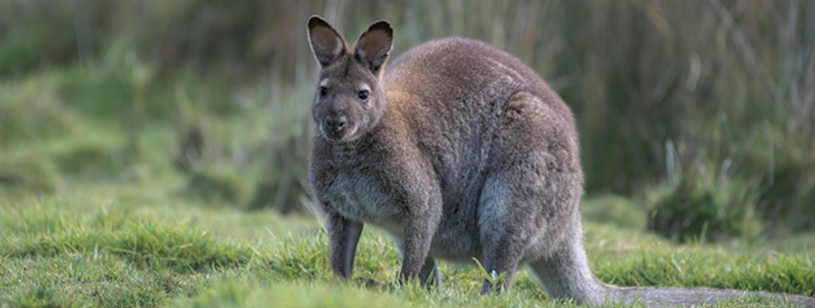
Wallabies are marsupials in the kangaroo family, Macropodidae. The name covers several groups rather than a single species. They feed mainly on plants and occupy varied habitats in Australia and New Guinea, with introduced populations in some other places.
Their strong hind legs help them hop, and the tail helps with balance. Habitat and movement differ between wallaby species.
Quick facts
| Common name | Wallaby |
| Scientific name | Macropodidae (wallabies in several genera) |
| Typical lifespan | Often 9-15 years in the wild, up to about 20 years in captivity |
| Maximum speed | Varies with species or individual, distance and conditions |
| Size | About 45 - 180 cm including the tail (depending on species) |
| Weight | About 2 - 25 kg (by species) |
| Diet | Mainly plant foods, including grasses, leaves and shoots; diet differs between species |
| Main predators | Dingoes, foxes, cats, wedge-tailed eagles, pythons, people |
| Conservation status | Assess separately by species and population; regional trends and needs differ |
| Habitat | Grasslands, forests, rocky habitats and semi-arid regions |
| Distribution (continents) | Australia, New Guinea; introduced to New Zealand, Hawaii and Britain |
- Primary category:Mammals
- Explore this animal's categories:
Interesting facts
- Efficient hoppers - Wallabies hop on their strong hind legs, and stretchy tendons store energy with each bound, making hopping very efficient at speed.
- Wallabies in dry habitats can obtain water from their food. Water requirements differ between species and conditions.
- In some wallabies, a mother can produce milk for young at different stages of development.
- Keeping still - Many wallabies freeze in dense vegetation to avoid being seen by predators.
Records and remarkable features
- Wallabies are marsupials in the kangaroo family, Macropodidae.
- Rock climbers - Rock-wallabies can leap among cliffs and boulders and even climb sloping tree trunks.
Physical Features and Unique Adaptations
Wallabies are smaller relatives of kangaroos, adapted to many habitats, from forests and grasslands to rocky hills and dry scrub.
Distinguishing physical appearance
- A compact, muscular body - Built for hopping.
- A long, strong tail helps with balance during hopping and provides support while standing.
- Varied fur colours - From reddish-brown to grey and black, often with stripes or patches that help camouflage them.
- Large ears - Help them hear predators.
- Long, strong hind legs are adapted for hopping. Elastic tendons store and release energy.
Adaptations for survival
- Saving energy - At higher speeds, hopping uses less energy than running would.
- Saving water - Species from dry regions get much of their water from plants and can go a long time without drinking.
- Keeping cool - On hot days, wallabies rest in the shade and lick their forearms to cool down.
- Staying still - Many wallabies rely on keeping still and hidden to avoid predators.
Habits and behaviour
Many wallabies are fairly solitary, but some species gather in small groups, called mobs, especially when feeding.
Life mode and daily routine
- Active at dusk and night - Most wallabies feed mainly in the early morning, evening and at night.
- Resting by day - They spend the hot part of the day resting in vegetation or among rocks.
- Home ranges - Wallabies usually stay in a familiar area and use regular paths to feeding places.
Social behaviour and interactions
- Loose groups - Some species feed in groups, while others are more solitary.
- Warning thumps - When they sense danger, wallabies thump the ground with their hind feet to warn others.
- Scent - They use scent to recognise each other and mark areas.
- Fights between males - Males sometimes fight by grappling and kicking.
Defence strategies
- Zigzag escape - When chased, wallabies hop away quickly and change direction suddenly.
- Hiding - Many species shelter in dense vegetation or among rocks.
- Kicking - If caught, they can kick hard with their hind feet and scratch with their claws.
Habitat and geographic distribution
Wallabies are native to Australia and New Guinea, but some species have been introduced to New Zealand, Hawaii and parts of Britain.
Geographical distribution
| Region | Examples and habitats |
|---|---|
| Australia | Many species in coastal forests, grasslands, rocky hills and dry scrub |
| New Guinea | Forest wallabies (pademelons and dorcopsis wallabies) in dense forests and mountains |
| New Zealand (introduced) | Several species, considered pests in some areas |
| Britain and Hawaii (introduced) | Red-necked wallabies on the Isle of Man and in Scotland; brush-tailed rock-wallabies on Oahu |
Habitats
- Forests - Forest species, such as the swamp wallaby and pademelons, live in thick vegetation.
- Rocky areas - Rock-wallabies are excellent climbers on cliffs and boulders.
- Grasslands and scrub - Species such as the agile wallaby live in open grassland and woodland.
Habitat threats
- Habitat loss - Farming and building reduce forests and grasslands.
- Introduced predators - Foxes and cats kill many wallabies, especially small species and young.
- Bushfires - Large fires can destroy whole habitats.
- Traffic - Many wallabies are hit by cars, especially at night.
Diet and feeding
Wallabies are herbivores that eat grasses, leaves, shoots and other plant material. Their diet depends on the species and habitat.
What do wallabies eat?
| Food type | Examples |
|---|---|
| Grasses and herbs | Native grasses, clover, herbs |
| Leaves | Leaves of shrubs and young trees |
| Fruit and seeds | Fallen fruit, berries, seeds |
| Shoots and ferns | Young shoots and ferns (forest species) |
| Fungi and bark | Eaten by some species, especially in dry periods |
Food behaviour
- Feeding at dusk and night - Wallabies feed mainly when it is cooler.
- Little drinking - Many species get much of their water from plants.
- Holding food - They often use their front paws to hold plants while eating.
- Chewing the cud - Like kangaroos, they have a chambered stomach in which microbes help digest plants, and they sometimes bring food back up to chew again.
- Seasonal diet - They eat more fresh grass in wet seasons and more leaves and shrubs in dry ones.
Reproduction and life cycle
Like other kangaroos, wallabies give birth to tiny young that grow up in their mother's pouch, and many can pause the development of an embryo.
Breeding and birth
| Characteristic | Details |
|---|---|
| Sexual maturity | About 12 - 24 months |
| Breeding season | All year round in many species; seasonal in others |
| Gestation | About 28 - 40 days |
| Number of young | Usually 1 |
| Time in the pouch | About 6 - 9 months |
| Weaning | Often at about 12 months |
Reproductive behaviour
- Embryonic diapause – In some wallabies, development of an embryo can pause while the mother raises an older joey in her pouch.
- Competition - Males compete for females, sometimes by fighting.
- The tiny newborn climbs into its mother’s pouch, where it continues to develop.
- Young may continue to nurse after leaving the pouch; the duration varies between species.
Longevity
- In the wild, wallabies often live about 9-15 years, depending on the species.
- In captivity, some live up to about 20 years.
Name and history
Origin of the name "Wallaby"
- The word "wallaby" comes from walabi, a word in Dharug, an Aboriginal language of the Sydney area.
- The term was adopted by European settlers in the late 18th century.
Taxonomic Classification
| Kingdom | Animalia |
|---|---|
| Phylum | Chordata |
| Class | Mammalia |
| Order | Diprotodontia |
| Family | Macropodidae |
| Main genera | Notamacropus, Petrogale, Thylogale, Wallabia |
History and documentation
- European descriptions - Wallabies were described by European naturalists from the late 18th century.
- Aboriginal culture - Aboriginal Australians have hunted wallabies for food and skins for thousands of years, and wallabies appear in Dreaming stories and rock art.
- New Zealand - Several wallaby species were brought to New Zealand in the 19th century, and some became pests.
- Scotland - A colony of red-necked wallabies was introduced to Inchconnachan, an island in Loch Lomond, in the 1940s.
Cultural significance and mythology
Wallabies are familiar Australian animals and have long been important to Aboriginal peoples.
- Aboriginal traditions - Wallabies are an important source of food and appear in many Aboriginal stories, songs and paintings.
- National symbol in sport - Australia's national rugby union team is called the Wallabies.
- Escaped colonies - Wild wallabies living in Britain, on the Isle of Man and in Hawaii surprise many visitors.
Conservation status and threats
Some wallabies are common, but others are threatened, mainly by introduced predators, habitat loss and fires.
Main threats to wallabies
- Habitat destruction - Clearing of land for farming and building reduces their habitat.
- Introduced predators - Foxes and cats attack young wallabies and small species.
- Bushfires - Large fires, such as those of 2019-2020 in Australia, destroyed important habitats.
- Control as pests - In some farming areas, common wallabies are culled because they eat pasture and crops.
- Traffic - Roads are dangerous for wallabies, especially at night.
Conservation status
| Species | Status |
|---|---|
| Notamacropus rufogriseus (red-necked wallaby) | Least Concern (IUCN) |
| Petrogale penicillata (brush-tailed rock-wallaby) | Near Threatened (IUCN); Vulnerable under Australian law |
| Petrogale persephone (Proserpine rock-wallaby) | Endangered (IUCN) |
| Onychogalea fraenata (bridled nail-tail wallaby) | Endangered; once thought extinct, rediscovered in 1973 |
Conservation efforts
- Protected areas - National parks and reserves in Australia and New Guinea.
- Reintroduction programmes - Some threatened species are bred in captivity and released into the wild.
- Predator control - Removing foxes and cats from fenced reserves and islands.
- Monitoring - Scientists follow populations after fires and droughts.
In popular culture
Wallabies in sport and symbols
- The Wallabies - Australia's national rugby union team has used the name since the early 20th century.
- Tourism - Wallabies are popular with visitors to Australian parks and wildlife sanctuaries.
Wallabies in everyday life
- Australian culture - Wallabies often appear in Australian children's books and as soft toys.
- Abroad - The wallabies of the Isle of Man and Loch Lomond are local curiosities that often appear in the news.