Common cockchaferMelolontha melolontha — habitat, diet and reproduction
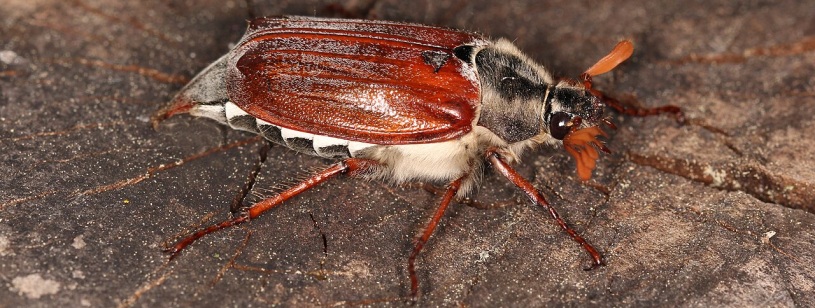
Common cockchafer (Melolontha melolontha) on bark. · Holger Krisp / CC BY 3.0 (https://creativecommons.org/licenses/by/3.0). Cropped and resized. Source: https://commons.wikimedia.org/wiki/File:Melolontha_melolontha_Gemeiner_Maik%C3%A4fer.jpg
The common cockchafer (Melolontha melolontha) is a brown beetle with fan-shaped antennae. Adults fly noisily on warm evenings and feed on leaves. Larvae spend several years underground eating roots. This account focuses on the species often called the May bug.
Quick facts
| Common name | Common cockchafer; May bug |
| Scientific name | Melolontha melolontha |
| Lifespan | Typically a 3–4-year cycle; active adult life around 5–6 weeks |
| Length | Adult approximately 2.5–3 cm |
| Appearance | Brown wing cases, white side triangles and fan-shaped antennae |
| Diet | Larvae: roots; adults: leaves and flowers |
| Predators | Birds including rooks, and animals searching soil for grubs |
| Conservation status | Widespread; Least Concern in the German national assessment |
| Distribution | Europe |
| Habitat | Grassland, farmland, gardens, parks and woodland edges |
| Family | Scarabaeidae |
| Reproduction | Eggs laid in soil; larva, pupa and adult stages |
Interesting facts
- Males have seven plates on each antennal fan; females have six smaller ones.
- Warm weather can bring adults out in April.
- Grubs are C-shaped with brown heads and three pairs of legs.
- The pointed end of the abdomen is not a sting.
Records and extremes
Active adult life lasts around five or six weeks, following years of underground development. Most of the life cycle remains hidden.
Some regions experience years with many adults. Synchronised development produces these peaks, with timing influenced by temperature and population.
Characteristics
Reddish-brown wing cases protect the flight wings. White triangles mark the sides of the abdomen and fine hairs cover the underside.
Antennal plates carry smell receptors. Males open their larger fans to detect environmental signals, including those from females.
Creamy grubs have soft bodies, hardened brown heads and short legs. Similar-looking larvae of other beetles require careful identification.
Behaviour
Adults fly mainly on warm evenings, producing a noticeable buzz. Lights attract them to lamps and windows.
Trees provide leaves and mating sites. Females return to soil to lay eggs. Grubs change depth with seasonal conditions.
Habitat and distribution
Widespread in Europe, the species uses landscapes combining suitable soil with food for adults. Meadows, orchards, parks and woodland edges can provide both.
Adults and larvae occupy different parts of the same landscape. Changes to vegetation or soil can affect development.
Diet and feeding
Larvae eat roots of grasses and other plants. Large populations can damage pasture or crops, causing poor growth or drying.
Adults consume leaves of oaks, beeches and fruit trees, supporting reproduction.
White grubs in compost may belong to other beetles. Some feed on dead plant matter and aid decomposition, so identification should precede control.
Reproduction and life cycle
Females lay dozens of eggs in soil. Larvae grow through moults and survive several winters underground.
Mature larvae pupate and transform. New adults remain below ground until the following spring. Egg, larva, pupa and adult form a complete metamorphosis.
Cycles commonly take three years in warmer regions and four in cooler ones. Weather also influences the timing of emergence.
Name and history
Linnaeus described the species in 1758. Melolontha melolontha belongs to Scarabaeidae, a family containing many beetles with lamellate antennae.
The name May bug reflects frequent spring sightings. Other chafers emerge later or differ in size; summer chafers are generally smaller.
Conservation and threats
The species remains widespread, with abundance varying between years and regions. Germany’s national assessment lists it as Least Concern.
Insecticides and habitat change can reduce numbers. Grubs and adults also feed birds and other wildlife. Damage assessments should identify the species and actual abundance.
Diverse garden vegetation supports relationships between prey and predators. An isolated adult at a light can be allowed to leave.
Frequently asked questions
Does it sting?
It has no sting. The pointed rear projection is part of the abdomen.
Why does it approach lamps?
Adults are attracted to light during evening flights.
Are all white grubs this species?
No. Several beetles have similar larvae, including decomposers.
How long is adult life?
Active life above ground lasts around five or six weeks.
What do larvae eat?
Roots of grasses and other plants underground.
How can the sexes be distinguished?
Males have seven larger plates per antennal fan; females have six.