Howler monkeyAlouatta — habitat, diet and reproduction
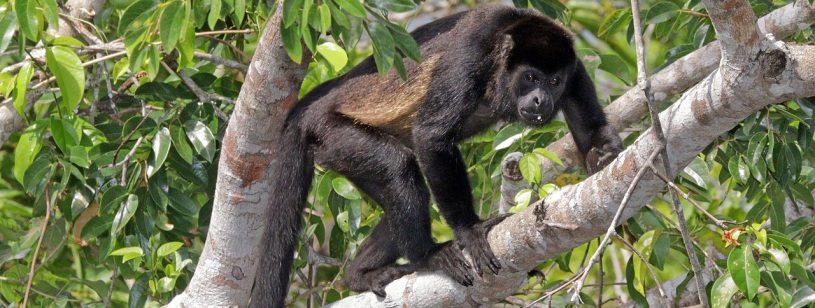
Howler monkey (Alouatta) on a branch. · Charles J. Sharp / CC BY-SA 4.0 (https://creativecommons.org/licenses/by-sa/4.0). Cropped and resized.
Howler monkeys are large monkeys of the American tropical forests, famous for their powerful calls. At dawn and dusk, groups roar to announce their territory, and the sound carries for several kilometres. They spend almost all their lives in trees, eating mostly leaves.
Quick facts
| Common name | Howler monkey |
| Scientific name | Alouatta (genus) |
| Lifespan | About 15–20 years |
| Length | Body about 56–92 cm, plus a tail of similar length |
| Weight | About 4–10 kg; males are heavier |
| Diet | Herbivore: leaves, fruit, flowers |
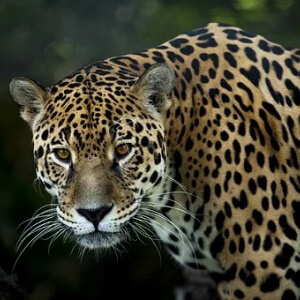
| Predators | Harpy eagles, jaguars, pumas |
| Conservation status | Varies: from Least Concern to Critically Endangered |
| Distribution | Southern Mexico to northern Argentina |
| Habitat | Humid and dry tropical forests, mangroves |
| Family | Atelidae |
| Lifestyle | In small groups in the forest canopy |
Interesting facts
- The howler monkey’s roar is considered the loudest call of any monkey.
- An enlarged bone in the throat works as a resonating chamber.
- The tail can support the monkey’s weight alone, like a fifth hand.
- They spend up to three-quarters of the day resting to save energy.
Characteristics
Howler monkeys have a sturdy body, thick neck and a beard, larger in males. Fur may be black, brown, red or golden, depending on species, and in some species males and females differ in colour.
The tail is prehensile, wrapping around branches, with a bare, touch-sensitive patch underneath near the tip. The throat holds a large, hollow hyoid bone.
Behaviour
They live in groups of 4–20 animals and roar mainly at dawn to tell other groups where they are, which helps avoid fights.
The rest of the day they are among the calmest monkeys, feeding and then resting on branches while digesting leaves. They move slowly through the canopy, using the tail for support.
Habitat and distribution
There are more than 10 species, from southern Mexico to northern Argentina, in humid and dry tropical forests, mangroves and riverside forests.
They cope with fragmented forests better than many monkeys because they can live on leaves.
Diet and feeding
Howler monkeys are among the few American monkeys that eat mostly leaves. They prefer young, more digestible leaves and add fruit, flowers and buds.
Leaves provide little energy, so they move little and sleep a lot. Gut bacteria help them break down plant fibre.
Reproduction and life cycle
The female usually has one infant after about six months of pregnancy. The infant clings to its mother’s fur, first on her belly, later on her back.
In some species, infants are born a different colour from adults. Young males and females often leave their birth group.
Name and history
The scientific name Alouatta comes from a word used by indigenous peoples of French Guiana. The common name describes the sound itself.
In Spanish it is called “mono aullador”, which also means “howling monkey”.
Conservation and threats
Status varies by species. Some are widespread, but the Guatemalan black howler and the Ecuadorian mantled howler are endangered.
Main threats include deforestation, hunting and yellow fever, which killed many howlers in Brazil.
Frequently asked questions
How far can a howler monkey be heard?
In the forest, the roar can carry several kilometres, up to about 5 km.
Why do howler monkeys howl?
To tell other groups where they are and defend their territory without fighting.
What do howler monkeys eat?
Mostly leaves, plus fruit, flowers and buds.
Are howler monkeys dangerous?
No. They are calm monkeys that avoid people; the roar only sounds threatening.