SiameseCharacteristics, history, behaviour and care
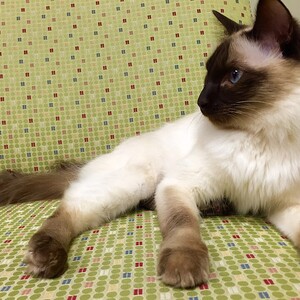
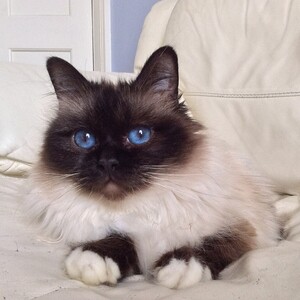
Siamese cat. · Eric Sonstroem / Wikimedia Commons, CC BY 2.0 (https://creativecommons.org/licenses/by/2.0). Cropped and resized.
The Siamese is one of the first recognised cat breeds. It descends from the Wichianmat cats of Thailand, called Siam until 1939. It has almond-shaped blue eyes, a triangular head, large ears and a long, slender body, with a light coat and darker “points” on the face, ears, legs and tail. It is affectionate, intelligent and very talkative.
Quick facts
| Common name | Siamese (Wichianmat in Thailand) |
| Scientific name | Felis catus |
| Country of origin | Thailand (Siam) |
| Official recognition | FIFe since 1949 (code SIA, category 4); all the major associations |
| Lifespan | 11.7 years on average (British study) |
| Weight | 2–6 kg (females 3–4 kg, males 4–5 kg) |
| Size | Medium |
| Body type | Long, tubular, slender and muscular, long neck |
| Coat type | Short, fine, glossy, without undercoat |
| Common colours | Pointed pattern: seal, blue, chocolate, lilac, red, cream, tabby, tortie |
| Eye colour | Blue, almond-shaped |
| Activity level | High |
| Temperament | Affectionate, intelligent, sociable, very talkative |
| Good with children | Good for families |
| Good with other pets | Sociable with other cats |
| Genetic predispositions | Progressive retinal atrophy, tumours (especially mammary), digestive problems |
- Primary category:Cat breeds
- Explore this animal's categories:
History and origin
Wichianmat cats are described and illustrated in the Thai manuscripts Tamra Maew (“The Cat-Book Poems”), from the period of the Ayutthaya kingdom (1351–1767). A legend says that after the Burmese conquered the capital in 1767, their king read the poem and took all the cats with him, like treasure.
In 1878, US President Rutherford B. Hayes received the first documented Siamese in the USA, called “Siam”. In 1884, the British consul in Bangkok, Edward Blencowe Gould, brought a pair, Pho and Mia, to Britain for his sister. Their kittens were shown in 1885 at the Crystal Palace show.
In the nineteenth century it was one of the most popular breeds in Europe and North America. Around 1950, breeders began to prefer a slimmer, more angular body; the traditional, rounder type became a separate breed: the Thai.
How the breed developed
- 1351–1767 – described in the Tamra Maew manuscripts.
- 1878 – the first documented Siamese in the USA, with President Hayes.
- 1884–1885 – the first Siamese in Britain, at the Crystal Palace.
- 1901 – the Siamese Cat Club is founded.
- 1949 – recognised by FIFe.
- The 1950s – the modern, slender type takes over.
At a glance: who is it right for?
- People who spend a lot of time at home. It always wants to be close to people.
- People who want a cat that “talks”. It is very communicative.
- Homes with another cat. German Wikipedia says it has strong social behaviour.
- People who want a cat that learns. It comes when called and quickly understands what is not allowed.
Physical characteristics
The modern standard calls for a long, tubular, muscular body, a long neck and a thin tail. German Wikipedia gives 3–4 kg for females and 4–5 kg for males.
General appearance
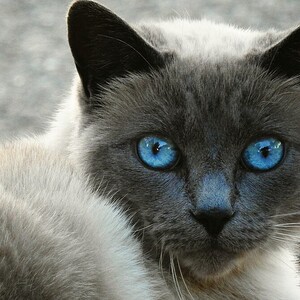
The head forms a triangle from the tip of the nose to the tip of each ear. The eyes are almond-shaped and light blue, and the ears are large, broad at the base and set towards the sides. Many cats in Thailand had a kink at the tip of the tail; breeders eliminated it around 1950, but Thai street cats still have it.
| Feature | Siamese |
|---|---|
| Size | Medium |
| Weight | 2–6 kg |
| Body | Long, tubular, slender |
| Head | Triangular |
| Ears | Large, broad at the base |
| Eyes | Almond-shaped, blue |
| Coat | Short, fine, without undercoat |
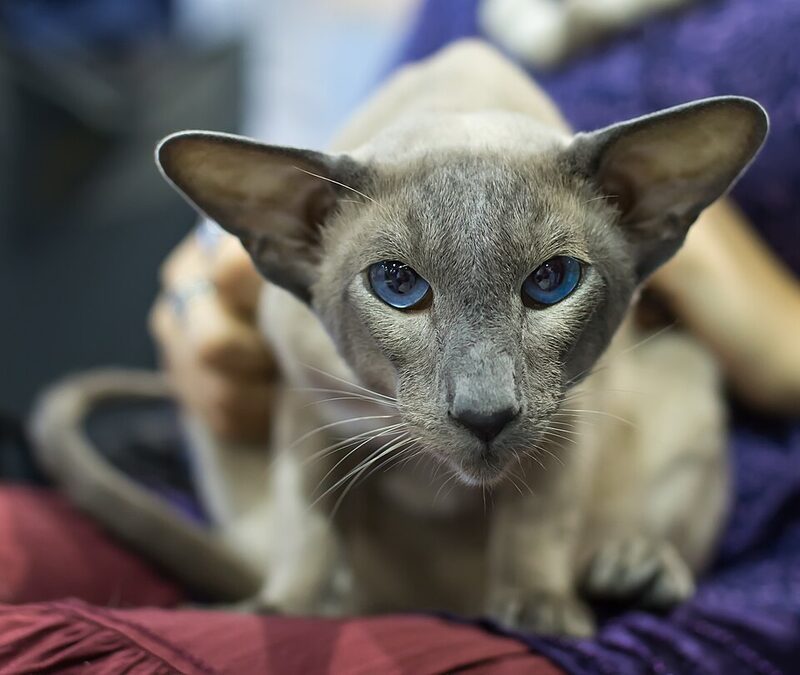
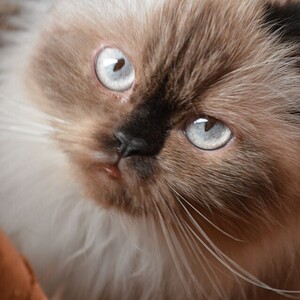
The pointed pattern is a form of partial albinism: the enzyme that produces colour works only in the cooler parts of the body, below 33 °C. That is why the face, ears, paws and tail are darker. Siamese cats darken with age, and those in warm climates have a lighter coat. Kittens are born white or cream, and the colour of the points shows at about 4 weeks.
Related breeds and how to tell them apart
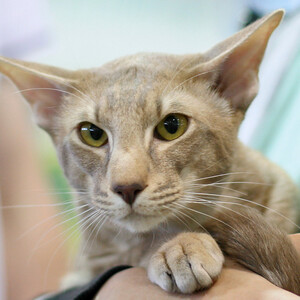
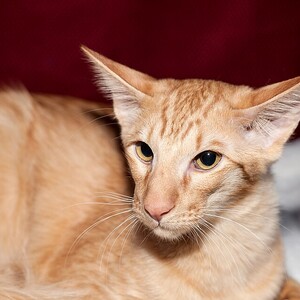
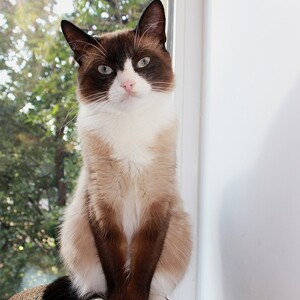
The Thai is the traditional, rounder type of Siamese. The Balinese is the semi-longhaired Siamese. The Oriental Shorthair has the same body, but colours without points and green eyes.
Behaviour and temperament
Wikipedia says Siamese cats are usually very affectionate and intelligent, known for their sociable nature; many are described as “extroverts”. They often bond strongly with a single person. Myrna Milani describes them as more active by day, closer to their owner and less given to hunting than other cats.
French Wikipedia says some people even “have conversations” with their Siamese: it can be very communicative. It comes when called and quickly understands what it is not allowed to do.
Socialisation
German Wikipedia says Siamese cats have strong social behaviour and an intense group life, with mutual grooming.
A kitten gets used to new people, noises and other animals most easily in its first months of life.
Habits at home
Like all cats, it sleeps a lot: usually 12–16 hours a day. It is most active early in the morning and in the evening, but partly adapts to the family's routine.
Cats instinctively bury their droppings, so it quickly learns to use a litter tray. It scratches rough surfaces to shed the old outer layer of its claws, so it needs a scratching post or board.
Life at home and activity
It is an active, playful cat that needs daily play and company.
| Activity | How often | Why it matters |
|---|---|---|
| Playing together with its owner | daily | It is very attached to people |
| Play with toys (wand toys, balls) | daily | Play imitates hunting and uses up its energy |
| Scratching post or board | always available | It looks after its claws without damaging the furniture |
| High places (cat tree, shelves) | always available | It has somewhere to watch from and to rest |
Tips for a balanced life
- Change its toys from time to time, so it does not get bored.
- Play with it in short sessions, several times a day.
- If it goes outside, let it do so in a fenced area or on a balcony with a safety net.
Care and health
Coat care
The short, fine coat without undercoat is very easy to look after: a weekly polish with your hand or a grooming glove is enough.
Common health problems
A British study found a life expectancy of 11.7 years, close to the average for all cats. Insurance data from Sweden, however, show higher mortality in the Siamese and related breeds, mainly from tumours (especially mammary), and more digestive problems.
The same gene that produces the points creates unusual connections between the eyes and the brain; many older Siamese were cross-eyed to compensate. The breed is also predisposed to progressive retinal atrophy.
| Condition | Description | Common symptoms |
|---|---|---|
| Progressive retinal atrophy | The retina gradually degenerates | Sees worse and worse, especially in the evening |
| Mammary tumours | Tumours of the mammary glands, especially in unspayed females | Lumps under the skin, on the belly |
Recommended genetic tests
German Wikipedia says that, like Abyssinians, Siamese cats are affected by progressive retinal atrophy, which has genetic causes. Ask the breeder whether the parents have been tested and had their eyes checked. Spaying females in good time lowers the risk of mammary tumours.
Is it hypoallergenic?
Cat allergy is caused mainly by the Fel d 1 protein, found in saliva and skin glands; it is behind the allergy in 90% of people who are allergic to cats. Kittens, females and neutered males produce less of it, but still enough to trigger symptoms. No breed is completely hypoallergenic.
The Siamese is among the breeds said to cause milder allergic reactions. However, research on whole breeds is not complete, so someone with allergies should spend time with the cat before taking it home.
Other care
- A check-up at the vet once a year.
- Vaccinations and parasite treatment on the schedule set by the vet.
- Trim the claws if they do not wear down on their own.
- Clean its teeth or give it food that helps keep them clean.
Diet and nutrition
The cat is a carnivore: it needs animal protein. Unlike a dog, it must get vitamin A, arachidonic acid and taurine from its food. Water is very important, because cats usually drink little; several water bowls around the house encourage it to drink.
Tips for a healthy diet
The table gives a starting estimate, calculated with the formula from the Merck Veterinary Manual for a healthy adult cat. The last column shows what this means in dry food with 3,500–4,000 kcal per kilogram. If you also feed wet food, reduce the dry portion.
| Cat's weight | Calories per day (neutered) | Calories per day (not neutered) | Dry food per day (approximate) |
|---|---|---|---|
| 2.5 kg | 170 kcal | 190 kcal | 42–54 g |
| 3 kg | 190 kcal | 220 kcal | 48–63 g |
| 4 kg | 240 kcal | 280 kcal | 60–80 g |
| 5 kg | 280 kcal | 330 kcal | 70–94 g |
- Adjust the portion to its weight: neutered cats put on weight easily.
- Weigh it monthly; the ribs should be easy to feel under your fingers.
- Kittens need more calories: Merck recommends 2.5 times the resting energy requirement.
Dangerous foods and substances
Some common household items are dangerous for cats:
- Lilies (and daylilies): they can destroy a cat's kidneys. Even the pollen or the water in the vase is dangerous.
- Paracetamol: extremely toxic to cats, which lack the enzyme that breaks it down. Never give it human medicines.
- Flea spot-ons and collars for dogs containing permethrin: the concentration meant for dogs is dangerous for cats.
- Foods: chocolate, coffee, alcohol, onions, garlic, grapes and raisins.
Reproduction and development
Maturity
Females usually reach sexual maturity at 5–10 months, and males at 5–7 months. The age varies from breed to breed.
Mating and pregnancy
Pregnancy in cats lasts 64–67 days, 65 on average. A first litter usually has fewer kittens than later ones. Only healthy cats that match the breed standard are used for breeding.
Blood type
Cats have blood type A, B or AB. Type A is the most common: in a study from England, 87.1% of non-pedigree cats and 54.6% of pedigree cats had type A. This matters for breeding: if the mother is type B and the kittens are type A, the antibodies in her first milk (colostrum) can destroy their red blood cells. The condition is called neonatal isoerythrolysis. That is why breeders test the blood type of both parents.
We found no published data on how common type B is in this breed; the test is done before mating anyway.
Caring for the kittens
Kittens are weaned at 6–7 weeks. They are ready to go to their new home at about 12 weeks, when they can be separated from their mother.
Neutering
Neutering used to be done at 6–9 months, but it is more and more often done before puberty, at around 3–6 months. It prevents unwanted kittens, urine marking in males and the loud “calling” of females in heat. A 2024 study found that neutered cats live one year longer on average. After the operation, the metabolism slows down and appetite increases, so the portion has to be reduced.
How to choose a kitten
- Ask for the pedigree from a recognised cat association (for example, a FIFe member).
- The kitten leaves its mother at about 12 weeks.
- Ask about the parents' genetic tests and eye checks.
- Look at the mother and at the place where the kittens are raised: it should be clean, with kittens used to people.
- Ask about vaccinations, parasite treatment and the blood type of the parents.
Interesting facts
- Cross-eyed. Many older Siamese were cross-eyed because of unusual connections between the eyes and the brain; today it is rare.
- The coat darkens with age. The colour depends on temperature: Siamese cats darken as they get older.
- Good hearing. Unlike many white cats with blue eyes, the Siamese does not have poor hearing.
- A spoil of war. A legend says the king of Burma took all the Wichianmat cats as plunder, in 1767.
In popular culture
In film
In the Disney film “Lady and the Tramp” (1955), the song “We are Siamese if you please” is sung by two Siamese cats, Si and Am, named after the old name of Thailand. In the film “Bell, Book and Candle” (1958), Pyewacket, the cat of the witch played by Kim Novak, is a Siamese.
In books
The novel “The Incredible Journey” (1961) by Sheila Burnford tells the story of three animals, among them the Siamese cat Tao, who travel 480 km through the Canadian wilderness to find their owners.
Frequently asked questions
Why are its face and legs darker?
Because of an enzyme that produces colour only in the cooler parts of the body.
Does it meow a lot?
Yes, it is very communicative and “talkative”.
How is it different from the Thai?
The modern Siamese is slimmer and more angular; the Thai keeps the old, rounder type.
How much does it weigh?
Females 3–4 kg, males 4–5 kg.
How long does it live?
A British study found 11.7 years on average.