BumblebeeInteresting facts and information
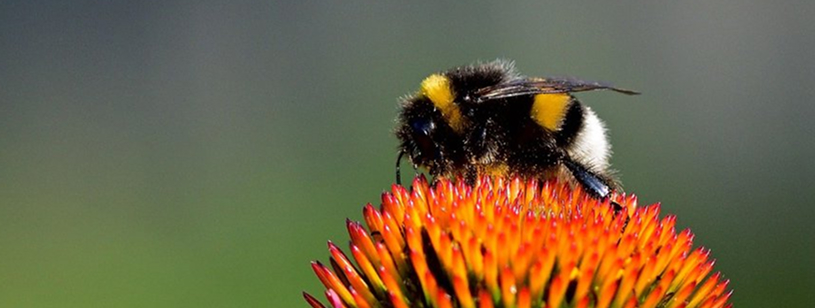
Bumblebees (Bombus) are hairy-bodied bees in the family Apidae. They visit flowers for nectar and pollen and pollinate many wild plants and crops. Different bumblebee species have different ranges, life cycles and conservation needs.
Bumblebees can use their flight muscles to vibrate flowers and release pollen, a process called buzz pollination. During this process they may hold their wings still rather than beat them against the flower.
Habitat loss, pesticides, climate change and other pressures affect some bumblebee species. The extent of decline differs between species and regions.
Quick facts
| Common name | Bumblebee |
| Scientific name | Bombus |
| Typical lifespan | A few weeks (workers) up to about one year (queens) |
| Maximum speed | Varies with species or individual, distance and conditions |
| Dimensions | About 1 - 3 cm long (queens of the largest species up to about 4 cm) |
| Weight | About 0.1 g (workers) up to about 0.6 g or more (queens) |
| Diet type | Nectar and pollen |
| Main predators | Birds, wasps, spiders, robber flies; badgers and other mammals dig up nests |
| Conservation status | Assess separately by species; some bumblebees are threatened, while others are widespread |
| Habitat | Meadows, gardens, woodland edges, tundra, alpine regions |
- Primary category:Insects
- Explore this animal's categories:Animals of AfricaAnimals of AsiaAnimals of AustraliaAnimals of EuropeAnimals of North AmericaAnimals of Romania’s gardens and parksAnimals of Romania’s grasslands and plainsAnimals of South AmericaAnimals that live in groupsArthropodsBEgg-laying animalsFlying animalsInsectsInsects of RomaniaInvertebratesNectar-feeding animalsPollinating insects
Interesting facts
- Flying in the cold - Bumblebees can warm themselves up by "shivering" their flight muscles, so they can fly on cool days when many other insects cannot, which makes them important pollinators in cold regions.
- Buzz pollination – Vibrating the flight muscles helps release pollen from certain flowers; it is not simply the action of beating the wings.
- A good memory - Bumblebees learn which flowers are rewarding and remember routes between them.
- Flight – Bumblebee wings generate lift through moving-wing aerodynamics. Their flight does not break physical laws.
- Seasonal colonies – In many temperate species, new queens survive winter while the old colony dies. Life cycles differ in other climates and in cuckoo bumblebees.
- "Nectar robbing" - Some bumblebees bite a hole near the base of a long flower and drink the nectar without pollinating it.
- Pollination – Bumblebees are valuable pollinators, including for greenhouse crops. No universal five-times-faster comparison with honeybees is claimed.
Records and remarkable features
- Large bumblebees – The South American species Bombus dahlbomii is a large bumblebee.
- High flyers - The Himalayan bumblebee Bombus impetuosus lives at altitudes above 5,000 metres, and in experiments some could still fly in air as thin as at about 9,000 metres.
- Bumblebee flight speed depends on species and conditions; a universal fastest-pollinator ranking is not appropriate.
- Tomato pollinators - Because of buzz pollination, bumblebees are bred in large numbers and used to pollinate tomatoes in greenhouses.
- Long-lived queens - Queens can live for about a year, while workers usually live only a few weeks.
Physical characteristics and adaptations
Bumblebees are sturdy, hairy bees with a fluffy appearance. They are usually larger and rounder than honeybees and can keep their bodies warm, which helps them fly in cool weather.
Body structure
- Head and antennae - Bumblebees have long antennae that detect the scents of flowers and of other bees.
- A hairy body - The dense hair collects pollen and keeps the bumblebee warm in cold conditions.
- Small but powerful wings - Their wings beat very fast, about 130-240 times a second, and create swirling air currents that give them lift.
- Pollen baskets - Queens and workers have "pollen baskets" (corbiculae) on their hind legs, used to carry pollen back to the nest.
Special adaptations for flight and survival
- Warming up - Bumblebees can produce heat by contracting their flight muscles without moving their wings, so they can fly in cold weather.
- Long tongues - Many species have long tongues that reach nectar deep inside flowers such as clover and foxglove.
- Stings – Females have a sting and can sting more than once; males do not. A sting can be dangerous, particularly for someone with an allergy.
Habits and behaviour
Most bumblebees are social insects that live in colonies founded each spring. Their colonies are much smaller than those of honeybees, usually with tens to a few hundred bees, and in temperate regions they die out in late summer or autumn.
Colony structure
| Individual type | Role |
|---|---|
| Queen | Usually the main egg-layer in a social colony; workers can also lay unfertilised eggs in some circumstances |
| Workers | Collect pollen and nectar, feed the larvae and look after the nest. |
| Males (drones) | Leave the nest to mate with new queens; they die before winter. |
- The queen starts the colony alone - In early spring, the queen comes out of hibernation and looks for a nest site, such as an old mouse nest, a hole in the ground or a tussock of grass.
- Workers run the nest - They collect pollen and nectar, feed the larvae and keep the brood warm.
- Males do not work - Their role is to mate with new queens.
Communication and navigation
- Scent signals (pheromones) - Queens and workers use scents to coordinate the colony, and bumblebees leave scent marks on flowers they have already visited.
- Memory - Bumblebees remember where good flowers are and return to them.
- Waking the nest - A successful forager runs around excitedly in the nest, which encourages other workers to go out.
Habitat and geographic distribution
Bumblebees are native mainly to the Northern Hemisphere and South America. They live in meadows, forests, gardens, tundra and mountains, and some species have been introduced to Australia and New Zealand.
Geographical distribution
| Region | Notable species |
|---|---|
| North America | Bombus pensylvanicus, Bombus affinis |
| Europe | Bombus terrestris, Bombus lapidarius |
| Asia | Bombus impetuosus, Bombus haemorrhoidalis |
| South America | Bombus dahlbomii (giant Patagonian bumblebee) |
| Australia and New Zealand | Introduced species, such as Bombus terrestris |
Adaptations to habitat
- Arctic and alpine bumblebees - Thick hair and the ability to produce heat help them survive in the cold; some live in the Arctic.
- Woodland bumblebees - Some species prefer woodland edges and clearings with plenty of flowers.
- Urban bumblebees - Many species live in gardens and parks, where they pollinate flowers and vegetables.
Diet and feeding
Bumblebees feed on nectar, which gives them energy, and pollen, which provides protein for the larvae. They visit many flowers and are among the most important pollinators.
What do bumblebees eat?
| Food type | Examples |
|---|---|
| Nectar | Lavender, clover, sunflowers, blueberries |
| Pollen | Clover, willow, bramble, tomato flowers |
| Stored nectar ("honey") | Small amounts kept in wax pots in the nest, much less than in honeybee hives |
| Larval food | Pollen mixed with nectar, fed to the larvae |
Special feeding methods
- Buzz pollination - Bumblebees grab a flower and vibrate their flight muscles to shake out pollen, for example from tomatoes and blueberries.
- Nectar robbing - When a flower's tube is too long, some bumblebees bite a hole near its base and take the nectar without pollinating it.
- Choosing flowers - They learn which flowers give the most nectar and pollen at different times of the season.
Reproduction and life cycle
In temperate regions, a bumblebee colony lasts only one season. Only the young, mated queens survive the winter and start new colonies the next spring.
Life Cycle Stages
| Stage | Description |
|---|---|
| Spring (new colony) | The queen comes out of hibernation and looks for a nest site. |
| Colony founding | The queen lays her first eggs, which develop into workers. |
| Colony growth | Workers collect food, while the queen keeps laying eggs. |
| New males and queens | Later in the season, the colony produces males and new queens, which leave to mate. |
| End of the colony | In autumn, the old queen, the workers and the males die; only the new queens hibernate. |
Mating and egg laying
- Mating behaviour differs between species and individuals.
- Mated queens store sperm and use it the next spring to fertilise their eggs.
- Temperature and the amount of flowers affect how well a colony grows.
- Cuckoo bumblebees do not make their own colonies: their females take over the nests of other bumblebees.
Name and history
Bumblebees have long been familiar insects and are today studied for their importance to farming and nature.
Origin of name
- "Bumblebee" comes from the Middle English verb bomblen, "to buzz" or "to boom"; an older English name was "humble-bee".
- The scientific name Bombus comes from Latin and means "buzzing" or "booming".
Taxonomic Classification
| Kingdom | Animalia |
|---|---|
| Phylum | Arthropoda |
| Class | Insecta |
| Order | Hymenoptera |
| Family | Apidae |
| Genus | Bombus |
History and discovery
- Carl Linnaeus described several bumblebee species, such as Bombus terrestris, in 1758; the genus Bombus was named in 1802.
- Charles Darwin wrote that the number of "humble-bees" affects how well red clover is pollinated, an early example of connections in nature.
- There are about 250 known species of bumblebees.
Cultural significance and mythology
A familiar claim about bumblebees says that they should be unable to fly. This is a misconception about aerodynamics, not a biological fact.
Bumblebees in science and folklore
- The idea that bumblebees defy the laws of flight is a myth. Moving insect wings generate lift in ways that simple fixed-wing comparisons do not capture.
- "Dumbledore" - An old English dialect word for bumblebee, used by J. K. Rowling for the headmaster of Hogwarts.
- Darwin's chain - Darwin suggested that more cats meant fewer mice, fewer destroyed bumblebee nests and more clover, a famous example of how species are connected.
Conservation status and threats
Bumblebees play a vital role in ecosystems, but many species have declined because of habitat loss, pesticides, disease and climate change.
Main threats
- Pesticides - Some insecticides, such as neonicotinoids, can harm bumblebees' navigation, learning and colony growth.
- Habitat loss - Intensive farming and building reduce the variety of flowers and nest sites they need.
- Climate change - Warmer temperatures have caused some species to disappear from the hottest parts of their range.
- Disease and parasites – Nosema bombi is a parasite associated with bumblebees; disease is one of several pressures on populations.
Species of endangered bumblebees
| Species | Status |
|---|---|
| Bombus affinis (rusty patched bumblebee) | Critically Endangered (IUCN); listed as endangered in the USA since 2017 |
| Bombus franklini (Franklin's bumblebee) | Critically Endangered; not seen since 2006 and possibly extinct |
| Bombus dahlbomii (giant Patagonian bumblebee) | Endangered; declining after the arrival of introduced bumblebees |
Conservation efforts
- Pesticide rules - The European Union has restricted the outdoor use of several neonicotinoid insecticides.
- Pollinator-friendly gardens - Planting native flowers provides food from spring to autumn.
- Research and reintroduction - Scientists study bumblebee diseases, and in England the short-haired bumblebee was reintroduced after it became extinct there.
In popular culture
Bumblebees have inspired music, books and famous characters.
Bumblebees in music and books
- Nikolai Rimsky-Korsakov’s Flight of the Bumblebee is a musical passage from The Tale of Tsar Saltan.
- Beatrix Potter - In "The Tale of Mrs. Tittlemouse" (1910), the bumblebee Babbitty Bumble moves into Mrs. Tittlemouse's house.
Bumblebees in films and animations
- "Bumblebee" (2018) - A film about the yellow Transformers robot Bumblebee, one of the best-known characters of the franchise.