GazelleGazella — habitat, diet and reproduction
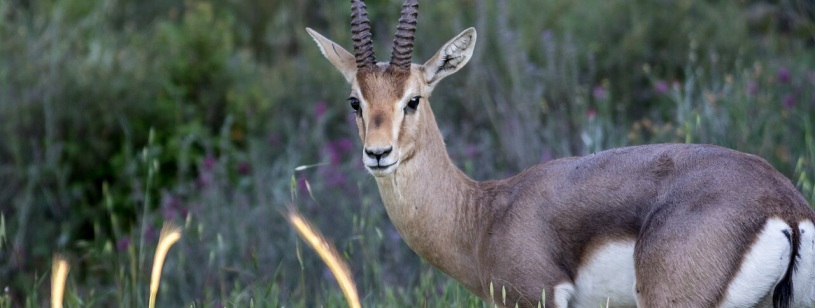
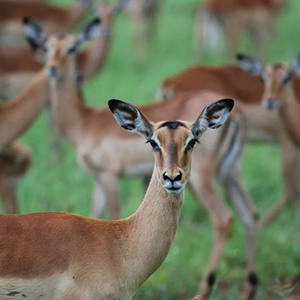
Gazelle (Gazella) in its natural habitat. · מינוזיג - MinoZig / CC BY-SA 4.0 (https://creativecommons.org/licenses/by-sa/4.0). Cropped and resized.
Gazelles are small, slender antelopes with long legs and ringed horns. They live in herds in the savannas, steppes and deserts of Africa and Asia. They are very fast and bounce high on stiff legs when they spot a predator.
Quick facts
| Common name | Gazelle |
| Scientific name | Gazella; plus the related genera Eudorcas and Nanger |
| Lifespan | About 10–12 years in the wild |
| Height | About 60–110 cm at the shoulder, depending on species |
| Weight | About 12–85 kg, depending on species |
| Diet | Herbivore: grasses, leaves, shoots |
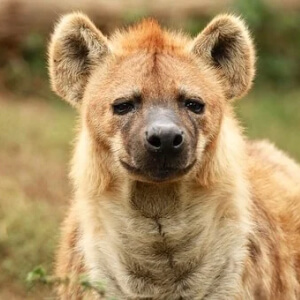
| Predators | Cheetahs, lions, leopards, hyenas, African wild dogs; jackals take fawns |
| Conservation status | Varies: some species Vulnerable or Critically Endangered |
| Distribution | Africa, the Middle East, Central Asia and India |
| Habitat | Savannas, steppes, semi-deserts and deserts |
| Family | Bovidae |
| Lifestyle | In herds |
Interesting facts
- Thomson’s gazelle can reach about 80–90 km/h over short distances.
- When they spot a predator, gazelles leap high on all four legs, showing they are fit.
- Many desert gazelles can live without drinking, getting water from plants.
- Thomson’s gazelle, the best-known gazelle, is now placed in the genus Eudorcas.
Characteristics
Gazelles have a light body, long neck and slender legs. Fur is usually light brown or sandy above and white below, and many species have a dark side stripe and facial stripes.
Horns are ringed and curved, often lyre-shaped. In many species females also have horns, but shorter and thinner.
Behaviour
Gazelles live in herds from a few animals to hundreds. Adult males defend territories in the breeding season and fight with their horns.
When they spot a predator, they make high, stiff-legged leaps with an arched back. This “stotting” may tell the predator it has been seen and that a chase is pointless.
Habitat and distribution
Gazelles live in Africa, especially the eastern savannas and the Sahara region, and in the Middle East, Central Asia, Mongolia and India.
Some species inhabit grassy savannas, others stony or sandy deserts.
Diet and feeding
Gazelles eat grasses, leaves, shoots, flowers and buds. In the rainy season they prefer fresh grass, in the dry season more shrub leaves.
Desert species can go long periods without water, grazing at night or early morning when plants hold more moisture from dew.
Reproduction and life cycle
Females usually give birth to a single fawn after five to six months of pregnancy. The fawn lies hidden and still in the grass for its first weeks while the mother grazes nearby.
With little scent, the fawn is hard for predators to find. After a few weeks it joins the herd.
Name and history
The word “gazelle” comes from the Arabic “ghazal”. In Arabic and Persian poetry the gazelle symbolised beauty and grace, and “ghazal” also became the name of a poetic form.
Scientists now divide gazelles into several genera: Gazella, Eudorcas and Nanger.
Conservation and threats
Status varies greatly. Some species, such as Thomson’s gazelle, are still numerous, but others are endangered, and the Saharan dama gazelle is Critically Endangered.
Main threats include hunting, overgrazing by livestock, desertification and war. Many species now survive only in protected areas or breeding programmes.
Frequently asked questions
How fast can a gazelle run?
Thomson’s gazelle can reach about 80–90 km/h over short distances.
What do gazelles eat?
Grasses, leaves, shoots and flowers; desert species get water from plants.
Can a gazelle escape a cheetah?
Sometimes. The cheetah is faster but tires quickly, and the gazelle can change direction suddenly.
Where do gazelles live?
In the savannas and deserts of Africa, the Middle East, Central Asia and India.