European goldfinchCarduelis carduelis — habitat, diet and reproduction
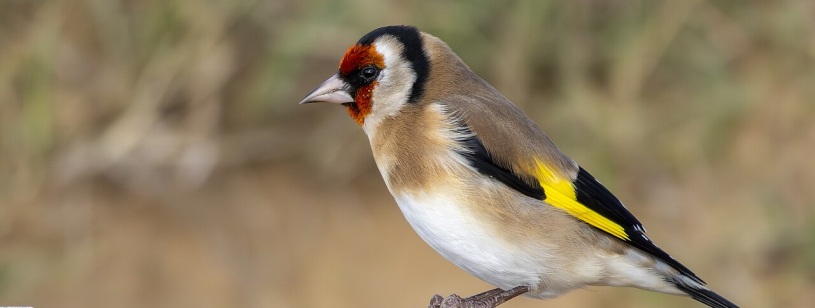
European goldfinch (Carduelis carduelis) perched on a wooden post. · Alexis Lours / CC BY 4.0 (https://creativecommons.org/licenses/by/4.0). Cropped and resized. Source: https://commons.wikimedia.org/wiki/File:European_Goldfinch_Saint-Jean-de-Monts.jpg
The European goldfinch (Carduelis carduelis) is a small finch with a red face and bright yellow wingbar. Its fine bill extracts seeds from thistles. It feeds in open areas with seed-bearing plants and nests in trees or shrubs.
Quick facts
| Common name | European goldfinch |
| Scientific name | Carduelis carduelis |
| Lifespan | BTO estimates around 2 years for birds reaching breeding age; some reach 10 years |
| Length | 12–13 cm |
| Weight | Around 16 g in BTO data; varies between individuals |
| Diet | Mainly seeds, with small invertebrates especially during breeding |
| Predators | Sparrowhawks; eggs and chicks face other predators |
| Conservation status | Least Concern globally |
| Distribution | Europe, North Africa and western Asia; introduced elsewhere |
| Habitat | Orchards, gardens, parks and open land with trees and seed-bearing plants |
| Family | Fringillidae |
| Reproduction | Often two broods annually; commonly 4–6 eggs |
Interesting facts
- Juveniles lack the adult red face but already show the yellow wingbar.
- They can hang upside down while extracting seeds.
- Their social calls help maintain contact in a flock.
- Carel Fabritius painted The Goldfinch in 1654.
Records and extremes
The BTO ringing database records an individual reaching 10 years and two days. This exceeds the typical lifespan estimated from survival data.
Outside breeding, goldfinches can gather in large flocks. Romanian sources describe groups of several hundred birds where food is abundant.
Characteristics
Adults combine a red face, white cheeks and black crown. The back is pale brown and the dark wings carry a bright yellow band.
The sexes look similar. Juveniles have brownish heads without the full adult facial pattern. They are smaller and finer-billed than house sparrows.
Behaviour
Goldfinches are sociable, keeping contact through frequent calls. Song includes rapid notes and trills, while their flight follows an undulating path.
They cling to stems and adjust their posture to reach seeds. Many remain in Romania year-round, while winter movements depend on weather and food. Some European populations migrate south.
Habitat and distribution
The natural range includes Europe, North Africa and western Asia. Introduced populations occur elsewhere, including New Zealand, where birds were brought from Britain in the nineteenth century.
Orchards, parks, gardens and woodland edges combine nesting cover with feeding areas. Rough ground with seed-bearing plants is especially useful.
Diet and feeding
Seeds form the main diet, including those of thistles, dandelions and other herbaceous plants. The pointed bill reaches between structures surrounding the seeds.
Small invertebrates supplement the diet, particularly during breeding. Standing dead seedheads can continue providing food into the colder months.
Reproduction and life cycle
The compact cup nest is woven from plant fibres and lined with soft material. It sits among branches and foliage, and a clutch commonly contains 4–6 eggs.
The female incubates for around 12–14 days while the male supplies food. Both adults contribute to feeding the young.
Chicks leave the nest at roughly two weeks, with some variation, and remain dependent afterwards. Favourable conditions allow a second brood.
Name and history
Carduelis is related to the Latin carduus, referring to thistles. Linnaeus described the species in 1758.
Carel Fabritius’s 1654 painting The Goldfinch, held by the Mauritshuis, shows a bird perched by its feeding box. The chain around its leg reflects the historical practice of keeping these birds in captivity.
Conservation and threats
The species is globally Least Concern, although local trends differ. Habitat loss and removal of seed-bearing vegetation can reduce food and nesting opportunities.
The Romanian Ornithological Society documents capture for cages as a conservation concern. Retaining wild vegetation, shrubs and trees supports free-living birds.
Watching wild goldfinches reveals their song, seed-feeding techniques and flock behaviour.
Frequently asked questions
Can a goldfinch without a red face be a juvenile?
Yes. Young birds have brownish heads but retain the yellow wingbar.
Why do they visit thistles?
The plants supply seeds reached with the fine bill.
Do all European goldfinches migrate?
Many remain year-round, while others move according to weather, food and population.
Is a goldfinch the same as a canary?
They are different finch species; adult European goldfinches have the characteristic red, black and white face.
Can they visit gardens?
Gardens with trees, shrubs and seed-bearing plants can attract them.
What does Fabritius’s painting show?
A goldfinch chained by its foot beside a feeding box, painted in 1654.