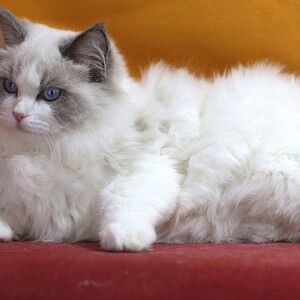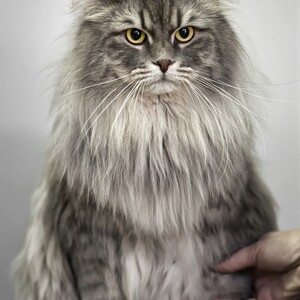
SiberianCharacteristics, history, behaviour and care
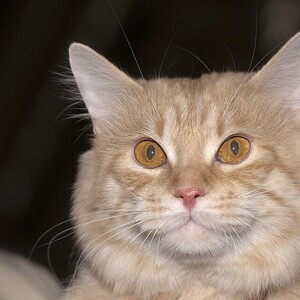
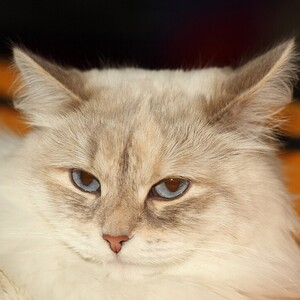
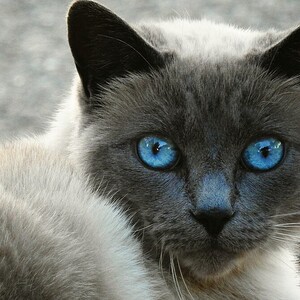
Siberian cat at a cat show. · Heikki Siltala / Wikimedia Commons, CC BY 3.0 (https://creativecommons.org/licenses/by/3.0). Cropped and resized.
The Siberian (the “Siberian Forest Cat”) is a natural breed from Russia, known for centuries and declared Russia's national cat. It is large, strong and rounded, with a dense, waterproof triple coat and a bushy tail. The FIFe profile describes it as friendly, curious, intelligent and very attached to its owner.
Quick facts
| Common name | Siberian (Siberian Forest Cat) |
| Scientific name | Felis catus |
| Country of origin | Russia (Siberia) |
| Official recognition | FIFe since 1997 (code SIB, category 2); WCF since 1991; TICA, CFA, GCCF |
| Lifespan | 15–20 years (French Wikipedia) |
| Weight | 4.5–9 kg on average; females much smaller |
| Size | Medium to large |
| Body type | Strong, barrel-shaped, rounded |
| Coat type | Semi-long to long, triple, very dense, waterproof |
| Common colours | Many colours; no chocolate, cinnamon, lilac, fawn or point |
| Eye colour | All colours; clear colours preferred |
| Activity level | High |
| Temperament | Friendly, curious, intelligent, playful, attached to its owner |
| Good with children | Good for families |
| Good with other pets | Sociable; best not kept alone |
| Genetic predispositions | A healthy breed; possible polycystic kidney disease and cardiomyopathy (from crosses) |
- Primary category:Cat breeds
- Explore this animal's categories:
History and origin
Siberian forest cats have long lived in Russia's dense forests. They appear in Slavic folk tales, folklore and art from as early as the tenth century. The FIFe profile says the breed's genetic base was formed by the whole history of cats in Russia, from the first contacts with Byzantium and Persia.
Russian semi-longhaired cats already took part in the first cat shows, in the nineteenth century. As a formal breed, the Siberian is relatively new: it was introduced to the world in the late 1980s. WCF recognised it in 1991, TICA in 1996 (championship), FIFe in 1997, and since 2006 it has been recognised by all the major associations.
How the breed developed
- Tenth century – appears in Slavic tales and art.
- Nineteenth century – Russian semi-longhaired cats at the first shows.
- Late 1980s – reaches the rest of the world.
- 1991 – recognised by WCF.
- 1997 – recognised by FIFe.
- 2024 – the fourth most popular breed at FIFe.
At a glance: who is it right for?
- Active families. It wants to take part in everything that happens at home.
- Large homes or homes with a fenced garden. German Wikipedia says it needs space and a tall, stable scratching tree.
- Homes with another cat. It should not be kept alone.
- People with mild allergies, with caution. It produces less Fel d 1, but this is not guaranteed.
Physical characteristics
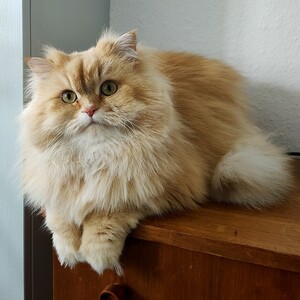
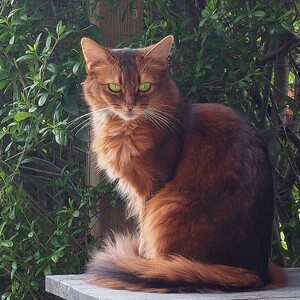
The FIFe profile describes it as medium to large and strong, one of the 10 largest breeds. Roundness and the absence of extremes are essential. The body is barrel-shaped, and its broad, solid stance has been compared to a bulldog's. Females are much smaller than males; adults weigh 4.5–9 kg on average. They develop slowly and reach their adult body at about 5 years.
General appearance
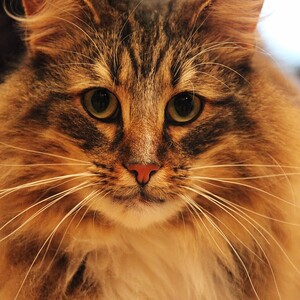
The slightly slanted eyes give it a somewhat melancholy look. The legs, although heavy-boned, are relatively short, and the hind legs are a little longer, so it jumps exceptionally high. The paws are large and round, and the tail is bushy.
| Feature | Siberian |
|---|---|
| Size | Medium to large |
| Weight | 4.5–9 kg |
| Body | Barrel-shaped, rounded |
| Paws | Large, round |
| Eyes | Slightly slanted |
| Tail | Bushy |
| Coat | Triple, waterproof |
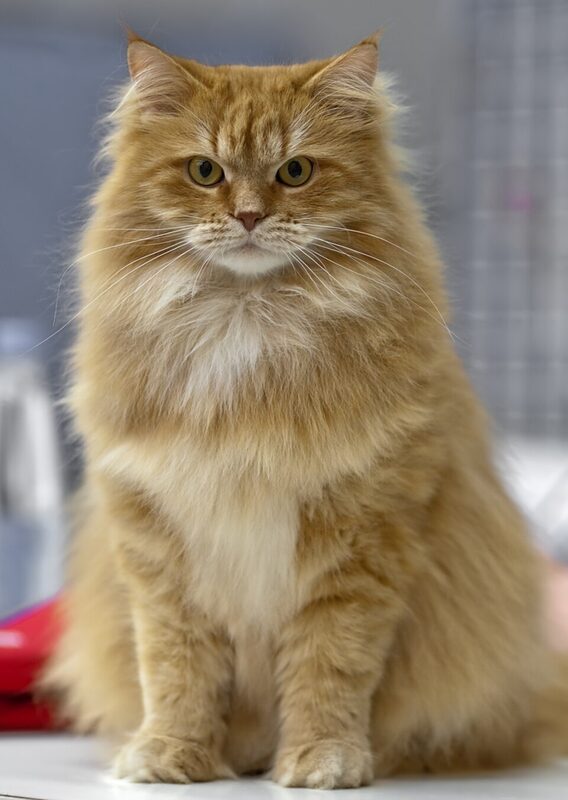
The thick coat has coarse outer hairs that form a waterproof “raincoat”. In winter it has a full ruff and a woolly undercoat, while in summer the coat can be short. There are many colours, but as in many natural breeds, chocolate, cinnamon, lilac and fawn are not accepted. The pointed varieties form the sister breed, the Neva Masquerade.
Related breeds and how to tell them apart
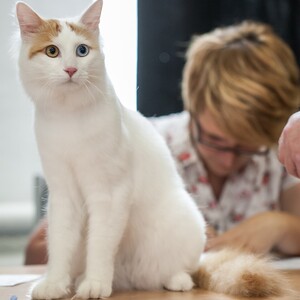
The Neva Masquerade is the sister breed, with a pointed pattern and blue eyes. Genetically, the Siberian is close to the Norwegian Forest Cat. The Maine Coon looks similar, but the resemblance comes from adapting to a cold climate, not from kinship.
Behaviour and temperament
The FIFe profile describes it as friendly, people-loving and very attached to its owner. It is curious, intelligent and playful and wants to take part in all household activities. It likes to “talk” with purrs and chirps, but it is not noisy.
German Wikipedia says that, given the chance, it is an excellent hunter, moves a lot and climbs and jumps very well.
Socialisation
French Wikipedia describes it as very sociable and affectionate, and German Wikipedia recommends not keeping it alone.
A kitten gets used to new people, noises and other animals most easily in its first months of life.
Habits at home
Like all cats, it sleeps a lot: usually 12–16 hours a day. It is most active early in the morning and in the evening, but partly adapts to the family's routine.
Cats instinctively bury their droppings, so it quickly learns to use a litter tray. It scratches rough surfaces to shed the old outer layer of its claws, so it needs a scratching post or board.
Life at home and activity
It is athletic and very energetic: it jumps exceptionally high. It needs space, a tall, stable climbing tree and, ideally, a fenced garden.
| Activity | How often | Why it matters |
|---|---|---|
| A tall, stable climbing tree | always within reach | It jumps and climbs a great deal |
| Play with toys (wand toys, balls) | daily | Play imitates hunting and uses up its energy |
| Scratching post or board | always available | It looks after its claws without damaging the furniture |
| High places (cat tree, shelves) | always available | It has somewhere to watch from and to rest |
Tips for a balanced life
- Change its toys from time to time, so it does not get bored.
- Play with it in short sessions, several times a day.
- If it goes outside, let it do so in a fenced area or on a balcony with a safety net.
Care and health
Coat care
It has all three types of hair. The dense coat is brushed several times a week, so it does not tangle. It moults heavily in spring, triggered by day length, and more lightly at the end of summer.
Common health problems
Wikipedia says it is a relatively healthy breed, with the highest genetic diversity of all breeds, comparable to that of non-pedigree cats. A study of nearly 550,000 cats from 18 breeds found the Siberian had the lowest overall risk of illness, together with the Ragdoll, but the highest risk of injury, because of its energy. French Wikipedia says that, when crossed with other breeds, polycystic kidney disease and hypertrophic cardiomyopathy can appear, detected by ultrasound after the age of two.
| Condition | Description | Common symptoms |
|---|---|---|
| Hypertrophic cardiomyopathy (HCM) | The heart wall thickens and the heart pumps less well. It is the most common heart disease in domestic cats | Often no signs at first; later rapid breathing, tiredness, sometimes sudden paralysis of the hind legs |
| Polycystic kidney disease (PKD) | Cysts (fluid-filled sacs) form in the kidneys and grow over time | Drinks and urinates a lot, loses weight, has a poor appetite |
Recommended genetic tests
Ask for the parents' heart and kidney ultrasound, done after the age of two.
Is it hypoallergenic?
Cat allergy is caused mainly by the Fel d 1 protein, found in saliva and skin glands; it is behind the allergy in 90% of people who are allergic to cats. No breed is completely hypoallergenic.
The Siberian is often called “hypoallergenic”: a study of Siberian cats from the breed's home region showed that they produce less Fel d 1 than other cats, and some have genetic variants that lower production. They still produce enough to trigger symptoms in some people, so someone with allergies should meet the cat first.
Other care
- A check-up at the vet once a year.
- Vaccinations and parasite treatment on the schedule set by the vet.
- Trim the claws if they do not wear down on their own.
- Clean its teeth or give it food that helps keep them clean.
Diet and nutrition
The cat is a carnivore: it needs animal protein. Unlike a dog, it must get vitamin A, arachidonic acid and taurine from its food. Water is very important, because cats usually drink little; several water bowls around the house encourage it to drink.
Tips for a healthy diet
The table gives a starting estimate, calculated with the formula from the Merck Veterinary Manual for a healthy adult cat. The last column shows what this means in dry food with 3,500–4,000 kcal per kilogram. If you also feed wet food, reduce the dry portion.
| Cat's weight | Calories per day (neutered) | Calories per day (not neutered) | Dry food per day (approximate) |
|---|---|---|---|
| 4.5 kg | 260 kcal | 300 kcal | 65–86 g |
| 5.5 kg | 300 kcal | 350 kcal | 75–100 g |
| 6.5 kg | 340 kcal | 400 kcal | 85–114 g |
| 8 kg | 400 kcal | 470 kcal | 100–134 g |
- Adjust the portion to its weight: neutered cats put on weight easily.
- Weigh it monthly; the ribs should be easy to feel under your fingers.
- Kittens need more calories: Merck recommends 2.5 times the resting energy requirement.
Dangerous foods and substances
Some common household items are dangerous for cats:
- Lilies (and daylilies): they can destroy a cat's kidneys. Even the pollen or the water in the vase is dangerous.
- Paracetamol: extremely toxic to cats, which lack the enzyme that breaks it down. Never give it human medicines.
- Flea spot-ons and collars for dogs containing permethrin: the concentration meant for dogs is dangerous for cats.
- Foods: chocolate, coffee, alcohol, onions, garlic, grapes and raisins.
Reproduction and development
Maturity
Females usually reach sexual maturity at 5–10 months, and males at 5–7 months. The age varies from breed to breed.
Mating and pregnancy
Pregnancy in cats lasts 64–67 days, 65 on average. A first litter usually has fewer kittens than later ones. Only healthy cats that match the breed standard are used for breeding.
Blood type
Cats have blood type A, B or AB. Type A is the most common: in a study from England, 87.1% of non-pedigree cats and 54.6% of pedigree cats had type A. This matters for breeding: if the mother is type B and the kittens are type A, the antibodies in her first milk (colostrum) can destroy their red blood cells. The condition is called neonatal isoerythrolysis. That is why breeders test the blood type of both parents.
We found no published data on how common type B is in this breed; the test is done before mating anyway.
Caring for the kittens
Kittens are weaned at 6–7 weeks. They are ready to go to their new home at about 12 weeks, when they can be separated from their mother.
Neutering
Neutering used to be done at 6–9 months, but it is more and more often done before puberty, at around 3–6 months. It prevents unwanted kittens, urine marking in males and the loud “calling” of females in heat. A 2024 study found that neutered cats live one year longer on average. After the operation, the metabolism slows down and appetite increases, so the portion has to be reduced.
How to choose a kitten
- Ask for the pedigree from a recognised cat association (for example, a FIFe member).
- The kitten leaves its mother at about 12 weeks.
- Look at the mother and at the place where the kittens are raised: it should be clean, with kittens used to people.
- Ask about vaccinations, parasite treatment and the blood type of the parents.
Interesting facts
- Russia's national cat. The Siberian is considered the national cat of Russia.
- The most genetically diverse. It has the highest genetic diversity of all breeds.
- A bulldog stance. It stands broad and solid, like a bulldog.
- Moulting by daylight. The spring moult is triggered by day length, not by temperature.
In popular culture
In Slavic tales
Siberian forest cats have appeared in folk tales, folklore and Slavic art since the tenth century.
Frequently asked questions
Is it hypoallergenic?
Not completely. It produces less Fel d 1 than other cats, but can still cause allergies.
How big does it get?
Adults weigh 4.5–9 kg on average; females are much smaller.
How long does it live?
French Wikipedia gives 15–20 years.
How often does it need brushing?
Several times a week, more often in spring.
How is it different from the Neva Masquerade?
The Neva Masquerade is the variety with a pointed pattern and blue eyes.