Bouvier des FlandresCharacteristics, history, training and care
The Bouvier des Flandres is a sturdy working dog associated with the Flanders region. Its rough coat and strong build reflect its background in farm and cattle work. It needs suitable grooming, training and activity rather than assumptions based only on appearance.
Quick facts
| Common name | Bouvier des Flandres |
| Scientific name | Canis lupus familiaris |
| Country of origin | Belgium, France |
| Official Recognition | Recognized by FCI, AKC, UKC |
| Typical lifespan | About 10-12 years |
| Dimensions (Male) | About 62-68 cm / 35-40 kg |
| Dimensions (Female) | About 59-65 cm / 27-35 kg |
| Coat type | Dense, rough, weather-resistant |
| Common colours | Fawn to black, including brindle, grey and salt and pepper |
| Energy Level | Moderate to high |
| Suitable for an apartment? | Depends on exercise, training, health and the individual dog |
| Temperament | Brave, intelligent, protective |
| Behaviour towards unfamiliar people and dogs | Individual behaviour varies; socialisation, training and management matter |
| Compatibility with children | Depends on the individual; adult supervision and suitable handling are essential |
| Compatibility with other animals | Depends on socialisation, prey drive and the animals involved |
| Health considerations | Hip and elbow dysplasia, bloat, eye problems, hypothyroidism |
- Primary category:Dog breeds
- Explore this animal's categories:
History and Origin
The Bouvier des Flandres was developed in Flanders (today's Belgium and northern France) as an all-round farm dog. Its name means "cattle driver of Flanders".
Evolution of the breed
- A versatile working dog - It was used to drive cattle, guard farms, pull carts and catch vermin.
- The First World War - Many Bouviers were used as messenger and ambulance dogs, and the fighting in Flanders almost wiped out the breed.
- Recovery - After the war, Belgian and French breeders rebuilt the breed; a war survivor, Champion Nic de Sottegem, became one of its most important ancestors.
- Today - The Bouvier des Flandres works with the police and in search and rescue, and is also a companion for active families.
Breed Evaluation
The Bouvier des Flandres is an intelligent, hard-working and protective dog, suited to active families and people with experience of large guardian dogs. These are general editorial ratings, not measured scores; individual dogs vary.
| Characteristic | Stars |
|---|---|
| Training and Intelligence | ★★★★★ |
| Easy to train | ★★★★★ |
| Intelligence | ★★★★★ |
| Level of independence | ★★★☆☆ |
| Level of stubbornness | ★★★☆☆ |
| Behavior and Temperament | ★★★★★ |
| Affectionate with family | ★★★★★ |
| Friendly with children | ★★★★★ |
| Compatible with other dogs | ★★★☆☆ |
| Compatible with cats and other animals | ★★★☆☆ |
| Degree of loyalty | ★★★★★ |
| Tendency to be aggressive | ★★☆☆☆ |
| Tendency to bark | ★★★☆☆ |
| Needs and Care | ★★★☆☆ |
| Shedding level | ★★★☆☆ |
| Requires frequent care | ★★★★☆ |
| Activity and Lifestyle | ★★★★★ |
| Energy level | ★★★★★ |
| Daily exercise requirement | ★★★★★ |
| Suitable for apartment living | ★★☆☆☆ |
| Health and Longevity | ★★★★☆ |
| Life expectancy | ★★★★☆ |
| Predisposition to genetic diseases | ★★★☆☆ |
| Work and Utility Features | ★★★★★ |
| Good guard dog | ★★★★★ |
| Good companion dog | ★★★★★ |
Physical Characteristics
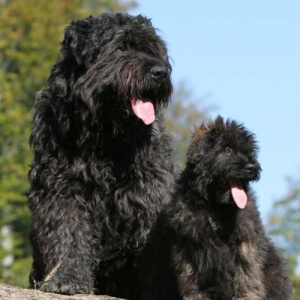
The Bouvier des Flandres is a powerful, solid dog with a rugged look and an intelligent expression.
General appearance
- A short, strong, muscular body, built for work.
- A rough, thick, weather-resistant double coat that looks tousled.
- A large head with a beard and moustache, and triangular ears, natural or cropped where this is legal.
- Dark, oval eyes with an alert, determined expression.
- A natural tail or, in some countries, a docked tail.
| Characteristic | Bouvier des Flandres |
|---|---|
| Size | Large (about 59-68 cm at the shoulder) |
| Weight | About 27-40 kg |
| Coat | Dense, rough, double |
| Muzzle | Strong, broad, bearded |
| Shedding tendency | Low to moderate |
| Build | Strong and compact |
The Bouvier des Flandres has an imposing presence, but it is gentle and loyal with its family.
Training and Socialization
The Bouvier des Flandres is intelligent and responsive, but it needs consistent training and a confident owner, as it can become independent and stubborn without clear rules.
Tips for effective training
- Start early - Socialisation should begin at about 8 weeks to prevent shyness or defensive behaviour.
- Positive training methods - It responds best to rewards, praise and interactive exercises, with clear rules from the start.
- Wide socialisation - It should get used to new people, other animals and different places to develop a balanced temperament.
- Managing its guarding instinct - Its natural protectiveness makes it a good watchdog, but it must learn not to be over-protective.
- Mental exercises - It gets bored quickly, so training should be varied.
With good training, the Bouvier des Flandres becomes a disciplined, devoted and balanced dog, suitable for work and family life.
Activity and Lifestyle Needs
This breed has plenty of energy and needs regular activity, ideally with a job to do.
| Activity | Recommended duration |
|---|---|
| Daily walks | About 60 min or more |
| Interactive games | About 30 min |
| Obedience training | About 15-20 min |
| Dog sports (herding, tracking, carting) | Recommended |
Recommendations for a balanced lifestyle
- Best in a house with a large garden - It is not ideal for apartments, as it needs space.
- Likes work - It does well in herding, carting, tracking, dog sports and hiking.
- Does not like inactivity - Without enough physical and mental activity, it may become frustrated and destructive.
- Protective - It can be reserved with strangers, but is devoted to its family if well socialised.
Without enough activity, the Bouvier des Flandres may become restless or hard to manage.
Care and Health
Its thick, rough coat needs regular care, and some inherited disorders should be monitored.
Fur and skin care
- Brushing 2-3 times a week - The coat should be brushed regularly to prevent mats and remove dirt.
- Regular trimming - The coat, beard and feet usually need trimming every couple of months.
- Occasional baths - Baths are needed only now and then, but the beard may need cleaning after meals.
- Ear and claw care - Ears should be checked regularly and claws trimmed if they do not wear down naturally.
Common health problems
| Condition | Description | Common symptoms |
|---|---|---|
| Hip and elbow dysplasia | Inherited joint problems affecting mobility | Lameness, stiff gait |
| Bloat (gastric torsion) | A serious emergency that may need surgery | Swollen belly, restlessness |
| Eye problems | Such as glaucoma and cataracts | Red, painful or cloudy eyes, poor vision |
| Hypothyroidism | Low thyroid hormone | Weight gain, low energy, coat problems |
Other aspects of care
- Weight control - It should be fed carefully to prevent extra weight, which strains the joints.
- Regular veterinary visits - Yearly check-ups help find joint, eye and other problems early.
The Bouvier des Flandres is a strong, generally healthy breed, but its joints, eyes and digestion should be monitored.
Diet and Nutrition
The Bouvier des Flandres needs a balanced diet with good-quality protein to maintain its strength and healthy joints.
Recommendations for a healthy diet
Choose a complete, balanced diet suited to age, size and health. Plan home-prepared diets and supplements with a qualified veterinarian; raw pet food can carry harmful bacteria.
| Food type | Daily Amount (Adults) | Frequency |
|---|---|---|
| Premium dry food | Individual amount; follow complete-food guidance and veterinary advice | 2 meals/day |
| Home cooked food | Individual amount; follow complete-food guidance and veterinary advice | 2 meals/day |
| Raw food: bacterial contamination is a concern | Individual amount; follow complete-food guidance and veterinary advice | 2 meals/day |
Forbidden foods
Chocolate, grapes and raisins, onions and xylitol - toxic to dogs. ; Cooked bones - can splinter and cause intestinal blockage. ; Fatty food - can lead to digestive problems and pancreatitis. ; Overfeeding - can cause weight gain, which affects the joints.
The Bouvier des Flandres should be fed properly to prevent joint problems and obesity.
Reproduction and Development
Breeding requires veterinary planning, suitable health screening and care for the mother and puppies. Pregnancy and birth can involve complications.
Physical and emotional maturity
- Physical maturity: This breed grows fast in the first year and is usually fully grown at about 18-24 months.
- Emotional maturity: It matures more slowly and usually becomes calmer and more balanced after about 2 years.
Mating and Gestation
- Breeding decisions require veterinary assessment of maturity, health and suitable screening; a fixed age does not establish that breeding is appropriate.
- Duration of gestation: Approximately 58-68 days, usually about 63 days.
- Average number of puppies: Usually about 6-10 puppies.
Puppy care
- The first 3 weeks: Puppies depend on their mother for warmth, milk and protection.
- Between 4-8 weeks: They begin to explore and play with littermates and people; socialisation is essential.
- Moving to a new home: When puppies go to their new homes, basic training should start right away.
Bouvier puppies grow fast, so their growth should be managed carefully to protect their joints.
Curiosities and Interesting Facts
- A war dog - In the First World War, Bouviers carried messages and helped find wounded soldiers.
- The name - "Bouvier" means "cowherd" or "cattle driver" in French.
- Little doggy smell - Its coat does not usually have a strong doggy smell.
- Nearly lost - The breed almost disappeared after the World Wars, but Belgian and French breeders saved it.
- A quiet watchdog - It is alert, but usually barks only when there is a real reason.
- A cart dog - In the past, Bouviers pulled carts loaded with farm produce, such as milk.
- A president's dog - US President Ronald Reagan had a Bouvier des Flandres called Lucky.
The Dog in Popular Culture
The Bouvier des Flandres is less famous than some large breeds, but it has a special place in Belgian history and literature.
The Bouvier des Flandres in modern media and culture
- "A Dog of Flanders" - Patrasche, the loyal working dog in Ouida's 1872 novel, is often pictured as a Bouvier des Flandres.
- Police and search dogs - In several European countries, the Bouvier is used by police and in search and rescue.
- A Belgian farm dog - It is seen as a symbol of traditional farm life in Flanders.
Importance in modern culture
- A true working dog - Unlike many breeds that are now mainly pets, the Bouvier still has a strong working instinct.
- A symbol of strength - It is seen as a brave, loyal and hard-working dog, ideal for people who want an active, devoted partner.