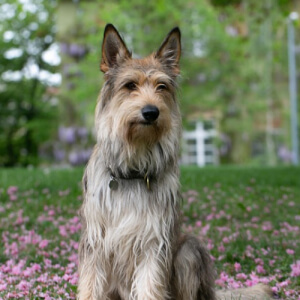
Berger PicardCharacteristics, history, training and care
The Berger Picard is a French herding breed with a rough coat and upright ears. It is an active dog that benefits from patient training and appropriate socialisation. Individual dogs differ, so breed descriptions are a starting point for care rather than a guarantee.
Quick facts
| Common name | Berger Picard |
| Scientific name | Canis lupus familiaris |
| Country of origin | France |
| Official Recognition | Recognized by FCI, AKC, UKC |
| Typical lifespan | About 12-14 years |
| Dimensions (Male) | About 60-65 cm / 23-32 kg |
| Dimensions (Female) | About 55-60 cm / 20-27 kg |
| Coat type | Hard, medium-length, weather-resistant |
| Common colours | Fawn or brindle tones; precise acceptable colours depend on the breed standard |
| Energy Level | High |
| Suitable for an apartment? | Depends on exercise, training, health and the individual dog |
| Temperament | Independent, intelligent, affectionate |
| Behaviour towards unfamiliar people and dogs | Individual behaviour varies; socialisation, training and management matter |
| Compatibility with children | Depends on the individual; adult supervision and suitable handling are essential |
| Compatibility with other animals | Depends on socialisation, prey drive and the animals involved |
| Health considerations | Hip dysplasia, eye problems, bloat |
- Primary category:Dog breeds
- Explore this animal's categories:
History and Origin
The Berger Picard is one of the oldest French sheepdogs, from the Picardy region in northern France.
Evolution of the breed
- Old ancestors - It is often said that its ancestors came to France with the Celts or the Franks, but there is little evidence for this.
- A traditional sheepdog - For centuries, it has been used in Picardy to herd and guard sheep and cattle.
- Nearly lost after the World Wars - Both World Wars were fought across northern France, and the breed almost disappeared.
- Revival - After 1945, French breeders worked to rebuild the breed and keep its rustic, practical character; the AKC recognised it in 2015.
- Rare but valued - Today the Berger Picard is still a rare breed, valued for its intelligence and loyalty.
Breed Evaluation
The Berger Picard is an energetic, intelligent and devoted dog, suited to active families and people with experience of working dogs. These are general editorial ratings, not measured scores; individual dogs vary.
| Characteristic | Stars |
|---|---|
| Training and Intelligence | ★★★★☆ |
| Easy to train | ★★★★☆ |
| Intelligence | ★★★★★ |
| Level of independence | ★★★★☆ |
| Level of stubbornness | ★★★☆☆ |
| Behavior and Temperament | ★★★★★ |
| Affectionate with family | ★★★★★ |
| Friendly with children | ★★★★★ |
| Compatible with other dogs | ★★★★☆ |
| Compatible with cats and other animals | ★★★☆☆ |
| Degree of loyalty | ★★★★★ |
| Tendency to be aggressive | ★☆☆☆☆ |
| Tendency to bark | ★★★☆☆ |
| Needs and Care | ★★★☆☆ |
| Shedding level | ★★★☆☆ |
| Requires frequent care | ★★★☆☆ |
| Activity and Lifestyle | ★★★★★ |
| Energy level | ★★★★★ |
| Daily exercise requirement | ★★★★★ |
| Suitable for apartment living | ★★☆☆☆ |
| Health and Longevity | ★★★★☆ |
| Life expectancy | ★★★★★ |
| Predisposition to genetic diseases | ★★★☆☆ |
| Work and Utility Features | ★★★★★ |
| Good guard dog | ★★★★☆ |
| Good companion dog | ★★★★★ |
Physical Characteristics
The Berger Picard is a medium-large, well-proportioned and muscular dog, known for its rustic look and alert expression.
General appearance
- An athletic, well-balanced body, slightly longer than tall.
- A medium-length, harsh, shaggy coat that protects it from cold and rain.
- Large, erect ears, about 10-12 cm long, that give it an expressive, attentive look.
- Dark brown eyes under thick eyebrows, with a lively expression.
- A tail that reaches the hock and ends in a slight hook ("J" shape), never carried over the back.
| Characteristic | Berger Picard |
|---|---|
| Size | Medium to large (about 55-65 cm at the shoulder) |
| Weight | About 20-32 kg |
| Coat | Harsh, medium length, shaggy |
| Muzzle | Strong, with a short beard and moustache |
| Shedding tendency | Moderate |
| Build | Muscular and athletic |
The Berger Picard is a sturdy, adaptable dog, well suited to outdoor activities and active owners.
Training and Socialization
The Berger Picard is clever but independent and sensitive, so training must be consistent and motivating. It learns quickly, but can become stubborn without enough stimulation.
Tips for effective training
- Start early - Puppies should start socialisation and basic commands from about 8 weeks to prevent shyness with strangers.
- Reward-based methods - It responds well to praise, games and food rewards, but resists harsh, authoritarian methods.
- Short, varied sessions - Changing the type of exercises keeps its attention.
- Wide socialisation - It can be reserved with strangers, so it should meet new people, other animals and many situations.
- Lead training - As an active dog, it may pull on the lead if it is not taught early.
A well-trained Berger Picard becomes a loyal, balanced and obedient companion.
Activity and Lifestyle Needs
This breed has a lot of energy and suits active people and families who love the outdoors.
| Activity | Recommended duration |
|---|---|
| Daily walks | At least 60-90 min |
| Interactive games | About 30 min |
| Obedience and agility training | About 15-30 min |
| Dog sports (agility, herding, canicross) | Recommended |
Recommendations for a balanced lifestyle
- Best in a house with a garden - It is not ideal for apartment life, as it needs a lot of exercise.
- Good for active people - The Berger Picard loves hiking, running and dog sports.
- Avoid boredom - Without enough physical and mental activity, it may dig or chew things.
- Watchful but not aggressive - It is alert and protective, but usually not aggressive.
Without enough activity, the Berger Picard may become frustrated and hard to manage.
Care and Health
Its coat does not need complicated care, but it should be brushed regularly. The breed is prone to some health problems that need monitoring.
Fur and skin care
- Weekly brushing - Its harsh coat does not tangle easily, but should be brushed about once a week to remove dead hair.
- Occasional baths - The coat tends to shed dirt, so it needs a bath only every few months.
- Ear and eye care - Its large ears should be checked and cleaned regularly to prevent infections.
Common health problems
| Condition | Description | Common symptoms |
|---|---|---|
| Hip dysplasia | An inherited joint problem affecting mobility | Limping, joint pain |
| Eye problems | Such as progressive retinal atrophy | Night blindness, poor vision |
| Bloat (gastric torsion) | An emergency, more likely after eating quickly | Swollen belly, restlessness |
Other aspects of care
- Weight control - It should be fed carefully to avoid extra weight, which strains the joints.
- Regular veterinary visits - Yearly check-ups help find joint and eye problems early.
The Berger Picard is a hardy breed, but its joints and eyes need attention.
Diet and Nutrition
The Berger Picard needs a balanced diet with good-quality protein and fat to support its activity and joints.
Recommendations for a healthy diet
Choose a complete, balanced diet suited to age, size and health. Plan home-prepared diets and supplements with a qualified veterinarian; raw pet food can carry harmful bacteria.
| Food type | Daily Amount (Adults) | Frequency |
|---|---|---|
| Premium dry food | Individual amount; follow complete-food guidance and veterinary advice | 2 meals/day |
| Home cooked food | Individual amount; follow complete-food guidance and veterinary advice | 2 meals/day |
| Raw food: bacterial contamination is a concern | Individual amount; follow complete-food guidance and veterinary advice | 2 meals/day |
Forbidden foods
Chocolate, grapes and raisins, onions and xylitol - toxic to dogs. ; Cooked bones - can splinter and cause intestinal blockage. ; Fatty food - can cause digestive problems and pancreatitis. ; Overfeeding - can cause weight gain, which affects the joints.
The Berger Picard should be fed properly to prevent joint and weight problems.
Reproduction and Development
The Berger Picard is a rare breed, so breeding programmes are carefully planned, with health screening, to keep its original traits and prevent inherited diseases. Breeding can involve health risks, and veterinary advice is necessary.
Physical and emotional maturity
- Physical maturity: It grows quickly in the first year and is usually fully grown at about 18-24 months.
- Emotional maturity: It stays playful and active until about 2-3 years, then usually becomes calmer.
Mating and Gestation
- Breeding decisions require veterinary assessment of maturity, health and suitable screening; a fixed age does not establish that breeding is appropriate.
- Duration of gestation: Approximately 58-68 days, usually about 63 days.
- Average number of puppies: Usually about 6-8 puppies.
Puppy care
- The first 3 weeks: Puppies depend on their mother for warmth and milk.
- Between 4-8 weeks: They begin to explore and play, and socialisation is important to prevent shyness.
- Moving to a new home: When puppies go to their new homes, basic training should start right away.
Early socialisation and meeting many different places help the Berger Picard become sociable and confident.
Curiosities and Interesting Facts
- An old French sheepdog - The Berger Picard is one of the oldest French herding breeds.
- Nearly lost - After the two World Wars, very few were left, but French breeders revived the breed.
- Still rare - Even in France, the Berger Picard is uncommon.
- A low-maintenance coat - Its harsh coat sheds dirt and water well and does not need much grooming.
- A film star - The scruffy dog in the film "Because of Winn-Dixie" (2005) was played by Berger Picards.
- Very expressive - Its large ears and lively eyes make it very expressive.
- Agile - It is quick and athletic and does well in agility, herding and tracking.
The Dog in Popular Culture
The Berger Picard became much better known after starring in a Hollywood film.
Berger Picard in modern media and culture
- "Because of Winn-Dixie" (2005) - The friendly, scruffy dog Winn-Dixie in this family film was played by Berger Picards, which made the breed popular in the USA.
- A French heritage breed - The breed is promoted at dog shows and by clubs working to preserve old French breeds.
Importance in modern culture
- A family dog - Although originally a working dog, the Berger Picard adapts well to life with active families.
- An authentic sheepdog - It has kept much of its traditional working character.
- A survivor - The breed survived two World Wars thanks to the passion of French breeders.