Airedale TerrierCharacteristics, history, training and care
Quick facts
| Common name | Airedale Terrier |
| Scientific name | Canis lupus familiaris |
| Country of origin | United Kingdom |
| Official Recognition | Recognised by FCI, AKC |
| Typical lifespan | About 10-13 years |
| Dimensions (Male) | About 58-61 cm |
| Dimensions (Female) | About 56-59 cm |
| Weight (Male) | About 20-30 kg |
| Weight (Females) | About 18-25 kg |
| Coat type | Wiry, dense, weather-resistant |
| Common colours | Black and tan, grizzle and tan |
| Energy Level | High |
| Suitable for apartment? | Depends on exercise, training, health and the individual dog |
| Temperament | Clever, alert, brave |
| Behaviour towards unfamiliar people and dogs | Individual behaviour varies; socialisation, training and management matter |
| Compatibility with children | Depends on the individual; adult supervision and suitable handling are essential |
| Compatibility with other animals | Depends on socialisation, prey drive and the animals involved |
| Genetic predispositions | Hip dysplasia, skin problems, hypothyroidism |
- Primary category:Dog breeds
- Explore this animal's categories:
History and Origin
The Airedale Terrier was developed in the 19th century in the valley of the River Aire (Airedale) in Yorkshire, England. Breeders crossed the Otterhound with local working terriers to create a versatile dog that could hunt both on land and in water.
Development of the breed
- The 1800s - Used by working people in Yorkshire to hunt otters, rats and other animals along the rivers.
- World War I - The British army used Airedales as messenger, sentry and Red Cross dogs, thanks to their courage and intelligence.
- The modern era - It is valued as a family dog, watchdog and working dog, and was one of the first breeds used by police in Britain and Germany.
Breed Evaluation
The Airedale Terrier is a very intelligent, active and independent dog that needs a consistent, experienced owner. These editorial ratings provide a general guide. Individual dogs vary with health, training and environment.
| Characteristic | Stars |
|---|---|
| Training and Intelligence | ★★★★☆ |
| Easy to train | ★★★☆☆ |
| Intelligence | ★★★★★ |
| Level of independence | ★★★★☆ |
| Level of stubbornness | ★★★★☆ |
| Behavior and Temperament | ★★★★☆ |
| Affectionate with family | ★★★★★ |
| Friendly with children | ★★★★☆ |
| Compatible with other dogs | ★★★☆☆ |
| Compatible with cats and other animals | ★★☆☆☆ |
| Degree of loyalty | ★★★★★ |
| Tendency to be aggressive | ★★☆☆☆ |
| Tendency to bark | ★★★☆☆ |
| Needs and Care | ★★★★☆ |
| Shedding level | ★★☆☆☆ |
| Requires frequent care | ★★★★☆ |
| Activity and Lifestyle | ★★★★★ |
| Energy level | ★★★★★ |
| Daily exercise requirement | ★★★★★ |
| Suitable for apartment living | ★★☆☆☆ |
| Health and Longevity | ★★★★☆ |
| Life expectancy | ★★★★☆ |
| Predisposition to genetic diseases | ★★★☆☆ |
| Work and Utility Features | ★★★★★ |
| Good guard dog | ★★★★☆ |
| Good companion dog | ★★★★☆ |
Physical Characteristics
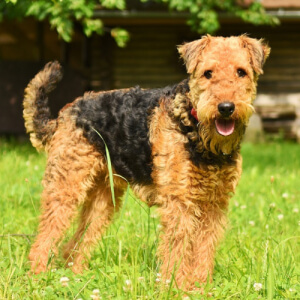
The Airedale Terrier is a strong, athletic dog with a square outline and an alert, intelligent expression.
General appearance
- A muscular body with a short, level back and a deep chest.
- A hard, wiry outer coat with a softer undercoat that protects it from the weather.
- A long, flat head with a strong muzzle and powerful jaws.
- Small, V-shaped ears folded forward, giving an alert expression.
- A tail carried upright; it is still docked in some countries where this is legal.
| Characteristic | Airedale Terrier |
|---|---|
| Size | Large for a terrier (about 56-61 cm at the shoulder) |
| Weight | About 18-30 kg |
| Coat | Wiry, double coat |
| Muzzle | Long, strong |
| Shedding tendency | Low |
| Build | Strong and muscular |
The Airedale Terrier is a versatile dog, suitable for both work and family life, but it needs regular exercise and good socialisation.
Training and Socialization
The Airedale Terrier is clever but independent, so training must be consistent, patient and based on positive methods. Because of its history as a working and hunting dog, it likes to be busy and to solve problems.
Tips for effective training
- Early socialisation is essential - Meeting many people, animals and places from puppyhood helps prevent suspicion and conflicts with other dogs.
- Reward-based training - It is very clever, but can become stubborn if methods are harsh. It responds best to food, toys and praise.
- Varied, interesting training - It gets bored quickly, so sessions should be short and interactive, with clear commands.
- Advanced exercises - Thanks to its intelligence, it can learn tricks, agility, tracking and scent work.
- Prey drive - Like most terriers, it may chase cats and small animals, so introductions should be careful and recall trained early.
Training should start early and continue throughout life; otherwise the Airedale can become very independent and hard to control.
Activity and Lifestyle Needs
The Airedale Terrier is a very active breed that needs plenty of exercise and mental stimulation to stay balanced.
| Activity | Recommended duration |
|---|---|
| Daily walks | About 60-90 min |
| Fetch and chase games | About 30 min |
| Hikes and outdoor activities | A few hours a week |
| Obedience training | About 15-20 min/day |
Recommendations for a healthy lifestyle
- Needs daily exercise - It is not suited to people with a quiet lifestyle or to life in a small apartment without enough exercise.
- Can become destructive - Without enough stimulation, it may dig, chew or bark excessively.
- Great for dog sports - It does well in agility, tracking and obedience.
- Suits active families - It is a good companion for runners, hikers and nature lovers.
The Airedale needs plenty of exercise and mental challenges to be a balanced and happy dog.
Care and Health
The Airedale's wiry coat and active character mean it needs regular grooming and veterinary check-ups.
Fur and skin care
- Brushing 1-2 times a week - Regular brushing prevents tangles and removes dead hair.
- Regular trimming (about every 2-3 months) - Hand-stripping is recommended to keep the coat's harsh texture; clipping makes the coat softer.
- Baths when needed - Frequent baths are not necessary, but the coat should be cleaned after muddy outings.
Common health problems
| Condition | Description | Possible signs |
|---|---|---|
| Hip dysplasia | Abnormal development of the hip joint | Lameness, pain on movement |
| Skin problems | Tendency to skin allergies and irritation | Itching, redness, hair loss |
| Hypothyroidism | Low thyroid hormone, which affects weight and energy | Tiredness, weight gain |
| Ear infections | Folded ears can trap moisture and dirt | Bad smell, scratching the ears |
Other aspects of care
- Regular ear and eye checks - To spot infections early.
- Regular nail trimming - Helps prevent discomfort when walking.
- Yearly veterinary check-ups - Important for spotting inherited problems early.
Diet and Nutrition
The Airedale Terrier is an active dog and needs a balanced diet with enough protein and nutrients to support its daily energy.
Recommendations for a balanced diet
Choose a complete, balanced diet for the dog’s age, size and health. Plan home-prepared diets or supplements with a qualified veterinarian. Raw pet food can carry harmful bacteria.
| Food type | Daily Amount (Adults) | Frequency |
|---|---|---|
| Premium dry food | Individual amount; follow a complete diet’s guidance and veterinary advice | 2 meals/day |
| Home cooked food | Individual amount; follow complete-food guidance and veterinary advice | 2 meals/day |
| Raw food: bacterial contamination is a concern | Individual amount; follow a complete diet’s guidance and veterinary advice | 2 meals/day |
Forbidden foods
Chocolate, grapes and raisins, onions and xylitol - toxic to dogs. / Cooked bones - can splinter and injure the gut. / Salty snacks - not suitable for dogs. / Fatty or fried foods - can cause digestive upsets and pancreatitis.
The Airedale Terrier needs a balanced diet to keep its energy and good health.
Reproduction and Development
Breeding can involve health risks. Responsible breeders use appropriate health screening and veterinary advice rather than assuming that a breed is free of reproductive problems.
Physical and emotional maturity
- Physical maturity: The Airedale Terrier reaches adult size at about 12-18 months, but continues to fill out until about 2 years.
- Emotional maturity: It stays energetic and playful all its life, but usually becomes calmer and easier to manage after 2-3 years.
Mating and Gestation
- Breeding decisions - A veterinarian should assess health, maturity and relevant screening. A fixed age alone does not establish that a dog should be bred.
- Duration of gestation: Approximately 58-68 days, usually about 63 days.
- Average number of puppies: Usually about 6-9 puppies per litter.
Puppy care
- The first 3 weeks: Puppies depend completely on their mother and need a warm, quiet place and careful supervision.
- Between 4-8 weeks: They begin to eat solid food and explore their surroundings.
- Moving to a new home - Timing depends on health, development and local requirements. Continue careful socialisation and veterinary care.
Curiosities and Interesting Facts
- The "King of Terriers" - The Airedale is the largest of the terriers, which earned it this nickname.
- A First World War hero - The British army used Airedales to carry messages, guard positions and find wounded soldiers; a dog named Jack became famous for carrying a message through heavy fire.
- An early police dog - Airedales were among the first dogs used by police in Britain and Germany in the early 20th century.
- A president's dog - Warren Harding, the 29th President of the United States, had an Airedale named Laddie Boy, who had his own chair at cabinet meetings.
- Good at dog sports - The Airedale does well in agility, obedience, tracking and search and rescue.
- Playful in old age - Many Airedales stay curious and playful even when they are old.
The Dog in Popular Culture
The Airedale Terrier has appeared in history, politics and Hollywood thanks to its distinctive look and loyal, intelligent character.
The Airedale Terrier in history and media
- Laddie Boy - President Warren Harding's Airedale was one of the first celebrity dogs of the White House and often appeared in newspapers.
- John Wayne - The actor got his nickname "Duke" from his childhood Airedale, called Duke.
- Theodore Roosevelt - The president also kept Airedales and praised the breed.