Norwich TerrierCharacteristics, history, training and care
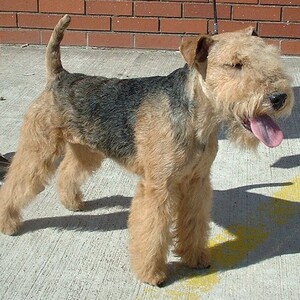
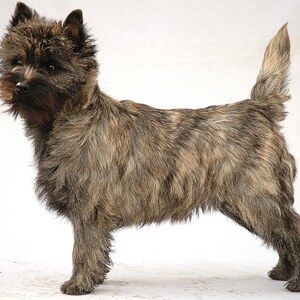
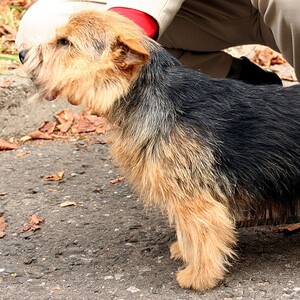
Norwich Terrier. · Pleple2000 / Wikimedia Commons, CC BY-SA 3.0. Cropped and resized.
The Norwich Terrier is one of the smallest working terriers, short-legged and compact, with a hard coat and erect, pointed ears. It is a close relative of the Norfolk Terrier, from which it differs by its ears. The standard describes it as lovable, not quarrelsome, very active, hardy, cheerful and fearless.
Quick facts
| Common name | Norwich Terrier |
| Scientific name | Canis lupus familiaris |
| Country of origin | United Kingdom |
| Official recognition | FCI, definitively since 16 October 1954 (group 3, small-sized terriers; standard no. 72); also recognised by the AKC |
| Lifespan | 12–15 years, according to the AKC |
| Size (males) | ideally 25 cm at the withers; about 5.5 kg according to the AKC |
| Size (females) | ideally 25 cm at the withers; about 5.5 kg according to the AKC |
| Coat type | Hard, wiry, straight, with a dense undercoat |
| Common colours | Red, wheaten, black and tan, grizzle |
| Energy level | High |
| Suited to an apartment? | Yes, with plenty of exercise |
| Temperament | Lovable, very active, cheerful, fearless |
| Tendency to aggression | Low |
| Good with children | Very good, according to the AKC |
| Good with other animals | Poor with rodents; hunting instinct |
| Genetic predispositions | Upper airway syndrome, hip dysplasia, epilepsy, degenerative myelopathy |
- Primary category:Dog breeds
- Explore this animal's categories:
History and origin
The FCI standard says the Norwich and the Norfolk take their names from the city and the county in the east of England, but in the early and middle 19th century there was no such distinction: it was simply a general farm dog. The Glen of Imaal, red Cairn Terriers and the Dandie Dinmont are among the breeds behind it.
Wikipedia says that shortly before the First World War, the Irish horseman Frank Jones sold many small terriers in the United States, where they were called “Jones Terriers”; it was also he who said they came from Norwich. In 1932 the breed was accepted by the Kennel Club, and the drop-eared variety later became the Norfolk Terrier.
How the breed developed
- Early 19th century – A general farm dog in the east of England.
- Before 1914 – Frank Jones sells “Jones Terriers” in the United States.
- 1932 – The Kennel Club accepts the breed.
- 16 October 1954 – The FCI recognises the breed.
- 1964 – The drop-eared variety becomes the Norfolk Terrier.
Breed rating
| Feature | Stars |
|---|---|
| Training and intelligence | ★★★☆☆ |
| Easy to train | ★★★☆☆ |
| Intelligence | ★★★★☆ |
| Independence | ★★★☆☆ |
| Stubbornness | ★★★★☆ |
| Behaviour and temperament | ★★★★☆ |
| Affectionate with family | ★★★★★ |
| Friendly with children | ★★★★★ |
| Good with other dogs | ★★★☆☆ |
| Good with cats and other animals | ★☆☆☆☆ |
| Loyalty | ★★★★★ |
| Tendency to be aggressive | ★☆☆☆☆ |
| Tendency to bark | ★★★★☆ |
| Needs and care | ★★★☆☆ |
| Shedding | ★★★☆☆ |
| Needs frequent grooming | ★★☆☆☆ |
| Activity and lifestyle | ★★★★☆ |
| Energy level | ★★★★☆ |
| Daily exercise needs | ★★★★☆ |
| Suited to apartment life | ★★★★☆ |
| Health and longevity | ★★★★☆ |
| Life expectancy | ★★★★☆ |
| Predisposition to genetic diseases | ★★★☆☆ |
| Working abilities and uses | ★★★★☆ |
| Good guard dog | ★★★★☆ |
| Good companion dog | ★★★★★ |
Indicative rating: 5 stars means the highest level. It is based on the ratings the American Kennel Club gives the breed and on the FCI standard.
Physical characteristics
The AKC says it stands no more than 25 cm at the withers and weighs around 5.5 kg, making it one of the smallest working terriers. Under the harsh coat it is a stocky, solid dog; it is no lapdog, but was bred as a tough, fearless ratter.
General appearance
The coat is hard, wiry and straight, lying close to the body, with a dense undercoat. On the neck it is longer and rougher, forming a ruff that frames the face. The hair on the head and ears is short and smooth, with slight whiskers and eyebrows. The ears are erect.
| Feature | Norwich Terrier |
|---|---|
| Size | Very small |
| Height at the withers | ideally 25 cm |
| Weight | ~5.5 kg (AKC) |
| Coat | Hard, with a ruff on the neck |
| Ears | Erect, pointed |
| Body | Stocky, solid |
The accepted colours are all shades of red, wheaten, black and tan, and grizzle. White marks are tolerated.
Training and socialisation
The AKC says it is a spirited little terrier, usually eager to please, which responds well to training. Puppies must be properly socialised to become friendly and outgoing, as is typical of the breed.
It does well at earthdog, barn hunt, obedience and agility. It has kept its hunting instincts, so the AKC says it should be walked on a lead or let loose only in a securely fenced yard.
Tips for effective training
- Always walk it on a lead. Its hunting instinct is strong.
- Socialise it as a puppy. That is how it becomes friendly and outgoing.
- Try earthdog or barn hunt. The AKC says it does well at them.
- Use rewards. It is eager to please.
Activity needs and lifestyle
The AKC says it is curious and energetic and needs plenty of exercise, for both physical and mental health.
| Activity | How often | Why it matters |
|---|---|---|
| Walks on the lead | several times a day | High energy |
| Play in a fenced yard | daily | Activity |
| Dog sports | weekly | Terrier instinct |
Tips for a balanced life
- It can also live in an apartment.
- The fence must have no gaps.
- Brush its teeth often.
Care and health
Coat and skin care
The AKC says it has a double coat, harsh and almost weatherproof outside, with a soft undercoat. Hand-stripping removes old hair and excess undercoat, so that new, glossy, richly coloured hair can grow.
Common health problems
The AKC says it is a hardy breed that lives 12–14 years with good care. The most common problem is upper airway syndrome. Breeders also screen their dogs for:
| Condition | Description | Common symptoms |
|---|---|---|
| Upper airway syndrome | Abnormalities of the airways, still poorly understood | Noisy or rattling breathing, tires quickly |
| Hip dysplasia | The hip joint forms incorrectly and, over time, arthritis develops | Limping, difficulty getting up or jumping, hip pain |
| Epilepsy | Repeated neurological seizures | Trembling, convulsions |
| Degenerative myelopathy | A disease that gradually affects the spinal cord | Weakness in the hind legs |
Other care
- Brush its teeth often: it is prone to tartar.
- Check its breathing after exercise.
- Trim the nails regularly.
Diet and nutrition
The AKC says the standard gives an ideal weight of 5.5 kg, but dogs vary in height and build, so the right weight is set for each individual.
Tips for a healthy diet
The table gives a starting estimate, calculated with the formula from the Merck Veterinary Manual. The first two calorie columns show the calories per day for a healthy adult dog. The last column shows what this means in dry food with 3,500–4,000 kcal per kilogram.
| Dog's weight | Calories per day (neutered) | Calories per day (not neutered) | Dry food per day (approximate) |
|---|---|---|---|
| 5 kg | 370 kcal | 420 kcal | 92–120 g |
| 5.5 kg | 400 kcal | 450 kcal | 100–130 g |
| 6 kg | 430 kcal | 480 kcal | 110–140 g |
- Give it its food in two meals a day.
- Treats count towards the daily portion.
- A dog is at the right weight when you can feel its ribs under the coat without pressing hard.
Foods to avoid
Some human foods are dangerous for dogs: chocolate, coffee, grapes and raisins, onions, garlic, xylitol (a sweetener used in chewing gum), macadamia nuts and alcohol.
Reproduction and development
Physical and emotional maturity
In dogs, sexual maturity usually comes between 6 and 12 months. Small breeds become adults faster than large ones, usually at around one year.
Mating and pregnancy
Pregnancy lasts about 63 days, counted from ovulation. Mating a female on her first heat is not recommended. The FCI standard requires that only healthy dogs of typical breed appearance are used for breeding.
Caring for the puppies
In small breeds, a litter has 3–4 puppies on average. The puppies are very small and fragile in the first weeks, so they must be kept warm and handled with care. Socialisation starts early: gentle handling, everyday noises and new people.
Interesting facts
- “Jones Terriers”. In the United States, the first dogs were named after Frank Jones.
- No lapdog. The AKC says it was bred as a tough ratter.
- The ears make the difference. The Norwich has erect ears, the Norfolk drop ears.
- A ruff of hair. The hair on its neck frames its face.
- Among the smallest. It is one of the smallest working terriers.
Frequently asked questions
What is the difference between the Norwich and the Norfolk?
The Norwich has erect ears, the Norfolk drop ears.
How big does it get?
Ideally 25 cm; the AKC gives around 5.5 kg.
Is it good with children?
The AKC gives it top marks for being good with children.
How long does it live?
The AKC gives 12–15 years.