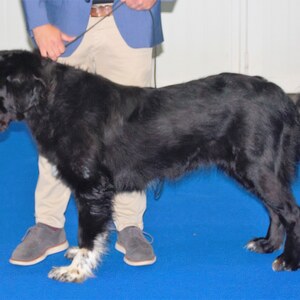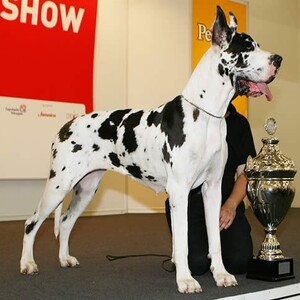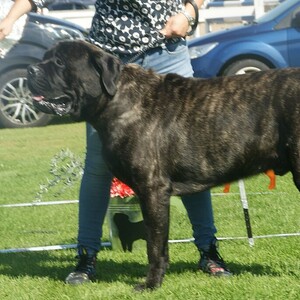
Pyrenean MastiffCharacteristics, history, training and care
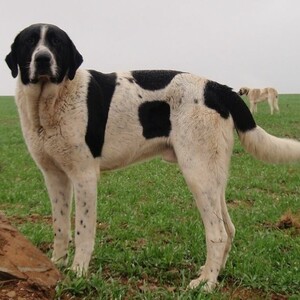
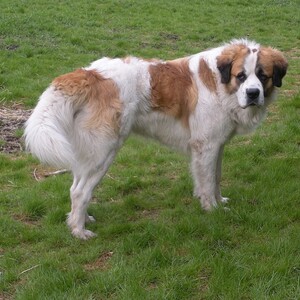
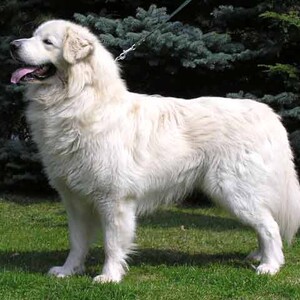
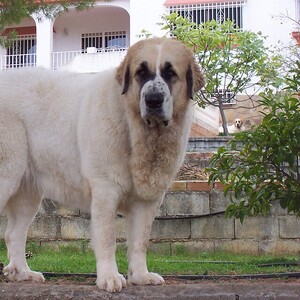
Pyrenean Mastiff. · Otaula / Wikimedia Commons, public domain. Cropped and resized.
The Pyrenean Mastiff (Mastín del Pirineo) is a giant Spanish livestock guardian dog, white with a mask and coloured patches, from Aragon. For centuries it defended the flocks against wolves and bears. The standard describes it as friendly with people, calm, noble and very intelligent, but brave and proud with strangers, from whom it never backs down.
Quick facts
| Common name | Pyrenean Mastiff (Mastín del Pirineo) |
| Scientific name | Canis lupus familiaris |
| Country of origin | Spain |
| Official recognition | FCI, definitively since 15 November 1954 (group 2, molossoid breeds, mountain type; standard no. 92); has a breed profile at the AKC |
| Lifespan | 10–12 years, according to the AKC |
| Size (males) | at least 77 cm at the withers (ideally over 81 cm); 54–86 kg according to the AKC |
| Size (females) | at least 72 cm at the withers (ideally over 75 cm); 54–86 kg according to the AKC |
| Coat type | Dense, thick, 6–9 cm long, harsh |
| Common colours | White with a mask and patches of the same colour |
| Energy level | Low |
| Suited to an apartment? | No |
| Temperament | Friendly, calm, noble, very intelligent, brave |
| Tendency to aggression | Low towards people; it does not back down before strangers |
| Good with children | Good, according to the AKC |
| Good with other animals | Good, according to the AKC |
| Genetic predispositions | Hip and elbow dysplasia, degenerative myelopathy, bloat |
- Primary category:Dog breeds
- Explore this animal's categories:
History and origin
Wikipedia says it is a livestock guardian dog from the autonomous community of Aragon, in north-eastern Spain, traditionally used to protect flocks during the annual transhumance to the summer pastures of the Pyrenees. It is a separate breed from the Spanish Mastiff.
The FCI standard says it was used for defence against wild beasts, especially wolves and bears. The AKC says that, once predators became scarce in the region, it became a property guard and companion.
How the breed developed
- For centuries – It guards the flocks on the Pyrenean transhumance.
- 15 November 1954 – The FCI recognises the breed.
- Today – A property guard and family companion.
Breed rating
| Feature | Stars |
|---|---|
| Training and intelligence | ★★☆☆☆ |
| Easy to train | ★★☆☆☆ |
| Intelligence | ★★★★☆ |
| Independence | ★★★★★ |
| Stubbornness | ★★★★☆ |
| Behaviour and temperament | ★★★★☆ |
| Affectionate with family | ★★★★☆ |
| Friendly with children | ★★★★☆ |
| Good with other dogs | ★★★★☆ |
| Good with cats and other animals | ★★★☆☆ |
| Loyalty | ★★★★★ |
| Tendency to be aggressive | ★★☆☆☆ |
| Tendency to bark | ★★★★☆ |
| Needs and care | ★★★★☆ |
| Shedding | ★★★☆☆ |
| Needs frequent grooming | ★★★★★ |
| Activity and lifestyle | ★★☆☆☆ |
| Energy level | ★★☆☆☆ |
| Daily exercise needs | ★★★☆☆ |
| Suited to apartment life | ★☆☆☆☆ |
| Health and longevity | ★★★☆☆ |
| Life expectancy | ★★★☆☆ |
| Predisposition to genetic diseases | ★★★☆☆ |
| Working abilities and uses | ★★★★★ |
| Good guard dog | ★★★★★ |
| Good companion dog | ★★★★☆ |
Indicative rating: 5 stars means the highest level. It is based on the ratings the American Kennel Club gives the breed and on the FCI standard.
Physical characteristics
It is a giant dog with a broad, deep, muscular chest. The standard sets no upper height limit: with equal quality, the bigger dog is preferred, and males should exceed 81 cm.
General appearance
The coat is dense, thick and of moderate length, ideally 6–9 cm on the back, longer on the shoulders, neck, belly, backs of the legs and tail. The texture is harsh, not woolly.
| Feature | Pyrenean Mastiff |
|---|---|
| Size | Giant |
| Height at the withers | males: at least 77 cm; females: at least 72 cm |
| Weight | 54–86 kg (AKC) |
| Coat | Thick, 6–9 cm |
| Mask | Always well defined |
| Drooling | Very high |
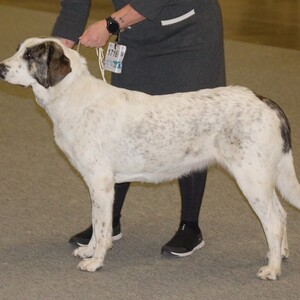
The base colour is white, always with a well-defined mask, sometimes with patches of the same colour as the mask, irregularly distributed. The ears are always patched, and the tip of the tail and the lower legs are always white.
Training and socialisation
The standard describes it as friendly with people, calm, noble and very intelligent, but brave and proud with strangers. Towards other dogs it is tolerant and aware of its strength.
The AKC says that, like other livestock guardians, it thinks independently and has to be motivated to work. It can be very obedient if trained from puppyhood, especially with rewards.
Tips for effective training
- Start early. The AKC recommends training from puppyhood.
- Use rewards. It has to be motivated to work.
- Be patient. It thinks independently.
- Keep a towel handy. The AKC gives it top marks for drooling.
Activity needs and lifestyle
The AKC says it saves its energy for when it is needed: most enjoy lying on the sofa or on cool tiles, but also hikes and quiet walks. For growing puppies, structured exercise should be limited.
| Activity | How often | Why it matters |
|---|---|---|
| Quiet walks | daily | Moderate exercise |
| Time in a large yard | daily | It guards its territory |
| Hiking | occasionally | Stamina |
Tips for a balanced life
- It needs a house with a large yard.
- Limited exercise for puppies.
- In summer, give it shade and a cool place.
Care and health
Coat and skin care
The AKC says that, as it has a double coat, dirt is easily brushed out. The feathering on the backs of the legs, belly and rump should be brushed weekly. The nails, including the front and rear dewclaws, should be trimmed regularly.
Common health problems
The AKC says responsible breeders screen their dogs for:
| Condition | Description | Common symptoms |
|---|---|---|
| Hip dysplasia | The hip joint forms incorrectly and, over time, arthritis develops | Limping, difficulty getting up or jumping, hip pain |
| Elbow dysplasia | The elbow joint develops incorrectly and arthritis appears | Limping on the front legs, especially after exercise |
| Degenerative myelopathy | A disease that gradually affects the spinal cord | Weakness in the hind legs |
| Gastric dilatation-volvulus (bloat) | The stomach fills with gas and may twist; this is a veterinary emergency | Swollen belly, trying to vomit without success, drooling, restlessness |
Other care
- Check the drop ears regularly.
- Trim the dewclaws.
- Wipe its mouth often.
Diet and nutrition
The AKC says females can stay on puppy food until 18 months and males until 2 years, and that glucosamine, chondroitin or fish oil help the joints of a growing giant.
Tips for a healthy diet
The table gives a starting estimate, calculated with the formula from the Merck Veterinary Manual. The first two calorie columns show the calories per day for a healthy adult dog. The last column shows what this means in dry food with 3,500–4,000 kcal per kilogram.
| Dog's weight | Calories per day (neutered) | Calories per day (not neutered) | Dry food per day (approximate) |
|---|---|---|---|
| 55 kg | 2,260 kcal | 2,540 kcal | 560–730 g |
| 70 kg | 2,710 kcal | 3,050 kcal | 680–870 g |
| 85 kg | 3,140 kcal | 3,530 kcal | 780–1010 g |
- Split the food into two meals a day to reduce the risk of bloat.
- Do not let it run right after a meal.
- Puppies need growth food suited to very large breeds.
Foods to avoid
Some human foods are dangerous for dogs: chocolate, coffee, grapes and raisins, onions, garlic, xylitol (a sweetener used in chewing gum), macadamia nuts and alcohol.
Reproduction and development
Physical and emotional maturity
In dogs, sexual maturity usually comes between 6 and 12 months, but in large breeds it can be delayed until about two years. Very large breeds become adults only at around 2 years.
Mating and pregnancy
Pregnancy lasts about 63 days, counted from ovulation. Mating a female on her first heat is not recommended. The FCI standard requires that only healthy dogs of typical breed appearance are used for breeding.
Caring for the puppies
In large breeds, a litter has around 7 puppies on average. The puppies grow very fast, so they need growth food suited to large breeds. Socialisation starts in the first weeks.
Interesting facts
- No height limit. The standard prefers the bigger dog.
- The spiked collar. Wikipedia shows the “carlanca”, the Spanish spiked collar worn against wolves.
- The wolf fighter. It has fought wolves for hundreds of years.
- Patched ears. The ears are always patched.
- Lazy for a reason. The AKC says it saves its energy for when it is needed.
Frequently asked questions
How big does it get?
Males measure at least 77 cm and females at least 72 cm; the AKC gives 54–86 kg.
Is it aggressive?
It is friendly with people, but brave and proud with strangers.
Is it the same as the Spanish Mastiff?
No, they are separate breeds.
How long does it live?
The AKC gives 10–12 years.