Cornish RexCharacteristics, history, behaviour and care
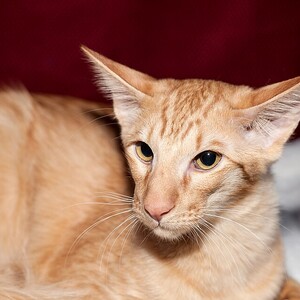
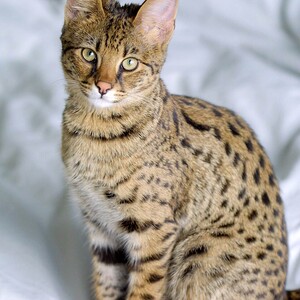
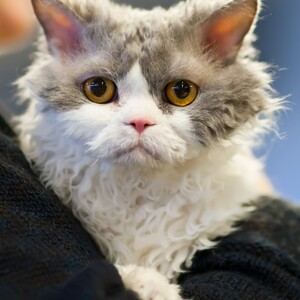
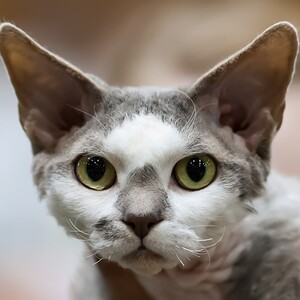
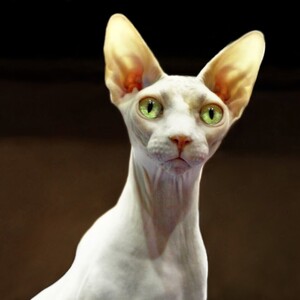
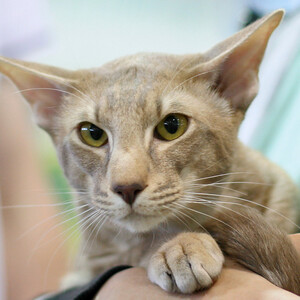
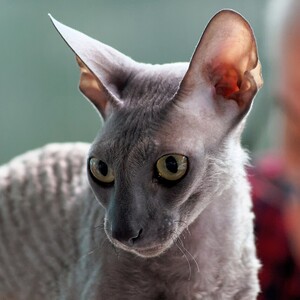
Cornish Rex at a cat show. · Jakub Hałun / Wikimedia Commons, CC BY-SA 4.0 (https://creativecommons.org/licenses/by-sa/4.0). Cropped and resized.
The Cornish Rex is a breed from Cornwall, in Britain, with a short, very fine coat that curls in waves. Unlike other cats, it has only down, without the long hairs on top. It is slender, with long legs and very large ears; it is called the “greyhound of cats”. It is curious and playful and wants to take part in everything that happens in the house.
Quick facts
| Common name | Cornish Rex |
| Scientific name | Felis catus |
| Country of origin | United Kingdom (Cornwall) |
| Official recognition | FIFe since 1968 (code CRX, category 4); GCCF, CFA, TICA |
| Lifespan | We found no data for the breed; pet cats live about 13 years on average |
| Weight | Females 2.5–3.5 kg, males 3–4.5 kg |
| Size | Medium |
| Body type | Slender but muscular, with long legs |
| Coat type | Down only: very short, fine, curling in waves |
| Common colours | Any colour and pattern |
| Eye colour | Medium to large, any colour |
| Activity level | Very high |
| Temperament | Curious, playful, affectionate, dislikes being alone |
| Good with children | Good with children |
| Good with other pets | Enjoys the company of other cats and dogs |
| Genetic predispositions | We found no specific diseases in the sources; sensitive to cold |
- Primary category:Cat breeds
- Explore this animal's categories:
History and origin
Every Cornish Rex in the world descends from a single tomcat, Kallibunker, born on 21 July 1950. He was one of the five kittens of Serena, a tortoiseshell farm cat from near Bodmin Moor, in Cornwall.
Kallibunker was mated with his mother and two more curly kittens were born. The breed was then developed with house cats and British cats. Poldhu's daughter, Lamorna Cove, was taken to America and crossed with a Siamese; the long, thin tail and the large ears come from there.
In 2013, researchers found the mutation that gives the curly coat: a small deletion in the LPAR6 gene, which is important for the structure of the hair.
How the breed developed
- 21 July 1950 – Kallibunker, the first Cornish Rex, is born.
- The 1950s – more curly kittens appear; breeding begins.
- 1968 – recognised by FIFe.
- 2013 – the LPAR6 gene mutation is discovered.
At a glance: who is it right for?
- Families who spend a lot of time at home. French Wikipedia says it hates being alone.
- Warm homes. Its thin coat makes it sensitive to cold.
- People who want a very active cat. It jumps very high and wants to be everywhere.
- Homes with other pets. It enjoys the company of other cats and dogs.
Physical characteristics
The FIFe profile describes it as a medium-sized cat, slender but muscular. The difference between the sexes is clear: the female is elegant and delicate, the male more muscular. German Wikipedia gives 2.5–3.5 kg for females and 3–4.5 kg for males. The hind legs are slightly longer than the front legs, so it jumps very high.
General appearance
The head is egg-shaped, with a straight profile and a flat forehead. The ears are very large, broad at the base and set upright. The eyes are medium to large, with an alert expression. It is called the “greyhound of cats” because of its slender body and its galloping run.
| Feature | Cornish Rex |
|---|---|
| Size | Medium |
| Weight | 2.5–4.5 kg |
| Body | Slender, muscular |
| Head | Egg-shaped |
| Ears | Very large, upright |
| Legs | Long; the hind legs slightly longer |
| Coat | Down only, curling in waves |
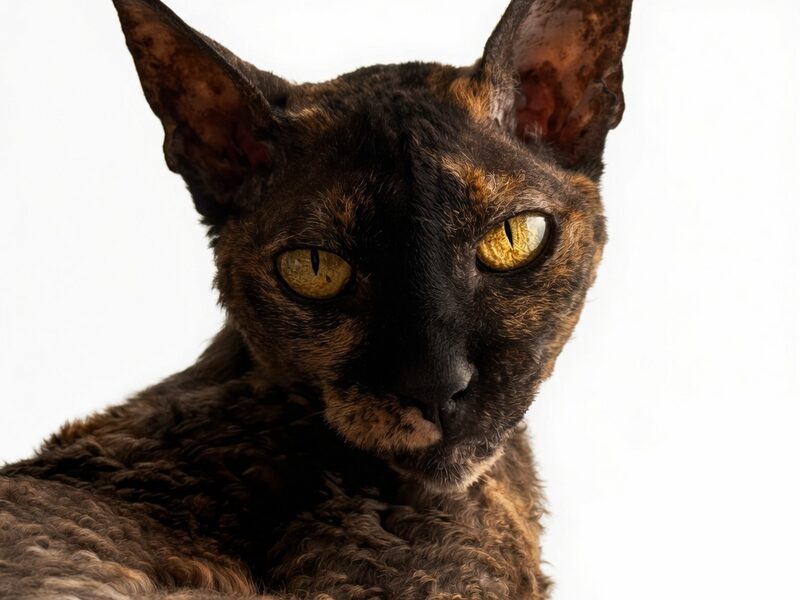
Most cats have three types of hair: the long top hairs, a middle layer and the down. The Cornish Rex has only the down, very fine and curly. It can be any colour.
Related breeds and how to tell them apart
The Devon Rex looks similar, but its curly coat comes from a different mutation and it has short top hairs, so it sheds. The German Rex also has a curly coat, but a less slender body.
Behaviour and temperament
The FIFe profile says it wants to take part in the whole life of the house; if something interesting is happening in two places at once, it tries to be in both. At first it may keep its distance, but then it ends up sitting on its owner's shoulder or even head.
French Wikipedia describes it as very sociable, lively and very playful, affectionate and always looking for cuddles. It is attached to its owner and follows them everywhere.
Socialisation
It enjoys the company of other cats and dogs and hates being alone.
A kitten gets used to new people, noises and other animals most easily in its first months of life.
Habits at home
Like all cats, it sleeps a lot: usually 12–16 hours a day. It is most active early in the morning and in the evening, but partly adapts to the family's routine.
Cats instinctively bury their droppings, so it quickly learns to use a litter tray. It scratches rough surfaces to shed the old outer layer of its claws, so it needs a scratching post or board.
Life at home and activity
It is very active: it runs at a gallop and jumps very high. It needs daily play and high places.
| Activity | How often | Why it matters |
|---|---|---|
| Warm spots (blanket, heated bed) | always within reach | Its coat is thin and it feels the cold |
| Play with toys (wand toys, balls) | daily | Play imitates hunting and uses up its energy |
| Scratching post or board | always available | It looks after its claws without damaging the furniture |
| High places (cat tree, shelves) | always available | It has somewhere to watch from and to rest |
Tips for a balanced life
- Keep it indoors, in the warm; it is not suited to staying outside in the cold.
- Give it tall shelves and climbing frames.
- Do not leave it alone for many hours; a second cat helps.
Care and health
Coat care
The coat does not need frequent brushing; a harsh brush can damage it. French Wikipedia recommends cleaning the ears and eyes regularly. Because it has no protective guard hairs, it is best kept indoors, warm and dry.
Common health problems
French Wikipedia says that, although it looks fragile, it is no more delicate than other cats, it just feels the cold easily. The sources consulted do not describe diseases typical of the breed.
Recommended genetic tests
Ask the breeder whether the parents have been checked by a vet, including their heart and kidneys.
Is it hypoallergenic?
Cat allergy is caused mainly by the Fel d 1 protein, found in saliva and skin glands; it is behind the allergy in 90% of people who are allergic to cats. Kittens, females and neutered males produce less of it, but still enough to trigger symptoms. No breed is completely hypoallergenic.
The Cornish Rex is among the breeds said to cause milder allergic reactions. However, research on whole breeds is not complete, so someone with allergies should spend time with the cat before taking it home.
Other care
- A check-up at the vet once a year.
- Vaccinations and parasite treatment on the schedule set by the vet.
- Trim the claws if they do not wear down on their own.
- Clean its teeth or give it food that helps keep them clean.
Diet and nutrition
The cat is a carnivore: it needs animal protein. Unlike a dog, it must get vitamin A, arachidonic acid and taurine from its food. Water is very important, because cats usually drink little; several water bowls around the house encourage it to drink.
Tips for a healthy diet
The table gives a starting estimate, calculated with the formula from the Merck Veterinary Manual for a healthy adult cat. The last column shows what this means in dry food with 3,500–4,000 kcal per kilogram. If you also feed wet food, reduce the dry portion.
| Cat's weight | Calories per day (neutered) | Calories per day (not neutered) | Dry food per day (approximate) |
|---|---|---|---|
| 2.5 kg | 170 kcal | 190 kcal | 42–54 g |
| 3 kg | 190 kcal | 220 kcal | 48–63 g |
| 3.5 kg | 210 kcal | 250 kcal | 52–71 g |
| 4.5 kg | 260 kcal | 300 kcal | 65–86 g |
- Adjust the portion to its weight: neutered cats put on weight easily.
- Weigh it monthly; the ribs should be easy to feel under your fingers.
- Kittens need more calories: Merck recommends 2.5 times the resting energy requirement.
Dangerous foods and substances
Some common household items are dangerous for cats:
- Lilies (and daylilies): they can destroy a cat's kidneys. Even the pollen or the water in the vase is dangerous.
- Paracetamol: extremely toxic to cats, which lack the enzyme that breaks it down. Never give it human medicines.
- Flea spot-ons and collars for dogs containing permethrin: the concentration meant for dogs is dangerous for cats.
- Foods: chocolate, coffee, alcohol, onions, garlic, grapes and raisins.
Reproduction and development
Maturity
Females usually reach sexual maturity at 5–10 months, and males at 5–7 months. The age varies from breed to breed.
Mating and pregnancy
Pregnancy in cats lasts 64–67 days, 65 on average. A first litter usually has fewer kittens than later ones. Only healthy cats that match the breed standard are used for breeding.
Blood type
Cats have blood type A, B or AB. Type A is the most common: in a study from England, 87.1% of non-pedigree cats and 54.6% of pedigree cats had type A. This matters for breeding: if the mother is type B and the kittens are type A, the antibodies in her first milk (colostrum) can destroy their red blood cells. The condition is called neonatal isoerythrolysis. That is why breeders test the blood type of both parents.
We found no published data on how common type B is in this breed; the test is done before mating anyway.
Caring for the kittens
Kittens are weaned at 6–7 weeks. They are ready to go to their new home at about 12 weeks, when they can be separated from their mother.
Neutering
Neutering used to be done at 6–9 months, but it is more and more often done before puberty, at around 3–6 months. It prevents unwanted kittens, urine marking in males and the loud “calling” of females in heat. A 2024 study found that neutered cats live one year longer on average. After the operation, the metabolism slows down and appetite increases, so the portion has to be reduced.
How to choose a kitten
- Ask for the pedigree from a recognised cat association (for example, a FIFe member).
- The kitten leaves its mother at about 12 weeks.
- Look at the mother and at the place where the kittens are raised: it should be clean, with kittens used to people.
- Ask about vaccinations, parasite treatment and the blood type of the parents.
Interesting facts
- A single ancestor. Every Cornish Rex descends from Kallibunker, born in 1950 on a farm in Cornwall.
- Down only. It has no long top hairs; all you see is the curly down.
- “The greyhound of cats”. It is called that because of its slender body and its galloping run.
- It loves blankets. It likes to wrap itself in a blanket or sleep under the sheet.
Frequently asked questions
Why is its coat curly?
Because of a mutation in the LPAR6 gene; it has only down, without the long hairs on top.
Does it feel the cold?
Yes, easily. It is best kept indoors, in the warm, with somewhere to heat up.
Is it hypoallergenic?
No cat is completely hypoallergenic, but the Cornish Rex is among the breeds said to cause milder reactions.
How is it different from the Devon Rex?
They are different mutations; the Devon Rex also has short top hairs, while the Cornish Rex has only down.