Bowhead whaleInteresting facts and information
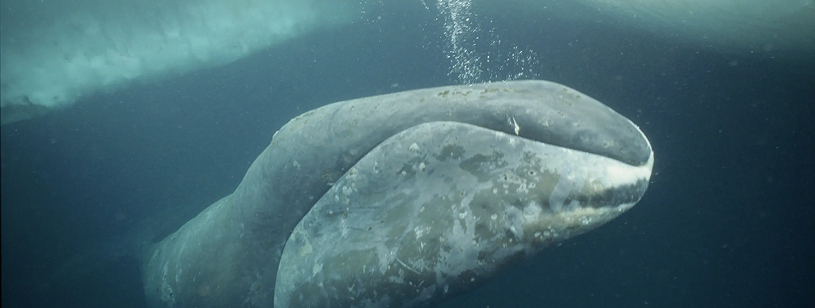
The bowhead whale (Balaena mysticetus) is a baleen whale adapted to Arctic and subarctic waters with seasonal sea ice. It has a massive head, a thick layer of blubber and very long baleen plates.
Evidence suggests that some bowheads can live for more than 200 years. They make seasonal movements within northern waters as ice and feeding conditions change.
Past commercial whaling severely reduced bowhead populations. Recovery and current pressures differ between stocks; climate change, entanglement, noise and vessel strikes remain concerns.
Quick facts
| Common name | Bowhead whale |
| Scientific name | Balaena mysticetus |
| Typical lifespan | Evidence suggests some individuals can live for over 200 years |
| Length | About 14-18 m |
| Weight | About 75-100 tonnes |
| Diet type | Small zooplankton, especially copepods and euphausiids |
| Main predators | Killer whales (mainly calves); people (hunting in the past) |
| Conservation status | Least Concern globally (IUCN); some populations endangered, and listed as endangered under the US Endangered Species Act |
| Distribution | Arctic and subarctic waters |
| Living environment | Cold, ice-covered seas and the edges of the pack ice |
- Primary category:Marine mammals
- Explore this animal's categories:
Interesting facts
- Longevity – Evidence suggests a lifespan exceeding 200 years in some individuals; this is an age estimate, not an exact birthday record.
- Ice-breaker - With its massive head, a bowhead can break through sea ice more than half a metre thick to breathe.
- The longest baleen - Its baleen plates can be about 4 m long or more, longer than those of any other whale.
- An Arctic whale - Unlike most large whales, the bowhead spends its whole life in Arctic and subarctic waters, moving with the sea ice.
- Jazz singers - Bowheads in the Arctic sing a huge variety of songs, and their repertoire changes from year to year, which has led scientists to compare them to jazz musicians.
Records and remarkable features
- Long lives – Bowheads are among the longest-lived mammals known.
- The longest baleen - Up to about 4-4.5 m long, longer than in any other whale.
- The thickest blubber - Its layer of blubber can be about 40-50 cm thick, the thickest of any animal, keeping it warm in icy water.
- Life near sea ice – Bowheads are adapted to Arctic and subarctic waters; other cetaceans also use icy northern habitats.
- Old harpoons - Pieces of 19th-century harpoons have been found in bowheads killed in Alaska in the 2000s, showing that they had lived for well over a century.
Physical characteristics and adaptations
The bowhead whale (Balaena mysticetus) is the baleen whale best adapted to life in the Arctic, with a huge, rounded body, very thick blubber and a strong head that can break ice.
Key physical adaptations
- A stocky, rounded body - Its bulky shape helps it keep in heat.
- An enormous head - About a third of its body length, the head is strong enough to push up through ice to make breathing holes.
- Thick blubber - Up to about 50 cm thick, it keeps the whale warm in near-freezing water.
- Very long baleen - Up to about 4 m long, used to filter tiny animals from the water.
- No dorsal fin - Like right whales, the bowhead has no fin on its back, which helps it swim under the ice.
- Large lungs - It usually dives for about 10-20 minutes, but can stay underwater for up to about an hour.
What does the bowhead whale look like?
| Characteristic | Details |
|---|---|
| Colour | Black, with a white patch on the chin and often white on the tail stock |
| Length | About 14-18 m |
| Weight | About 75-100 tonnes |
| Baleen | Dark grey to black, up to about 4 m long |
| Flippers | Short and broad |
| Dorsal fin | None |
Habits and behaviour
Bowhead whales usually travel alone or in small groups and are known for their varied songs.
Daily life
- Small groups - Bowheads usually travel alone or in groups of a few animals, but larger groups gather in rich feeding areas.
- Seasonal movements - They move north in spring as the ice breaks up and south in autumn as it forms again, but stay in cold northern waters.
- Songs and calls - Males sing complex songs, especially in winter and spring.
- Feeding - They feed at the surface, in mid-water and near the sea floor, often in waters about 100-200 m deep.
- Rubbing on rocks - In Canada, bowheads have been filmed rubbing against rocks, probably to help remove old, peeling skin.
Specific behaviors
- Breaking ice - They push up through thin ice with their heads to make breathing holes.
- Showing the tail - Bowheads often lift their tail flukes before a deep dive.
- Breaching - Although less often than humpbacks, bowheads sometimes leap out of the water.
Survival strategies
- Predation – Killer whales can attack bowheads. Risk varies with age, size and ice conditions.
- Hiding in the ice - Bowheads may move into areas of thick ice, where killer whales are less likely to follow.
- Navigating under ice - They seem to use sound to find their way and locate openings in the ice.
Habitat and geographic distribution
Bowheads live in Arctic and subarctic waters and make seasonal movements influenced by ice and feeding conditions.
Distribution context
| Region | Population information | Habitat examples |
|---|---|---|
| Bering, Chukchi and Beaufort Seas | The largest population, more than 15,000 whales and increasing | Waters off Alaska, Canada and Russia |
| Eastern Canada and West Greenland | Several thousand; recovering | Baffin Bay, Davis Strait, Hudson Bay |
| Sea of Okhotsk | A small population of a few hundred | Northern Sea of Okhotsk |
| Svalbard and the Barents Sea | A very small population, almost wiped out by whaling | Waters around Svalbard and Franz Josef Land |
Habitat types
- Waters near sea ice - Bowheads live near the edge of the pack ice and in open channels between the ice.
- Rich feeding areas - They gather where currents bring together large numbers of tiny crustaceans.
- Shallow seas - They often feed over continental shelves.
Environmental change
- Melting sea ice - Less ice changes their habitat and may bring more ships and killer whales into the Arctic.
- Ship traffic - More shipping in the Arctic increases the risk of collisions.
- Noise - Noise from ships and oil and gas exploration can disturb their communication.
Diet and feeding
The bowhead whale is a filter feeder that eats huge numbers of tiny crustaceans. Its very long baleen lets it filter even very small prey.
What does the bowhead whale eat?
| Food group | Examples |
|---|---|
| Copepods | Tiny crustaceans such as Calanus species, often the main food |
| Krill | Arctic krill such as Thysanoessa species |
| Other small animals | Amphipods, mysids and occasionally small fish |
Feeding methods
- Skim feeding - The whale swims slowly with its mouth open, and water flows through its baleen, which traps the food.
- Feeding in rich areas - Bowheads look for places where currents and ice edges concentrate their prey.
- Feeding near the bottom - They also feed close to the sea floor, sometimes coming up with mud on their heads.
- Living on fat - When food is scarce, they live on their thick blubber.
Reproduction and life cycle
Bowhead whales breed very slowly, which made it hard for them to recover after centuries of whaling.
Breeding season
- Mating is thought to take place mainly in late winter and spring.
- Males sing complex songs during the breeding season, probably to attract females.
- Several males may gather around one female.
Developmental stages
| Stage | Duration | Characteristics |
|---|---|---|
| Gestation | About 13-14 months | The female gives birth to a single calf |
| Newborn calf | About 4-4.5 m long | Weighs about a tonne |
| Nursing | About 9-12 months | Grows quickly on rich, fatty milk |
| Independence | After weaning | Young whales grow slowly for many years |
| Sexual maturity | About 20-25 years | One of the latest ages of maturity of any mammal |
Survival strategies
- Fatty milk helps calves build up blubber quickly in their first months.
- Mothers stay close to their calves and protect them from killer whales.
- Females usually give birth only every 3-4 years, so populations grow slowly.
Name and history
Origin of the name
- Common name – “Bowhead” refers to the arched shape of the head and lower jaw. “Greenland whale” is another historical name.
- The scientific name Balaena mysticetus comes from Latin and Greek: Balaena means "whale", and mysticetus is an old Greek word probably linked to the whale's "moustache" of baleen.
Taxonomic classification
| Classification | Name |
|---|---|
| Kingdom | Animalia |
| Phylum | Chordata |
| Class | Mammalia |
| Order | Artiodactyla (cetaceans) |
| Family | Balaenidae |
| Genus | Balaena |
| Species | Balaena mysticetus |
Evolution and fossils
- The bowhead belongs to the right whale family (Balaenidae), together with the three species of right whales.
- Right whales and bowheads are only distantly related to rorquals such as the blue whale and the humpback.
- Fossils of the bowhead's relatives date back several million years.
Cultural significance and mythology
For the Indigenous peoples of the Arctic, the bowhead whale has been a vital source of food and materials for thousands of years and is at the heart of their culture.
- Iñupiat whaling - The Iñupiat of Alaska still hunt a small number of bowheads each year under international rules, sharing the meat across their communities.
- Nalukataq - After a successful spring whaling season, Iñupiat communities hold a festival with the famous blanket toss.
- Commercial whaling - From the 17th century, European and American whalers hunted bowheads for their oil and baleen, which was used to make corsets, whips and umbrellas.
Conservation status and threats
The bowhead whale was one of the most heavily hunted whales in history because of its thick blubber and long baleen. Today the species as a whole is recovering, but some small populations remain endangered.
Main pressures
- Past whaling - Commercial whaling from the 17th to the early 20th century reduced bowhead populations to a fraction of their former size.
- Melting Arctic ice - Climate change is changing their habitat and food supply.
- Noise - Increasing shipping and industry in the Arctic may disturb their communication.
- Ship strikes and entanglement - More ships and fishing gear in the Arctic increase the risk of injury.
- Oil and gas - Exploration and possible oil spills threaten Arctic waters.
Current population
- Before commercial whaling, there were probably more than 50,000 bowheads.
- Today, there are thought to be about 25,000 or more, and the species as a whole is listed as Least Concern by the IUCN.
- The Svalbard-Barents Sea population is still very small and endangered.
Protection efforts
| Measure | Organization / Action |
|---|---|
| Ban on commercial whaling | International Whaling Commission (bowheads protected since the 1930s) |
| Managed subsistence hunting | Small quotas for Indigenous communities in Alaska, Russia, Canada and Greenland |
| Monitoring | Population counts and satellite tracking by scientists and Indigenous communities |
| Reducing noise | Rules for shipping and industry in important bowhead areas |
Bowhead whale in popular culture
As one of the longest-lived animals on Earth, the bowhead whale fascinates writers, filmmakers and scientists.
Bowhead whale as a symbol
- Longevity - The bowhead is a symbol of very long life, and scientists study it to understand how it avoids cancer and other diseases of old age.
- Moby-Dick - Herman Melville's novel describes the "Greenland whale", an old name for the bowhead.