African grey parrotPsittacus erithacus — habitat, diet and reproduction
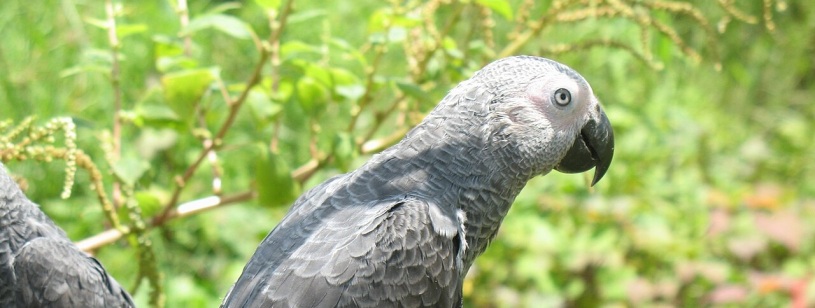
An African grey parrot perched on a branch. · Lucy Keith-Diagne / CC BY 4.0 (https://creativecommons.org/licenses/by/4.0). Cropped and resized.
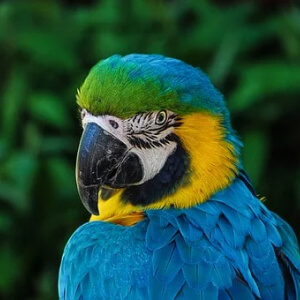
The African grey parrot has grey plumage, a black bill and a bright red tail. It is known for learning sounds and solving certain cognitive tasks. In the wild, its life depends on forests, trees with nesting hollows and relationships within the flock.
Quick facts
| Common name | African grey parrot, grey parrot |
| Scientific name | Psittacus erithacus |
| Lifespan | May reach 50–60 years in human care; longevity varies |
| Length | About 33 cm |
| Weight | Around 400 g |
| Diet | Mainly fruit, seeds and other plant foods |
| Predators | Birds of prey; mammals may take eggs and chicks |
| Conservation status | Endangered (EN), globally |
| Distribution | Forested regions of equatorial Africa |
| Habitat | Rainforest, forest edges and gallery forest |
| Family | Psittacidae |
| Nest | Hollow in a tall tree |
Interesting facts
- African greys imitate other animals as well as sounds heard around people.
- Birds share roosts and split into smaller feeding groups.
- The red tail is a useful identification feature in flight.
- Some trained greys have learned vocal labels for objects and their properties.
Characteristics
Pale feather edges create a scalloped pattern on the neck and breast. Whitish skin surrounds the eyes. The strong, hooked bill handles foods with tough coverings.
The related Timneh parrot, Psittacus timneh, has a maroon tail and a pale area on the upper bill. This account concerns Psittacus erithacus, the bright red-tailed species.
Behaviour
Calls maintain contact during travel. Other signals convey alarm or occur during interactions between partners and during food begging. Listening and learning are important parts of flock life.
Irene Pepperberg’s research examined recognition of colours, shapes and quantities in trained individuals. These results describe abilities demonstrated under particular conditions. They do not imply that every grey automatically understands human speech.
Foraging activities and safe objects provide learning opportunities in human care. New objects are best introduced gradually because some individuals are cautious about change.
Habitat and distribution
African greys inhabit equatorial African forests, including the Congo Basin. They use mature forest, forest edges, mangroves and riverine woodland. Cultivated ground may also provide food.
Tall trees offer roosting sites and nesting cavities. Forest fragmentation separates these resources and can make movements between them more difficult.
Diet and feeding
Wild foods include fruit, seeds, nuts and other plant material. Oil-palm fruit is eaten in some areas. Birds use their bill and feet to hold and process food.
Fruit availability influences feeding locations. Groups visit trees as crops ripen, moving through forest and its edges.
Reproduction and life cycle
Pairs nest in a hollow within a tall tree. World Parrot Trust describes clutches of usually two or three eggs. The female incubates while the male provides food.
Incubation takes about 30 days. Both parents feed the young, which leave the cavity at roughly 11–12 weeks. Parental care and learning continue after the first flights.
Name and history
The species is also called the grey parrot or Congo African grey. Its scientific name is Psittacus erithacus.
Alex became well known through research on communication and cognition: how animals process information. Tasks included selecting objects by colour or shape and answering questions about quantities.
Conservation and threats
The species is globally Endangered. Capture for the bird trade and forest loss have reduced wild populations. Demand for companion birds has contributed to this pressure.
Protecting nesting trees and preventing illegal capture are important conservation measures. Birds kept by people should have documented origins.
Frequently asked questions
Do all African greys talk?
Imitation varies between individuals. Interaction and learning influence their repertoire, and some birds favour whistles or other sounds.
Are grey and Timneh parrots the same species?
Current classifications separate Psittacus erithacus from Psittacus timneh. Timneh parrots have darker tails and a pale area on the upper bill.
Is a grey parrot suitable for an impulse purchase?
It requires daily interaction, space and long-term care. Its lifespan may extend over several decades.
Why do some birds imitate a telephone?
They learn sounds from their surroundings. A repeated sound associated with human attention may enter their repertoire.