DalmatianCharacteristics, history, training and care
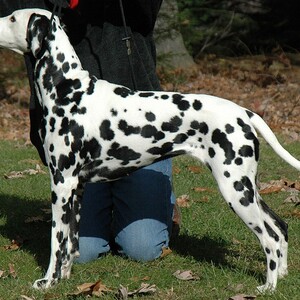
Dalmatian. · Mllefantine / Wikimedia Commons, public domain. Cropped and resized.
The Dalmatian is the white dog with black or brown spots, originally from the historical province of Dalmatia, in Croatia. It has been a hunting dog, a guard dog for horses and carriages and the firefighters' mascot. It is friendly, loyal, lively and easy to train, but it needs a great deal of exercise.
Quick facts
| Common name | Dalmatian (Dalmatinski pas) |
| Scientific name | Canis lupus familiaris |
| Country of origin | Croatia (Dalmatia) |
| Official recognition | FCI, standard published on 7 April 1955 (group 6, related breeds of scenthounds; standard no. 153); also recognised by the AKC |
| Lifespan | 11–13 years, according to the AKC; a 2024 British study found 13.2 years |
| Size (males) | 56–62 cm at the withers |
| Size (females) | 54–60 cm at the withers |
| Weight | about 20–32 kg (AKC) |
| Coat type | Short, glossy, harsh and dense |
| Common colours | White with black spots or white with brown spots |
| Energy level | High |
| Suited to an apartment? | It can adapt, if it gets plenty of exercise |
| Temperament | Friendly, lively, loyal, independent, easy to train |
| Tendency to aggression | Low; reserved with strangers |
| Good with children | Average; it is energetic |
| Good with other animals | Good; very good with horses |
| Genetic predispositions | Deafness, urinary stones, hip dysplasia |
- Primary category:Dog breeds
- Explore this animal's categories:
History and origin
The FCI standard says the Dalmatian's origins can be seen in paintings and church chronicles from the 16th to the 18th century. Dalmatians appear on the altarpiece “Madonna with Jesus and the Angels” in the church at Veli Lošinj (1600–1630) and in a fresco at Zaostrog, in Dalmatia. This suggests that the breed comes from the eastern Mediterranean, especially Dalmatia.
The first descriptions appear in the chronicles of Bishop Petar Bakić from 1719 and of Andreas Keczkemety from 1737, where the dog is called “Canis Dalmaticus”. In 1771, Thomas Pennant called it the “Dalmatian”, and in 1790 Thomas Bewick called it the “Dalmatian or Coach Dog”. The first unofficial standard was written in England in 1882 by Vero Shaw.
How the breed developed
- 1600–1630 – Dalmatians appear on an altarpiece in Veli Lošinj.
- 1719 and 1737 – Church chronicles describe the “Canis Dalmaticus”.
- 1771 – Thomas Pennant calls it the “Dalmatian”.
- 1882 – Vero Shaw writes the first unofficial standard.
- 1890 – The Dalmatian Club is founded in England.
- 7 April 1955 – The FCI publishes the first breed standard.
- 13 October 2010 – The current FCI standard is published.
Breed rating
| Feature | Stars |
|---|---|
| Training and intelligence | ★★★★☆ |
| Easy to train | ★★★★☆ |
| Intelligence | ★★★★☆ |
| Independence | ★★★☆☆ |
| Stubbornness | ★★★☆☆ |
| Behaviour and temperament | ★★★★☆ |
| Affectionate with family | ★★★★★ |
| Friendly with children | ★★★☆☆ |
| Good with other dogs | ★★★☆☆ |
| Good with cats and other animals | ★★★☆☆ |
| Loyalty | ★★★★★ |
| Tendency to be aggressive | ★★☆☆☆ |
| Tendency to bark | ★★★☆☆ |
| Needs and care | ★★★★☆ |
| Shedding | ★★★★☆ |
| Needs frequent grooming | ★★☆☆☆ |
| Activity and lifestyle | ★★★★☆ |
| Energy level | ★★★★☆ |
| Daily exercise needs | ★★★★★ |
| Suited to apartment life | ★★★☆☆ |
| Health and longevity | ★★★★☆ |
| Life expectancy | ★★★★☆ |
| Predisposition to genetic diseases | ★★★☆☆ |
| Working abilities and uses | ★★★★☆ |
| Good watchdog | ★★★★☆ |
| Good companion dog | ★★★★☆ |
Indicative rating: 5 stars means the highest level. It is based on the ratings the American Kennel Club gives the breed and on the FCI standard.
Physical characteristics
The standard describes it as a dog with a rectangular, strong, muscular body and characteristic spots. The AKC says it is an elegant dog built for trotting, with great stamina and a smooth, effortless gait.
General appearance
The colour of the oval eyes matches the spots: dark in black-spotted dogs, lighter in brown-spotted ones. The soft, triangular ears hang close to the head and are often spotted. The tail reaches roughly to the hock and is carried like a sabre.
| Feature | Dalmatian |
|---|---|
| Size | Large |
| Height at the withers | males: 56–62 cm; females: 54–60 cm |
| Weight | about 20–32 kg |
| Coat | Short, glossy, harsh |
| Spots | 2–3 cm on the body; smaller on the head and legs |
| Tail | Sabre-shaped, preferably spotted |
The ground colour is pure white. There are two varieties: with black spots and with brown spots. The spots should be well defined, evenly spread and preferably of equal size, 2–3 cm. Large patches are not wanted.
Training and socialisation
The standard describes it as friendly, lively, loyal, independent and easy to train, without nervousness or aggression. It loves water and outdoor activities and has a well-marked scenthound instinct.
The AKC says Dalmatians can be very sensitive, so positive, reward-based training is a must. Early socialisation, with as many pleasant new experiences as possible, is very important.
Tips for effective training
- Use only rewards. It is sensitive to harshness.
- Socialise it thoroughly as a puppy. It can be reserved with strangers.
- Do not overexert it until the age of 2. The AKC says that is when the bones and joints mature.
- Give it something to do. Without exercise, it easily gets into mischief.
Activity needs and lifestyle
The AKC says it can be a very high-energy dog and a wonderful partner for runners and hikers. It enjoys playing fetch, running alongside a bicycle and long hikes.
| Activity | How often | Why it matters |
|---|---|---|
| Running or brisk walk | daily | It was bred to run alongside carriages |
| Long hikes | weekly | Great stamina |
| Playing fetch with a ball | daily | Burns off energy |
Tips for a balanced life
- Always leave fresh water available.
- Take it out often to urinate.
- It suits a very active family.
Care and health
Coat and skin care
The AKC says the coat is easy to care for: a weekly brushing with a horsehair mitt or a rubber brush and an occasional bath. Even so, the AKC gives it a high score for shedding. The nails should be trimmed at least once a month.
Common health problems
The AKC says the Dalmatian is a relatively healthy breed, but it has two specific problems:
| Condition | Description | Common symptoms |
|---|---|---|
| Deafness | Hereditary deafness, in one or both ears | Does not react to sounds; breeders test the puppies |
| Urinary stones | A breed-specific tendency to form stones in the kidneys and bladder | Difficult or bloody urination |
| Hip dysplasia | The hip joint forms incorrectly and, over time, arthritis develops | Limping, difficulty getting up or jumping, hip pain |
Other care
- Check the ears regularly.
- Trim the nails at least once a month.
- Make sure the puppy has all its vaccinations, especially against parvovirus.
Diet and nutrition
The AKC says Dalmatians are not fussy eaters. For urinary stones, fresh water always within reach and frequent trips outside matter a great deal. A special diet is needed only if the problem appears.
Tips for a healthy diet
The table gives a starting estimate, calculated with the formula from the Merck Veterinary Manual. The first two calorie columns show the calories per day for a healthy adult dog. The last column shows what this means in dry food with 3,500–4,000 kcal per kilogram.
| Dog's weight | Calories per day (neutered) | Calories per day (not neutered) | Dry food per day (approximate) |
|---|---|---|---|
| 20 kg | 1,060 kcal | 1,190 kcal | 260–340 g |
| 26 kg | 1,290 kcal | 1,450 kcal | 320–410 g |
| 32 kg | 1,510 kcal | 1,700 kcal | 380–490 g |
- Give it its food in two meals a day.
- Ask your vet for advice on the right food if stones appear.
- A dog is at the right weight when you can feel its ribs without pressing hard.
Foods to avoid
Some human foods are dangerous for dogs: chocolate, coffee, grapes and raisins, onions, garlic, xylitol (a sweetener used in chewing gum), macadamia nuts and alcohol.
Reproduction and development
Physical and emotional maturity
In dogs, sexual maturity usually comes between 6 and 12 months, but in large breeds it can be delayed until about two years. The body also reaches its adult form later than in small breeds.
Mating and pregnancy
Pregnancy lasts about 63 days, counted from ovulation. Mating a female on her first heat is not recommended. The FCI standard requires that only healthy dogs of typical breed appearance are used for breeding.
Caring for the puppies
In large breeds, a litter has around 7 puppies on average. Socialisation starts in the first weeks: gentle handling, everyday noises and new people.
Interesting facts
- Puppies are born white. The spots start to appear after a few weeks.
- The firefighters' dog. It ran ahead of horse-drawn fire engines and has remained their mascot.
- A friend of horses. Dalmatians and horses get along very well.
- A circus dog. Its looks and intelligence made it popular in circus shows.
- Breed-specific stones. The tendency to form urinary stones is a peculiarity of the breed.
In popular culture
101 Dalmatians
The breed became very popular after the novel “The Hundred and One Dalmatians” (1956) by the British writer Dodie Smith and the 1961 Disney animated film. These were followed by the live-action film “101 Dalmatians” (1996) and its sequel “102 Dalmatians” (2000).
Frequently asked questions
Where does the Dalmatian come from?
From Croatia, from the historical province of Dalmatia.
Are they born with spots?
No. Puppies are born white, and the spots appear after a few weeks.
How big does it get?
Males measure 56–62 cm and females 54–60 cm; they weigh about 20–32 kg.
Is it suitable for a family?
Yes, for an active family. It is loyal and affectionate, but needs plenty of exercise.
How long does it live?
The AKC gives 11–13 years; a 2024 British study found 13.2 years.