BorzoiCharacteristics, history, training and care
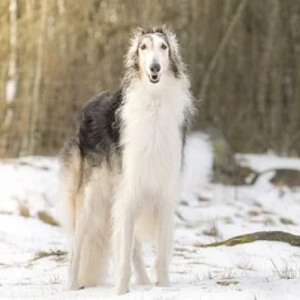
The Borzoi is a very tall, elegant sighthound with a long, silky coat, created in Russia to hunt hares, foxes and wolves. Until 1936 it was known in the West as the Russian Wolfhound. The FCI standard says it has a calm temperament and a neutral or friendly attitude towards people.
Quick facts
| Common name | Borzoi (Russian Wolfhound) |
| Scientific name | Canis lupus familiaris |
| Country of origin | Russia |
| Official recognition | FCI, definitively since 13 January 1956 (group 10, sighthounds; standard no. 193) |
| Lifespan | 12 years on average, according to a 2024 UK study; the AKC gives 9–14 years |
| Size (males) | 75–85 cm at the withers; 34–48 kg (AKC) |
| Size (females) | 68–78 cm at the withers; 27–39 kg (AKC) |
| Coat type | Long, silky, wavy or slightly curly |
| Common colours | Almost all, from white to black, solid, patched or with tan |
| Energy level | Moderate at home, very high when running |
| Suited to an apartment? | Only with a daily run in an enclosed area |
| Temperament | Calm, affectionate, independent |
| Tendency to aggression | Low towards people; strong hunting instinct |
| Good with children | Good with older children |
| Good with other animals | Good with other dogs; may chase cats and small animals |
| Genetic predispositions | Heart disease, bloat, sensitivity to anaesthesia |
- Primary category:Dog breeds
- Explore this animal's categories:
History and origin
According to Wikipedia, the breed appeared in 16th-century Russia, from crosses between Saluki-type sighthounds and thick-coated Russian dogs. The name comes from an old Russian word meaning “swift”. Before 1917, Borzois were not sold, but given as gifts by the tsar.
Grand Duke Nikolai Nikolaevich bred a great many Borzois on his estate at Perchino. The FCI standard says the first breed standard was written in 1888 by N. P. Ermolov. After the 1917 revolution, Borzois were seen as a symbol of the tsars and were killed in large numbers.
The breed survived mainly thanks to dogs exported earlier to the West. The FCI recognised it definitively on 13 January 1956. It is related to the Saluki, the Afghan Hound and the Tazy.
How the breed developed
- 16th century – The first Russian sighthounds appear.
- 1888 – The first standard, written by N. P. Ermolov.
- After 1917 – The breed almost disappears in Russia.
- 1936 – The name Russian Wolfhound is replaced by Borzoi.
- 13 January 1956 – Definitive FCI recognition.
Breed rating
| Feature | Stars |
|---|---|
| Training and intelligence | ★★★★☆ |
| Easy to train | ★★☆☆☆ |
| Intelligence | ★★★☆☆ |
| Independence | ★★★★★ |
| Stubbornness | ★★★★☆ |
| Behaviour and temperament | ★★☆☆☆ |
| Affectionate with family | ★★★☆☆ |
| Friendly with children | ★★★☆☆ |
| Good with other dogs | ★★★☆☆ |
| Good with cats and other animals | ★★☆☆☆ |
| Loyalty | ★★★☆☆ |
| Tendency to be aggressive | ★☆☆☆☆ |
| Tendency to bark | ★★☆☆☆ |
| Needs and care | ★★★☆☆ |
| Shedding | ★★★☆☆ |
| Needs frequent grooming | ★★☆☆☆ |
| Activity and lifestyle | ★★★☆☆ |
| Energy level | ★★★★☆ |
| Daily exercise needs | ★★★★☆ |
| Suited to apartment life | ★★☆☆☆ |
| Health and longevity | ★★★☆☆ |
| Life expectancy | ★★★☆☆ |
| Predisposition to genetic diseases | ★★★☆☆ |
| Working abilities and uses | ★★★★☆ |
| Good sight-hunting dog | ★★★★☆ |
| Good companion dog | ★★★★☆ |
Indicative rating: 5 stars means the highest level. The rating is based on the breed's AKC profile (trainability 2 out of 5, energy 4 out of 5, barking 2 out of 5) and on the FCI standard.
Physical characteristics
The FCI standard describes it as an aristocratic dog, tall and lean, with strong but not massive bones. The body is slightly longer than its height, and the back forms a gentle arch. The head is narrow and very long.
General appearance
The coat is silky and soft, wavy or in small curls. On the neck it forms a mane, and on the legs, thighs and tail it has long feathering. According to Wikipedia, the undercoat thickens in winter and falls out in hot weather.
| Feature | Borzoi |
|---|---|
| Size | Very large |
| Height at the withers | males: 75–85 cm; females: 68–78 cm (FCI) |
| Weight | males: 34–48 kg; females: 27–39 kg (AKC) |
| Coat | Long, silky, wavy |
| Colour | From white to black |
| Head | Narrow and very long |
The standard accepts any colour from white to black, solid, patched or with tan. Brown, blue, isabella (lilac) and other dilute colours, in which the nose is not black, are not accepted.
Training and socialisation
According to Wikipedia, it learns selectively and quickly gets bored with repeated exercises. Its AKC profile gives it 2 stars out of 5 for ease of training. With patience, it can do well even in obedience and agility competitions.
Like any sighthound, it sets off after a running animal and no longer hears the recall. Lessons should be short, gentle and rewarding.
Tips for effective training
- Keep lessons short. It gets bored quickly.
- Use rewards. Harshness does not work.
- Let it off the lead only in an enclosed area. It chases anything that runs.
- Socialise it with cats from an early age. Otherwise it may see them as prey.
Activity needs and lifestyle
The standard says that when searching for game it moves at a slow trot, and switches to a gallop in pursuit. At home it is usually calm, but it needs long walks every day and, from time to time, a free run in a well-fenced area.
| Activity | How often | Why it matters |
|---|---|---|
| Long walks | daily | Fitness |
| Running in a fenced area | several times a week | Sighthound instinct |
| Lure coursing (chasing a lure) | occasionally | A busy mind |
Tips for a balanced life
- Suits calm, patient owners.
- A large yard with a high fence.
- A soft bed, as it has little fat.
Care and health
Coat and skin care
The long coat is brushed once or twice a week, and more often during the moult. Its AKC profile gives it 2 stars out of 5 for grooming. The feathering on the legs and tail tangles most easily.
Common health problems
A 2024 study in the United Kingdom found a life expectancy of 12 years. An American study of healthy dogs found heart murmurs in 53.8% of them. Like other sighthounds, it is slower to wake up from anaesthesia.
| Condition | Description | Common symptoms |
|---|---|---|
| Heart disease | The heart valves do not close completely; some dogs develop heart disease | Tiredness, coughing, laboured breathing |
| Gastric dilatation-volvulus (bloat) | The stomach fills with gas and may twist; this is a veterinary emergency | Swollen belly, trying to vomit without success, drooling, restlessness |
| Sensitivity to anaesthesia | It has little fat and is slower to wake up | Long sleep after surgery |
Other care
- Tell the vet that it is a sighthound before any anaesthesia.
- Do not let it run after a meal.
- Have its heart checked every year.
Diet and nutrition
A large, lean sighthound needs good-quality food suited to its age and activity. Small, frequent meals reduce the risk of bloat.
Tips for a healthy diet
The table gives a starting estimate, calculated with the formula from the Merck Veterinary Manual. The first two calorie columns show the calories per day for a healthy adult dog. The last column shows what this means in dry food with 3,500–4,000 kcal per kilogram.
| Dog's weight | Calories per day (neutered) | Calories per day (not neutered) | Dry food per day (approximate) |
|---|---|---|---|
| 30 kg | 1,440 kcal | 1,620 kcal | 360–460 g |
| 38 kg | 1,710 kcal | 1,930 kcal | 430–550 g |
| 45 kg | 1,950 kcal | 2,190 kcal | 490–630 g |
- Split the food into two or three meals a day.
- Healthy sighthounds have a lean body: the last ribs and the hip bones are easy to see.
- Puppies need growth food suited to large breeds.
Foods to avoid
Some human foods are dangerous for dogs: chocolate, coffee, grapes and raisins, onions, garlic, xylitol (a sweetener used in chewing gum), macadamia nuts and alcohol.
Reproduction and development
Physical and emotional maturity
In dogs, sexual maturity usually comes between 6 and 12 months, but in large breeds it can be delayed until about two years. Very large breeds become adults only at around 2 years.
Mating and pregnancy
Pregnancy lasts about 63 days, counted from ovulation. Mating a female on her first heat is not recommended. The FCI standard requires that only healthy dogs of typical breed appearance are used for breeding.
Caring for the puppies
In large breeds, a litter has around 7 puppies on average. The puppies grow very fast, so they need growth food suited to large breeds. Socialisation starts in the first weeks.
Interesting facts
- A gift from the tsar. Before 1917 it was not sold, but received as a gift.
- Its name means “swift”. It comes from an old Russian word.
- Once a “wolfhound”. Until 1936 it was called the Russian Wolfhound.
- A heart to watch. 53.8% of the dogs in one study had heart murmurs.
- Saved from abroad. The breed survived through dogs exported before the revolution.
Frequently asked questions
Is it aggressive?
Rarely; the standard describes it as calm, neutral or friendly towards people.
How big does it get?
Males measure 75–85 cm at the withers and females 68–78 cm.
Can it be walked off the lead?
Only in an enclosed area; it chases any animal that runs.
How does it differ from the Afghan Hound?
The Borzoi is taller, and its coat is wavy, not straight and fine.