Tibetan TerrierCharacteristics, history, training and care
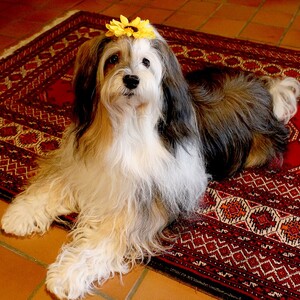
Tibetan Terrier. · Heisstudying / Wikimedia Commons, CC BY-SA 4.0. Cropped and resized.
The Tibetan Terrier is a sturdy, shaggy, medium-sized dog from Tibet. The FCI standard says that, despite its name, it is not a terrier but a herding dog, also used to guard merchants on the road to China, and describes it as lively, good-natured, loyal, outgoing, alert and intelligent, neither fierce nor quarrelsome, but sparing with its affection towards strangers.
Quick facts
| Common name | Tibetan Terrier (Tsang Apso) |
| Scientific name | Canis lupus familiaris |
| Country of origin | Tibet (China) |
| Official recognition | FCI, definitively since 18 December 1957 (group 9, companion and toy dogs; standard no. 209); also recognised by the AKC |
| Lifespan | 15–16 years, according to the AKC |
| Size (males) | 36–41 cm at the withers; 8–14 kg according to the AKC |
| Size (females) | slightly smaller |
| Coat type | Double: fine, woolly undercoat, profuse, long topcoat |
| Common colours | White, gold, cream, grey, black, particolour, tricolour |
| Energy level | High |
| Suited to an apartment? | Yes, with enough exercise |
| Temperament | Lively, good-natured, loyal, outgoing, intelligent |
| Tendency to aggression | Low |
| Good with children | Moderate |
| Good with other animals | Moderate |
| Genetic predispositions | Lens luxation, PRA, NCL, hip dysplasia, patellar luxation |
- Primary category:Dog breeds
- Explore this animal's categories:
History and origin
The FCI standard says it is believed to have been the original “holy dog” of Tibet. Wikipedia says its Tibetan name, Tsang Apso, roughly means “the shaggy or bearded dog from the province of Tsang”, and that its English name was given by European travellers because it resembled some terriers.
Wikipedia adds that Dr Agnes Greig from England brought the first Tibetan Terrier to Europe in 1922: she was given a gold-and-white puppy, Bunti, after successfully operating on a patient in Tibet. The first litter was born in 1924 and was registered as “Lhasa Terriers”.
How the breed developed
- Centuries ago – A herding and watch dog in Tibet.
- 1922 – Agnes Greig brings the first dog to Europe.
- 1924 – The first litter in Europe, registered as “Lhasa Terriers”.
- 18 December 1957 – The FCI recognises the breed.
Breed rating
| Feature | Stars |
|---|---|
| Training and intelligence | ★★★★☆ |
| Easy to train | ★★★★★ |
| Intelligence | ★★★☆☆ |
| Independence | ★★★★☆ |
| Stubbornness | ★★★★☆ |
| Behaviour and temperament | ★★★☆☆ |
| Affectionate with family | ★★★★☆ |
| Friendly with children | ★★★☆☆ |
| Good with other dogs | ★★★★☆ |
| Good with cats and other animals | ★★★☆☆ |
| Loyalty | ★★★★☆ |
| Tendency to be aggressive | ★★☆☆☆ |
| Tendency to bark | ★★★☆☆ |
| Needs and care | ★★★☆☆ |
| Shedding | ★★★★☆ |
| Needs frequent grooming | ★★★☆☆ |
| Activity and lifestyle | ★★★☆☆ |
| Energy level | ★★★★☆ |
| Daily exercise needs | ★★★★☆ |
| Suited to apartment life | ★★★★☆ |
| Health and longevity | ★★★★☆ |
| Life expectancy | ★★★☆☆ |
| Predisposition to genetic diseases | ★★☆☆☆ |
| Working abilities and uses | ★★☆☆☆ |
| Good companion dog | ★★★★☆ |
| Good companion dog | ★★★☆☆ |
Indicative rating: 5 stars means the highest level. It is based on the ratings the American Kennel Club gives the breed and on the FCI standard.
Physical characteristics
The standard describes it as a sturdy, medium-sized dog with a long coat and an almost square outline. It is livelier than the other Tibetan breeds in group 9, a sort of small watchdog, rather like a small Old English Sheepdog.
General appearance
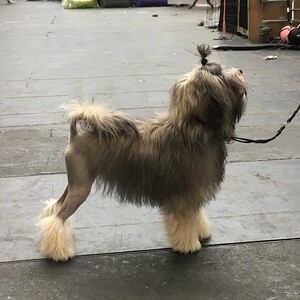
The coat is double: a fine, woolly undercoat and a profuse topcoat, fine but neither silky nor woolly, long, straight or wavy, but not curly. The head has long hair falling forward, but not over the eyes, and a small beard.
| Feature | Tibetan Terrier |
|---|---|
| Size | Medium |
| Height at the withers | males: 36–41 cm; females: slightly smaller |
| Weight | 8–14 kg (AKC) |
| Coat | Double, long |
| Body | Square |
| Type | Herding and companion dog |
The standard accepts white, gold, cream, grey or smoke, black, particolour and tricolour, practically any colour except chocolate, liver or merle.
Training and socialisation
The standard describes it as lively, good-natured and loyal, with many winning ways, outgoing, alert, intelligent and brave, neither fierce nor quarrelsome, but sparing with its affection towards strangers.
The AKC says it is independent and learns quickly, but wilts under obsessive repetition or harsh methods. It recommends methods that let it choose the right behaviour itself, such as clicker training.
Tips for effective training
- Use a clicker. It lets it choose for itself.
- Avoid repetition. It gets bored.
- Be gentle. Harsh methods make it shut down.
- Socialise it. It is reserved with strangers.
Activity needs and lifestyle
The AKC says it enjoys walks and being outdoors with its people, but exercise needs vary: some can climb mountains, while others are content with a walk round the block.
| Activity | How often | Why it matters |
|---|---|---|
| Walks | daily | Fitness |
| Hiking | occasionally | Stamina |
| Agility or obedience | weekly | Keeps its mind busy |
Tips for a balanced life
- Brush it often.
- Do not neuter it too early.
- Do the recommended DNA tests.
Care and health
Coat and skin care
The AKC says that, under the long show coat, it is an agile dog with a coat well suited to everyday life: the woolly undercoat resists damp and insulates naturally. The coat must be brushed regularly, right down to the skin, to stop it matting.
Common health problems
The AKC says the breed is generally healthy, but there are a few problems, and the recommended tests include:
| Condition | Description | Common symptoms |
|---|---|---|
| Primary lens luxation | The lens of the eye shifts out of place; DNA test | Red, painful eye |
| Progressive retinal atrophy | An eye disease; DNA test | Poor night vision |
| Neuronal ceroid lipofuscinosis | A hereditary neurological disease; DNA test | Changes in behaviour, unsteady gait |
| Hip dysplasia | The hip joint forms incorrectly and, over time, arthritis develops | Limping, difficulty getting up or jumping, hip pain |
| Patellar luxation | The kneecap slips out of place | Suddenly holds a hind leg up for a few steps, then uses it again |
Other care
- Ask for the parents' DNA tests.
- Have the puppy's hearing tested (BAER).
- Have its eyes checked.
Diet and nutrition
The AKC says Tibetan Terriers are naturally slim and savour their food, chewing it. Good-quality food suited to its age is enough.
Tips for a healthy diet
The table gives a starting estimate, calculated with the formula from the Merck Veterinary Manual. The first two calorie columns show the calories per day for a healthy adult dog. The last column shows what this means in dry food with 3,500–4,000 kcal per kilogram.
| Dog's weight | Calories per day (neutered) | Calories per day (not neutered) | Dry food per day (approximate) |
|---|---|---|---|
| 8 kg | 530 kcal | 600 kcal | 130–170 g |
| 11 kg | 680 kcal | 760 kcal | 170–220 g |
| 14 kg | 810 kcal | 910 kcal | 200–260 g |
- Treats count towards the daily portion.
- Split the food into two meals a day.
- A dog is at the right weight when you can feel its ribs under the coat without pressing hard.
Foods to avoid
Some human foods are dangerous for dogs: chocolate, coffee, grapes and raisins, onions, garlic, xylitol (a sweetener used in chewing gum), macadamia nuts and alcohol.
Reproduction and development
Physical and emotional maturity
In dogs, sexual maturity usually comes between 6 and 12 months. Most breeds become adults at around 13–15 months.
Mating and pregnancy
Pregnancy lasts about 63 days, counted from ovulation. Mating a female on her first heat is not recommended. The FCI standard requires that only healthy dogs of typical breed appearance are used for breeding.
Caring for the puppies
In dogs, a litter has 5–6 puppies on average, and the number rises with the size of the breed. Socialisation starts in the first weeks: gentle handling, everyday noises and new people.
Interesting facts
- Not a terrier. It is a herding dog.
- The “holy dog”. The standard says it may have been the original holy dog of Tibet.
- A gift for a doctor. Agnes Greig received it after a successful operation.
- It chews its food. The AKC says it savours its meals.
- Long-lived. The AKC gives 15–16 years.
Frequently asked questions
Is it a terrier?
No; it is a herding dog, wrongly called a terrier.
How big does it get?
Males measure 36–41 cm.
What colours does it come in?
Almost any, except chocolate, liver and merle.
How long does it live?
The AKC gives 15–16 years.