Pharaoh HoundCharacteristics, history, training and care
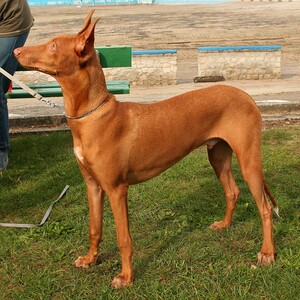
Pharaoh Hound. · Pleple2000 / Wikimedia Commons, CC BY-SA 3.0. Cropped and resized.
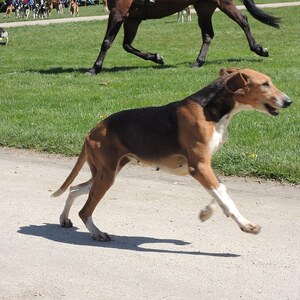
The Pharaoh Hound (Kelb tal-Fenek) is an elegant medium-to-large dog from Malta, tan in colour, with a nose and ears of the same shade and amber eyes. The Maltese name means “the rabbit dog”. The standard describes it as alert, intelligent, friendly, affectionate and playful.
Quick facts
| Common name | Pharaoh Hound (Kelb tal-Fenek) |
| Scientific name | Canis lupus familiaris |
| Country of origin | Malta |
| Official recognition | FCI, definitively since 9 August 1963 (group 5, primitive type; standard no. 248); also recognised by the AKC |
| Lifespan | 12–14 years, according to the AKC |
| Size (males) | 56–63.5 cm at the withers; 20–25 kg according to the AKC |
| Size (females) | 53–61 cm at the withers; 20–25 kg according to the AKC |
| Coat type | Short, glossy |
| Common colours | Tan or rich tan, with a little white |
| Energy level | High |
| Suited to an apartment? | Only with plenty of exercise |
| Temperament | Alert, intelligent, friendly, affectionate, playful |
| Tendency to aggression | Low |
| Good with children | Average |
| Good with other animals | Very good with other dogs, according to the AKC; poor with small animals |
| Genetic predispositions | Few; breeders screen the hips, elbows, kneecaps, eyes and thyroid |
- Primary category:Dog breeds
- Explore this animal's categories:
History and origin
Wikipedia says the Kelb tal-Fenek is a traditional breed of rural Malta, used for hunting rabbits on the rocky terrain of the islands. It is sometimes said to descend from the dogs painted in the tombs of ancient Egypt, hence the English name, but a 2023 genetic study found it to be more closely related to the other Mediterranean warren hounds.
In 1647, Giovanni Francesco Abela wrote about the Maltese dogs “called Cernechi, highly prized for rabbit hunting”, and some believe he was referring to this breed. It is the only Maltese breed recognised internationally.
How the breed developed
- 1647 – Abela describes the Maltese rabbit dogs, according to Wikipedia.
- 9 August 1963 – The FCI recognises the breed.
- 2023 – A genetic study compares it with other Mediterranean warren hounds.
Breed rating
| Feature | Stars |
|---|---|
| Training and intelligence | ★★★★☆ |
| Easy to train | ★★★★☆ |
| Intelligence | ★★★★☆ |
| Independence | ★★★★☆ |
| Stubbornness | ★★★☆☆ |
| Behaviour and temperament | ★★★★☆ |
| Affectionate with family | ★★★★★ |
| Friendly with children | ★★★☆☆ |
| Good with other dogs | ★★★★★ |
| Good with cats and other animals | ★★☆☆☆ |
| Loyalty | ★★★★★ |
| Tendency to be aggressive | ★☆☆☆☆ |
| Tendency to bark | ★★★☆☆ |
| Needs and care | ★★★☆☆ |
| Shedding | ★★☆☆☆ |
| Needs frequent grooming | ★☆☆☆☆ |
| Activity and lifestyle | ★★★★☆ |
| Energy level | ★★★★★ |
| Daily exercise needs | ★★★☆☆ |
| Suited to apartment life | ★★★☆☆ |
| Health and longevity | ★★★★☆ |
| Life expectancy | ★★★★☆ |
| Predisposition to genetic diseases | ★★☆☆☆ |
| Working abilities and uses | ★★★★☆ |
| Good hunting dog | ★★★★★ |
| Good companion dog | ★★★★☆ |
Indicative rating: 5 stars means the highest level. It is based on the ratings the American Kennel Club gives the breed and on the FCI standard.
Physical characteristics
The standard describes it as a medium-sized dog, graceful yet powerful. The AKC says it is a slender, streamlined hound, bred for fast pursuit over rocky ground, with a nose, ears and eye rims the same colour as its coat and amber eyes.
General appearance
The head is long and lean, shaped like a blunt wedge, with a nose the colour of the coat. The hair is short and glossy, fine or slightly harsh, with no feathering. Wikipedia says that when it is happy or excited, its nose and ears turn red.
| Feature | Pharaoh Hound |
|---|---|
| Size | Medium to large |
| Height at the withers | males: 56–63.5 cm; females: 53–61 cm |
| Weight | 20–25 kg (AKC) |
| Coat | Short, glossy |
| Eyes | Amber |
| Nose | The colour of the coat |
The colour is tan or rich tan. White is permitted only on the tip of the tail (much desired), on the chest (the “star”), on the toes and as a slim blaze down the centre of the face.
Training and socialisation
The standard describes it as alert, intelligent, friendly, affectionate and playful. The AKC says it learns quickly and is eager to please.
The problem is the recall: the AKC says most of these dogs, however well trained, will not come when called if they find themselves loose in an open space, but happily set off hunting instead.
Tips for effective training
- Do not let it off the lead in open spaces. The AKC says it will not come back when called.
- Use rewards. It learns quickly.
- The fence must be high. The AKC recommends at least 1.8 m.
- Be careful with small animals. It hunts by sight and by scent.
Activity needs and lifestyle
The AKC says it needs a regular exercise routine. A dog that runs on its own can be let out for 15–20 minutes twice a day in a yard of at least 15 × 15 m, with a 1.8 m fence.
| Activity | How often | Why it matters |
|---|---|---|
| Free running in a fenced area | twice a day, 15–20 min | Its need for speed |
| Walks on the lead | daily | Exercise |
| Coursing (chasing a lure) | occasionally | Hunting instinct |
Tips for a balanced life
- The fence must be high.
- In winter, its short coat does not protect it from the cold.
- Do not leave it unsupervised with small animals.
Care and health
Coat and skin care
The AKC says it does not need much grooming: a light brush daily or a more thorough one weekly, and baths as needed. The ears are kept clean, and the nails are trimmed short enough that they do not click on the floor.
Common health problems
The AKC says it is generally healthy, and most health test results are normal. Breeders screen their dogs for:
| Condition | Description | Common symptoms |
|---|---|---|
| Hip dysplasia | The hip joint forms incorrectly and, over time, arthritis develops | Limping, difficulty getting up or jumping, hip pain |
| Elbow dysplasia | The elbow joint develops incorrectly and arthritis appears | Limping on the front legs, especially after exercise |
| Patellar luxation | The kneecap slips out of place | Suddenly holds a hind leg up for a few steps, then uses it again |
| Eye diseases | Inherited eye conditions | Watery eyes, poor vision |
Other care
- Clean the ears regularly.
- Trim the nails short.
- Brush its teeth regularly.
Diet and nutrition
The AKC says some dogs gain weight easily, so calories and weight should be watched.
Tips for a healthy diet
The table gives a starting estimate, calculated with the formula from the Merck Veterinary Manual. The first two calorie columns show the calories per day for a healthy adult dog. The last column shows what this means in dry food with 3,500–4,000 kcal per kilogram.
| Dog's weight | Calories per day (neutered) | Calories per day (not neutered) | Dry food per day (approximate) |
|---|---|---|---|
| 20 kg | 1,060 kcal | 1,190 kcal | 260–340 g |
| 22 kg | 1,140 kcal | 1,280 kcal | 280–370 g |
| 25 kg | 1,250 kcal | 1,410 kcal | 310–400 g |
- Split the food into two meals a day.
- Do not let it run right after a meal.
- In sighthounds the ribs are easy to see; what matters is that it is not too thin.
Foods to avoid
Some human foods are dangerous for dogs: chocolate, coffee, grapes and raisins, onions, garlic, xylitol (a sweetener used in chewing gum), macadamia nuts and alcohol.
Reproduction and development
Physical and emotional maturity
In dogs, sexual maturity usually comes between 6 and 12 months, but in large breeds it can be delayed until about two years. The body also reaches its adult form later than in small breeds.
Mating and pregnancy
Pregnancy lasts about 63 days, counted from ovulation. Mating a female on her first heat is not recommended. The FCI standard requires that only healthy dogs of typical breed appearance are used for breeding.
Caring for the puppies
In large breeds, a litter has around 7 puppies on average. Socialisation starts in the first weeks: gentle handling, everyday noises and new people.
Interesting facts
- It blushes. Its nose and ears turn red when it is happy.
- “The rabbit dog”. That is what Kelb tal-Fenek means in Maltese.
- It hunts at night. Wikipedia says that in Malta it is taken hunting at night, when there are fewer distractions.
- A star on its chest. The white spot on the chest is called the “star”.
- It smiles. The AKC says it can “smile”.
Frequently asked questions
Does it come from Egypt?
The name suggests so, but it is a traditional breed from Malta.
How big does it get?
Males measure 56–63.5 cm, females 53–61 cm.
Can it be let off the lead?
Usually not: the AKC says it will not come back when called once it is loose.
How long does it live?
The AKC gives 12–14 years.