KooikerhondjeCharacteristics, history, training and care
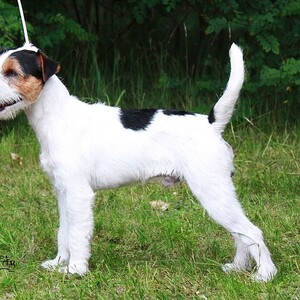
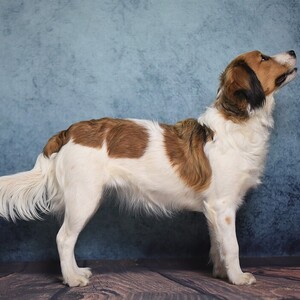
Kooikerhondje. · Hundepfote / Wikimedia Commons, CC BY-SA 4.0. Cropped and resized.
The Kooikerhondje is a small Dutch spaniel-type dog, white with red-orange patches, black-tipped ears and a bushy tail. It was used in duck decoys: it lures the ducks with the movement of its tail without hunting them. The standard describes it as lively, self-assured, faithful and friendly.
Quick facts
| Common name | Kooikerhondje (Nederlandse Kooikerhondje) |
| Scientific name | Canis lupus familiaris |
| Country of origin | Netherlands |
| Official recognition | FCI, definitively since 31 January 1990 (group 8, flushing dogs; standard no. 314); also recognised by the AKC |
| Lifespan | 12–15 years, according to the AKC |
| Size (males) | ideally 40 cm at the withers (+2/−3 cm) |
| Size (females) | ideally 38 cm at the withers (+2/−3 cm) |
| Weight | 9–13.5 kg, according to the AKC |
| Coat type | Medium, slightly wavy or straight, with a well-developed undercoat |
| Common colours | Red-orange patches on white |
| Energy level | High |
| Suited to an apartment? | Yes, with plenty of exercise |
| Temperament | Lively, self-assured, faithful, friendly |
| Tendency to aggression | Low |
| Good with children | Average |
| Good with other animals | Average; it has prey drive |
| Genetic predispositions | Polymyositis, kidney disease, epilepsy, patellar luxation, von Willebrand disease |
- Primary category:Dog breeds
- Explore this animal's categories:
History and origin
Wikipedia says the breed appeared in the Netherlands around the 16th century to lure ducks into traps. It often appears in paintings by the Dutch masters, such as Jan Steen, Rembrandt and Johannes Vermeer.
The FCI standard says that in 1942, during the Second World War, Baroness Van Hardenbroek van Ammerstol began to restore the breed. She gave a pedlar a picture of the dog she was looking for, and he found, on a farm in Friesland, a bitch named Tommy, who became the foundation of the breed. The breed was officially recognised in the Netherlands in 1971.
How the breed developed
- 16th century – The dogs lure ducks into traps.
- 17th century – They appear in paintings by the Dutch masters.
- 1942 – Baroness Van Hardenbroek begins restoring the breed with the bitch Tommy.
- 1971 – The breed is officially recognised in the Netherlands.
- 31 January 1990 – The FCI recognises the breed.
Breed rating
| Feature | Stars |
|---|---|
| Training and intelligence | ★★★★☆ |
| Easy to train | ★★★★★ |
| Intelligence | ★★★★☆ |
| Independence | ★★★☆☆ |
| Stubbornness | ★★★☆☆ |
| Behaviour and temperament | ★★★★☆ |
| Affectionate with family | ★★★★★ |
| Friendly with children | ★★★☆☆ |
| Good with other dogs | ★★★☆☆ |
| Good with cats and other animals | ★★★☆☆ |
| Loyalty | ★★★★★ |
| Tendency to be aggressive | ★☆☆☆☆ |
| Tendency to bark | ★★★☆☆ |
| Needs and care | ★★★☆☆ |
| Shedding | ★★★☆☆ |
| Needs frequent grooming | ★★☆☆☆ |
| Activity and lifestyle | ★★★★☆ |
| Energy level | ★★★★☆ |
| Daily exercise needs | ★★★★☆ |
| Suited to apartment life | ★★★★☆ |
| Health and longevity | ★★★☆☆ |
| Life expectancy | ★★★★★ |
| Predisposition to genetic diseases | ★★★☆☆ |
| Working abilities and uses | ★★★☆☆ |
| Good hunting dog | ★★★★☆ |
| Good companion dog | ★★★★★ |
Indicative rating: 5 stars means the highest level. It is based on the ratings the American Kennel Club gives the breed and on the FCI standard.
Physical characteristics
The AKC describes it as a small sporting dog, harmonious, with an almost square body, white with red-orange patches. It moves with its head held high, and the richly feathered tail is carried level or higher.
General appearance
The ears may have black hairs at the tips, the so-called “earrings”. The coat is medium length, soft, slightly wavy or straight, with a well-developed undercoat. On the back of the hind legs it has fairly long “trousers”.
| Feature | Kooikerhondje |
|---|---|
| Size | Small |
| Height at the withers | males: ideally 40 cm; females: ideally 38 cm |
| Weight | 9–13.5 kg (AKC) |
| Coat | Medium, soft, with an undercoat |
| Ears | With black “earrings” at the tips |
| Tail | Bushy, white |
The coat has clear red-orange patches on pure white, and the red-orange must predominate. A white blaze runs down the head to the nose. A few black hairs among the red ones are accepted but not desirable.
Training and socialisation
The AKC says it is a cheerful, intelligent and lively, but not hyperactive companion. It has prey drive and energy, but also the sensitive nature of a spaniel. It can be very determined, so it is best trained with firmness and gentle methods.
The standard says that, outside the hunting season, it was expected to catch vermin, so it has to be quick and tough.
Tips for effective training
- Be firm but gentle. It is sensitive, like a spaniel.
- Use rewards. It learns very quickly.
- Socialise it from an early age. It helps it become a well-balanced dog.
- Be careful around small animals. It has prey drive.
Activity needs and lifestyle
The AKC gives it a high score for energy and for mental stimulation needs. Dog sports, long walks and search games keep it happy.
| Activity | How often | Why it matters |
|---|---|---|
| Long walks | daily | High energy |
| Dog sports (agility, obedience) | weekly | Intelligence |
| Search games | daily | Mental stimulation |
Tips for a balanced life
- It suits active families.
- It needs daily activity.
- Do not leave it unsupervised with small animals.
Care and health
Coat and skin care
The AKC recommends weekly grooming and an occasional bath. The nails grow quickly and should be trimmed regularly, and the ears should be checked often.
Common health problems
The AKC says it is a fairly healthy, long-lived breed, but because it descends from a very small number of dogs, it is prone to some hereditary diseases. Wikipedia reports that a Dutch study of 842 dogs found patellar luxation in 24% of them.
| Condition | Description | Common symptoms |
|---|---|---|
| Polymyositis | Inflammation of the muscles | Weakness, stiff gait, difficulty swallowing |
| Kidney disease | The kidneys develop or work abnormally | Excessive thirst, frequent urination, weight loss |
| Epilepsy | Repeated neurological seizures | Trembling, convulsions |
| Patellar luxation | The kneecap slips out of place | Suddenly holds a hind leg up for a few steps, then uses it again |
| Von Willebrand disease | An inherited blood-clotting disorder | Bleeding that is hard to stop |
Other care
- Check the ears every week.
- Trim the nails regularly.
- Ask the breeder for the parents' genetic tests.
Diet and nutrition
The AKC says some dogs gain weight easily, so calories and weight should be watched.
Tips for a healthy diet
The table gives a starting estimate, calculated with the formula from the Merck Veterinary Manual. The first two calorie columns show the calories per day for a healthy adult dog. The last column shows what this means in dry food with 3,500–4,000 kcal per kilogram.
| Dog's weight | Calories per day (neutered) | Calories per day (not neutered) | Dry food per day (approximate) |
|---|---|---|---|
| 9 kg | 580 kcal | 650 kcal | 140–190 g |
| 11 kg | 680 kcal | 760 kcal | 170–220 g |
| 13.5 kg | 790 kcal | 890 kcal | 200–250 g |
- Give it its food in two meals a day.
- Treats count towards the daily portion.
- A dog is at the right weight when you can feel its ribs under the coat without pressing hard.
Foods to avoid
Some human foods are dangerous for dogs: chocolate, coffee, grapes and raisins, onions, garlic, xylitol (a sweetener used in chewing gum), macadamia nuts and alcohol.
Reproduction and development
Physical and emotional maturity
In dogs, sexual maturity usually comes between 6 and 12 months. Small breeds become adults faster than large ones, usually at around one year.
Mating and pregnancy
Pregnancy lasts about 63 days, counted from ovulation. Mating a female on her first heat is not recommended. The FCI standard requires that only healthy dogs of typical breed appearance are used for breeding.
Caring for the puppies
In small breeds, a litter has 3–4 puppies on average. The puppies are very small and fragile in the first weeks, so they must be kept warm and handled with care. Socialisation starts early: gentle handling, everyday noises and new people.
Interesting facts
- It does not hunt the ducks. It only lures them into the trap with its tail.
- Inspired by foxes. Wikipedia says hunters noticed that ducks were drawn to foxes playing near the water.
- Saved by a baroness. The restoration of the breed began with the bitch Tommy in 1942.
- Black “earrings”. The black tips of the ears are called “earrings”.
- For research. Some of the ducks caught are ringed for ornithological studies.
In popular culture
In the paintings of the Dutch masters
Wikipedia says the Kooikerhondje often appears in paintings by Jan Steen, Rembrandt and Johannes Vermeer, for example in Jan Steen's painting “As the Old Sing, So Pipe the Young”.
Frequently asked questions
Where does the name come from?
It is linked to the Dutch duck decoys in which this dog worked.
How big does it get?
Males ideally measure 40 cm and females 38 cm; the AKC gives 9–13.5 kg.
Does it hunt ducks?
No, it only lures them into the trap with its tail.
How long does it live?
The AKC gives 12–15 years.