Cimarrón UruguayoCharacteristics, history, training and care
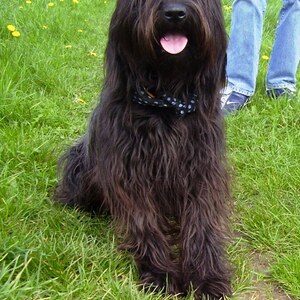
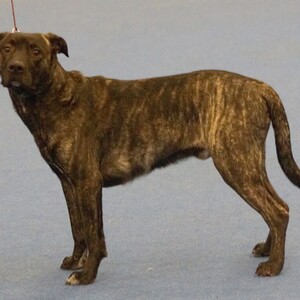
Cimarrón Uruguayo. · Canarian / Wikimedia Commons, CC BY 4.0. Cropped and resized.
The Cimarrón Uruguayo is a large, compact, muscular molossoid from Uruguay. Its ancestors were the dogs brought by Spanish and Portuguese settlers, which then lived free and went feral. Farmers caught and tamed them. It is balanced, intelligent and very brave, and is used for guarding farms, herding and hunting.
Quick facts
| Common name | Cimarrón Uruguayo (Cimarrón) |
| Scientific name | Canis lupus familiaris |
| Country of origin | Uruguay |
| Official recognition | FCI, provisionally since 21 February 2006 and definitively since 7 November 2017 (group 2, molossoid breeds, dogue type; standard no. 353); also recognised by the United Kennel Club |
| Lifespan | No published data exist for the breed; large breeds usually live 10–12 years |
| Size (males) | 58–61 cm at the withers (tolerance 2 cm); 38–45 kg |
| Size (females) | 55–58 cm at the withers (tolerance 2 cm); 33–40 kg |
| Coat type | Short, smooth, close-lying, with undercoat |
| Common colours | Brindle or fawn in all shades, including bluish, with or without a mask |
| Energy level | Moderate to high |
| Suited to an apartment? | No |
| Temperament | Balanced, intelligent, very brave |
| Tendency to aggression | Low with the family; firmly defends its territory |
| Good with children | Good, with socialisation from an early age |
| Good with other animals | Good, if socialised early |
| Genetic predispositions | Hip and elbow dysplasia (dogs are tested before breeding) |
- Primary category:Dog breeds
- Explore this animal's categories:
History and origin
Its exact origin is unknown. The FCI standard says the breed descends from dogs brought by the Spanish and Portuguese conquerors. The dogs left behind in the country interbred, and natural selection allowed only the strongest and cleverest to survive. Wikipedia links it mainly to the Alano Español.
In the 18th century, feral packs attacked cattle, and the government paid a bounty for every dog killed. Many survived even so, especially in the hills of Cerro Largo. Farmers there began to catch and tame them, using them as guard dogs and for working cattle.
How the breed developed
- Colonial era – Spanish and Portuguese settlers bring dogs to Uruguay; some of them go feral.
- 18th century – The feral dogs are hunted, with bounties paid by the government.
- Later – Farmers in Cerro Largo tame them and use them for guarding and for cattle.
- 21 February 2006 – The FCI provisionally accepts the breed.
- 7 November 2017 – The FCI definitively recognises the breed.
- 16 June 2022 – The current FCI standard is published.
Breed rating
| Feature | Stars |
|---|---|
| Training and intelligence | ★★★★☆ |
| Easy to train | ★★★☆☆ |
| Intelligence | ★★★★☆ |
| Independence | ★★★☆☆ |
| Stubbornness | ★★★☆☆ |
| Behaviour and temperament | ★★★★☆ |
| Affectionate with family | ★★★★☆ |
| Friendly with children | ★★★★☆ |
| Good with other dogs | ★★★☆☆ |
| Good with cats and other animals | ★★★☆☆ |
| Loyalty | ★★★★★ |
| Tendency to be aggressive | ★★★☆☆ |
| Tendency to bark | ★★☆☆☆ |
| Needs and care | ★★★★☆ |
| Shedding | ★★☆☆☆ |
| Needs frequent grooming | ★☆☆☆☆ |
| Activity and lifestyle | ★★★★☆ |
| Energy level | ★★★★☆ |
| Daily exercise needs | ★★★★☆ |
| Suited to apartment life | ★☆☆☆☆ |
| Health and longevity | ★★★★☆ |
| Life expectancy | ★★★☆☆ |
| Predisposition to genetic diseases | ★★☆☆☆ |
| Working abilities and uses | ★★★★☆ |
| Good guard dog | ★★★★★ |
| Good companion dog | ★★★☆☆ |
Indicative rating: 5 stars means the highest level. The breed has no AKC profile; the rating is based on the FCI standard (“balanced, intelligent and very brave”) and on the Wikipedia description.
Physical characteristics
The standard describes it as a dogue-type dog, medium to large, strong, compact, solid-boned, muscular and agile. The body is slightly longer than its height (ratio 10:11).
General appearance
The head is broader than it is long, with a strong muzzle slightly shorter than the skull. The almond-shaped brown eyes have a curious expression. The thick tail reaches the hock; at rest it hangs down, and in movement it is carried horizontally or slightly raised.
| Feature | Cimarrón Uruguayo |
|---|---|
| Size | Large |
| Height at the withers | males: 58–61 cm; females: 55–58 cm (tolerance 2 cm) |
| Weight | males: 38–45 kg; females: 33–40 kg |
| Coat | Short, smooth, with undercoat |
| Eyes | Almond-shaped, brown, as dark as possible |
| Tail | Thick, reaching the hock |
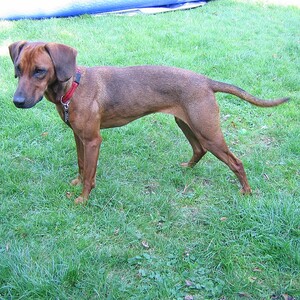
The coat is brindle or fawn in all shades; fawns may have black shading. Bluish brindle and bluish fawn are also accepted, all with or without a mask. White markings are allowed only under the jaw, on the neck, chest and belly and on the lower legs. Brown (chocolate) disqualifies.
Training and socialisation
It is an intelligent, well-balanced dog, used in Uruguay for guarding, hunting, herding, rescue and dog sports. Wikipedia says it is fairly calm and does not usually bark unless the threat is real.
Like any large, powerful dog, it must be very well socialised from an early age to be a safe companion.
Tips for effective training
- Socialise it early. People, children, other dogs and new places, from the first months.
- Be calm and consistent. A brave dog needs clear rules.
- Give it an activity. It was bred for work: guarding, herding or dog sports.
- Teach recall and lead walking well. It is very strong for its weight.
Activity needs and lifestyle
It is an agile, hardy working dog that needs daily exercise and space. It is happiest in a house with a large yard.
| Activity | How often | Why it matters |
|---|---|---|
| Long lead walks | daily | Exercise and contact with the world |
| Time in a fenced yard | daily | It watches over its territory |
| Training or dog sports | several times a week | Mental activity |
Tips for a balanced life
- The fence must be solid.
- It is not suitable for a flat.
- It suits an experienced owner.
Care and health
Coat and skin care
The short coat is easy to maintain: brushing once a week with a rubber grooming mitt is enough. During the moulting season it should be brushed more often.
Common health problems
No health studies have been published for the breed. Wikipedia recommends that dogs be tested for dysplasia before breeding:
| Condition | Description | Common symptoms |
|---|---|---|
| Hip dysplasia | The hip joint forms incorrectly and, over time, arthritis develops | Limping, difficulty getting up or jumping, hip pain |
| Elbow dysplasia | The elbow joint develops incorrectly and arthritis appears | Limping on the front legs, especially after exercise |
| Gastric dilatation-volvulus (bloat) | The stomach fills with gas and may twist; this is a veterinary emergency | Swollen belly, trying to vomit without success, drooling, restlessness |
Other care
- Check the ears and teeth once a week.
- Trim the nails when they start to touch the floor.
- Check for ticks after outings in nature.
Diet and nutrition
A muscular, active dog needs a good-quality food suited to large breeds. The portion should be based on its actual weight and daily activity.
Tips for a healthy diet
The table gives a starting estimate, calculated with the formula from the Merck Veterinary Manual. The first two calorie columns show the calories per day for a healthy adult dog. The last column shows what this means in dry food with 3,500–4,000 kcal per kilogram.
| Dog's weight | Calories per day (neutered) | Calories per day (not neutered) | Dry food per day (approximate) |
|---|---|---|---|
| 33 kg | 1,540 kcal | 1,730 kcal | 380–490 g |
| 40 kg | 1,780 kcal | 2,000 kcal | 440–570 g |
| 45 kg | 1,950 kcal | 2,190 kcal | 490–630 g |
- Split the food into two meals a day to reduce the risk of bloat.
- Puppies need a growth food suited to large breeds.
- A dog is at the right weight when you can feel its ribs without pressing hard.
Foods to avoid
Some human foods are dangerous for dogs: chocolate, coffee, grapes and raisins, onions, garlic, xylitol (a sweetener used in chewing gum), macadamia nuts and alcohol.
Reproduction and development
Physical and emotional maturity
In dogs, sexual maturity usually comes between 6 and 12 months, but in large breeds it can be delayed until about two years. The body also reaches its adult form later than in small breeds.
Mating and pregnancy
Pregnancy lasts about 63 days, counted from ovulation. Mating a female on her first heat is not recommended. The FCI standard requires that only healthy dogs of typical breed appearance are used for breeding.
Caring for the puppies
In large breeds, a litter has around 7 puppies on average. Socialisation starts in the first weeks: gentle handling, everyday noises and new people.
Interesting facts
- The name means “gone wild”. “Cimarrón” was the name given in South America to domestic animals that lived free.
- The army's mascot. It is the mascot of the National Army of Uruguay.
- Bounties for ears. Wikipedia says that in the past, to claim the bounty, people handed in the ears of the dogs they had killed.
- Studied by the university. The Faculty of Veterinary Medicine in Montevideo carries out genetic studies on the breed.
- It has reached the United States. The breed has been exported to the United States and is recognised by the United Kennel Club.
In popular culture
A national symbol of Uruguay
The story of the feral dogs that survived being hunted and became guardians of the farms has made the Cimarrón a national symbol in Uruguay. The breed is the mascot of the National Army of Uruguay.
Frequently asked questions
Where does the Cimarrón Uruguayo come from?
From Uruguay; it descends from the dogs brought by Spanish and Portuguese settlers, which went feral.
How big does it get?
Males measure 58–61 cm and weigh 38–45 kg; females measure 55–58 cm and weigh 33–40 kg.
Is it a family dog?
It can be, if it is well socialised from an early age. It is balanced, but very brave and protective.
Is it recognised by the FCI?
Yes, provisionally since 2006 and definitively since 2017.