Bucovina Shepherd DogCharacteristics, history, training and care
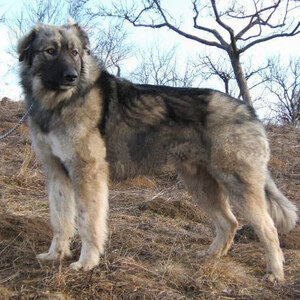
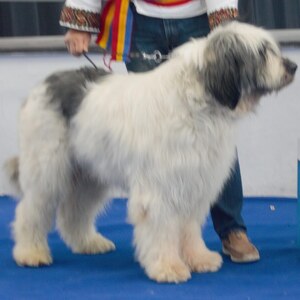
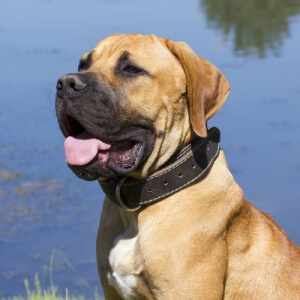
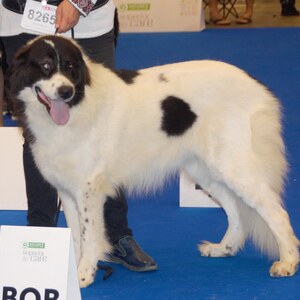
Bucovina Shepherd Dog. · Canarian / Wikimedia Commons, CC BY-SA 4.0. Cropped and resized.
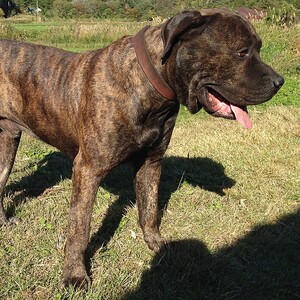
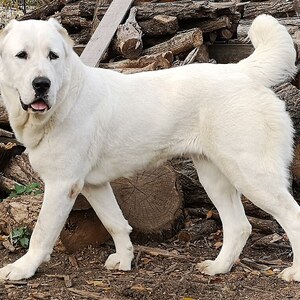
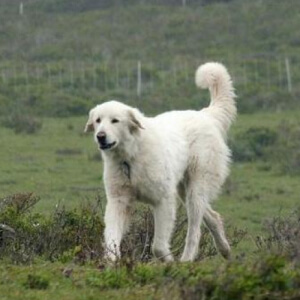
The Bucovina Shepherd Dog is a very large, imposing and proud dog, bred in north-eastern Romania to defend flocks. It has a long white coat with black or grey patches and a deep bark. With the family it is calm and loyal, and it likes children.
Quick facts
| Common name | Bucovina Shepherd Dog |
| Scientific name | Canis lupus familiaris |
| Country of origin | Romania (Carpathian Mountains, province of Bucovina) |
| Official recognition | FCI, definitively since 29 April 2019 (group 2, section mountain molossoids, standard no. 357) |
| Lifespan | No published data for the breed; very large breeds live 8–13 years on average |
| Size (males) | 68–78 cm at the withers; ideally 71–75 cm |
| Size (females) | 64–72 cm at the withers; ideally 66–68 cm |
| Weight | In proportion to height; the standard gives no figure |
| Coat type | Long (6–9 cm), straight and harsh, with a very dense undercoat; mane on the neck |
| Common colours | White or off-white with grey, black, or black with reddish-tinted patches |
| Energy level | Moderate |
| Suited to an apartment? | No, it needs a large fenced yard |
| Temperament | Well balanced, calm, loyal, proud |
| Tendency to aggression | Low with the family; very protective towards strangers |
| Good with children | Very good; the standard says it likes children |
| Good with other animals | Good with the animals it guards |
| Genetic predispositions | No known breed-specific diseases; as in all very large dogs, a risk of hip dysplasia and bloat |
- Primary category:Dog breeds
- Explore this animal's categories:
History and origin
The Bucovina Shepherd Dog is a natural breed that took shape in the Carpathian Mountains. Breeders paid particular attention to it in north-eastern Romania, in Bucovina, an area long known for transhumance, the seasonal movement of flocks between mountain and lowland pastures.
The dogs were selected for how well they defended the flock. Even today, in their region of origin, they guard sheep, cattle and farmsteads.
How the breed developed
- Centuries of work at the sheepfold – The dogs accompany flocks on transhumance and defend them against predators.
- 1982 – The Romanian Kennel Association writes the first breed standard.
- 2001 and 29 March 2002 – The standard is updated, then rewritten in the format required by the FCI.
- 29 April 2019 – The FCI recognises the breed definitively.
- 20 August 2023 – The FCI publishes the current version of the standard.
Breed rating
| Feature | Stars |
|---|---|
| Training and intelligence | ★★★☆☆ |
| Easy to train | ★★☆☆☆ |
| Intelligence | ★★★★☆ |
| Independence | ★★★★☆ |
| Stubbornness | ★★★★☆ |
| Behaviour and temperament | ★★★★☆ |
| Affectionate with family | ★★★★★ |
| Friendly with children | ★★★★★ |
| Good with other dogs | ★★★☆☆ |
| Good with cats and other animals | ★★★★☆ |
| Loyalty | ★★★★★ |
| Tendency to be aggressive | ★★☆☆☆ |
| Tendency to bark | ★★★★★ |
| Needs and care | ★★★☆☆ |
| Shedding | ★★★☆☆ |
| Needs frequent grooming | ★★★☆☆ |
| Activity and lifestyle | ★★★☆☆ |
| Energy level | ★★★☆☆ |
| Daily exercise needs | ★★★☆☆ |
| Suited to apartment life | ★☆☆☆☆ |
| Health and longevity | ★★★☆☆ |
| Life expectancy | ★★★☆☆ |
| Predisposition to genetic diseases | ★★☆☆☆ |
| Working abilities and uses | ★★★★★ |
| Good livestock guardian | ★★★★★ |
| Good companion dog | ★★★★☆ |
Indicative rating: 5 stars means the highest level. The breed has no AKC profile, so the rating is based on the description of temperament in the FCI standard.
Physical characteristics
It is a large, imposing and proud dog with strong bones. The body is slightly longer than it is tall, and the muzzle is the same length as the skull. Males are noticeably larger than females.
General appearance
On the head and the front of the legs the hair is short. On the body it is long and harsh, forming a mane on the neck. There is feathering and “trousers” on the back of the legs, and the tail is bushy. The eyes are small and brown, and the V-shaped ears hang close to the cheeks.
| Feature | Bucovina Shepherd Dog |
|---|---|
| Size | Very large |
| Height at the withers | males: 68–78 cm; females: 64–72 cm (tolerance ±4 cm) |
| Coat | 6–9 cm long, straight and harsh; short, very dense, soft undercoat |
| Eyes | Small, almond-shaped, brown, never yellow |
| Ears | V-shaped, hanging close to the cheeks; cropping is forbidden |
| Tail | Hangs at rest; in action it rises to the level of the back without curling |
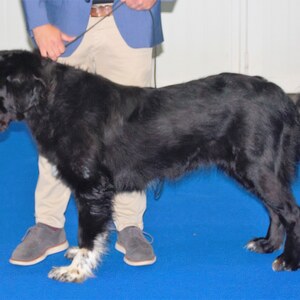
The classic colour is white or off-white with clear patches of grey, black, or black with reddish tints. Black or grey freckles may appear on the legs. Solid-coloured dogs (white, off-white, ash grey or black) are accepted but not encouraged.
Training and socialisation
The Bucovina Shepherd Dog is well balanced and calm, but has a very strong guarding instinct. At night it patrols alone around the farmstead or the flock. When a stranger approaches it barks loudly, in a deep voice.
Training calls for calm and consistency. Basic commands are a must for such a large, powerful dog.
Tips for effective training
- Socialise it from puppyhood. Get the puppy used to guests, neighbours, cars and other animals.
- Be consistent. The same rules, applied by the whole family, every day.
- Use rewards. Praise and play work better than punishment.
- Teach it to stop on command. A guard dog that barks at night must be able to be quietened by its owner.
- Introduce it to your guests. It accepts people more easily when it sees the family welcome them.
Activity needs and lifestyle
The Bucovina is not a running dog. It needs moderate daily exercise and, above all, a territory to watch over.
| Activity | How often | Why it matters |
|---|---|---|
| Walk on the lead | daily | Exercise, strong muscles and socialisation |
| Free time in a fenced yard | daily | It patrols its territory, as at the sheepfold |
| Obedience exercises | a few minutes a day | Keeps control of a very powerful dog |
Tips for a balanced life
- The fence must be high and solid.
- Barking at night is natural for the breed; think of the neighbours before getting one.
- In summer it needs shade and fresh water, because of its dense coat.
Care and health
Coat and skin care
The long coat and dense undercoat should be brushed once or twice a week. During the moult, in spring and autumn, brush more often so that knots do not form on the neck and the back of the legs.
Common health problems
There are no published health studies for this breed. As with any very large dog, two conditions are worth watching:
| Condition | Description | Common symptoms |
|---|---|---|
| Hip dysplasia | The hip joint forms incorrectly and, over time, arthritis develops | Limping, difficulty getting up or jumping, hip pain |
| Gastric dilatation-volvulus (bloat) | The stomach fills with gas and may twist; this is a veterinary emergency | Swollen belly, trying to vomit without success, drooling, restlessness |
Other care
- Trim the nails when they start to touch the floor.
- Check the ears and teeth once a week.
- Check for ticks after walks through tall grass.
Diet and nutrition
For such a large dog, the amount of food should be set according to its actual weight. Weigh it and watch its waistline, not just the instructions on the packet.
Tips for a healthy diet
The table gives a starting estimate, calculated with the formula from the Merck Veterinary Manual. The first two calorie columns show the calories per day for a healthy adult dog. The last column shows what this means in dry food with 3,500–4,000 kcal per kilogram.
| Dog's weight | Calories per day (neutered) | Calories per day (not neutered) | Dry food per day (approximate) |
|---|---|---|---|
| 50 kg | 2,110 kcal | 2,370 kcal | 530–680 g |
| 60 kg | 2,410 kcal | 2,720 kcal | 600–780 g |
| 70 kg | 2,710 kcal | 3,050 kcal | 680–870 g |
- Split the food into two meals a day. This lowers the risk of bloat.
- Puppies need growth food suitable for large breeds; growing too fast harms the joints.
- A dog is at the right weight when you can feel its ribs under the coat without pressing hard.
Foods to avoid
Some human foods are dangerous for dogs: chocolate, coffee, grapes and raisins, onions, garlic, xylitol (a sweetener used in chewing gum), macadamia nuts and alcohol.
Reproduction and development
Physical and emotional maturity
In dogs, sexual maturity usually comes between 6 and 12 months, but in large breeds it can be delayed until about two years. Very large breeds become adults only at around 2 years.
Mating and pregnancy
Pregnancy lasts about 63 days, counted from ovulation. Mating a female on her first heat is not recommended. The FCI standard requires that only healthy dogs of typical breed appearance are used for breeding.
Caring for the puppies
In large breeds, a litter has around 7 puppies on average. The puppies grow very fast, so they need growth food suited to large breeds. Socialisation starts in the first weeks.
Interesting facts
- It patrols at night. The standard says that during the night it makes rounds of the farmstead or the flock.
- It has a deep voice. Its bark is very loud and low-pitched.
- It wears “trousers”. The long hair on the back of the hind legs forms a kind of trousers.
- Brindle patches are rejected. The standard does not accept brindle-looking patches.
- It belongs to the molossoid group. Although it guards flocks, the FCI places it among the mountain molossoids, alongside massive dogs such as the Saint Bernard.
Frequently asked questions
How big does a Bucovina Shepherd Dog get?
Males measure 68–78 cm at the withers and females 64–72 cm. It is one of the largest Romanian breeds.
Does it get on with children?
Yes. The FCI standard says it is calm, loyal and likes children. As with any large dog, play should be supervised.
Does it bark a lot?
It barks loudly when strangers or animals appear and patrols at night. For close neighbours, this can be a problem.
What colours does it come in?
Usually white or off-white with grey or black patches. Solid-coloured dogs are also accepted.
Can it live in a block of flats?
No. It needs a large fenced yard where it can watch over its territory.