Romanian Carpathian Shepherd DogCharacteristics, history, training and care
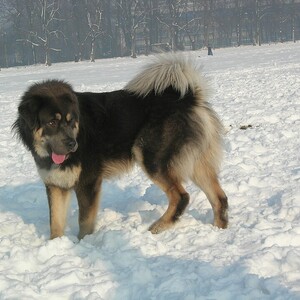
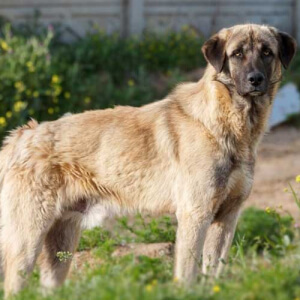
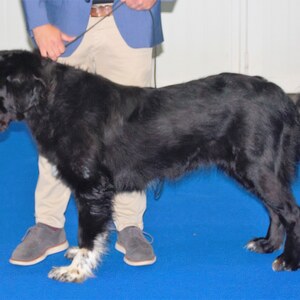
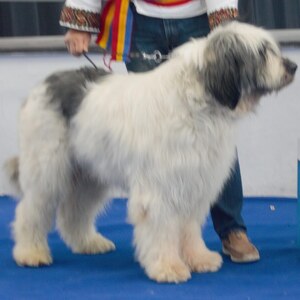
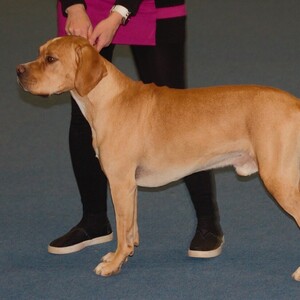
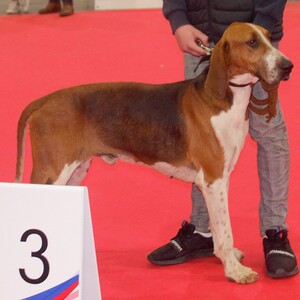
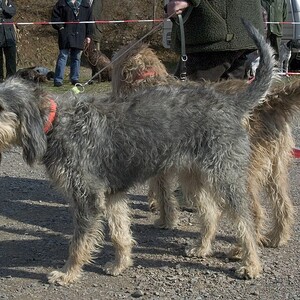
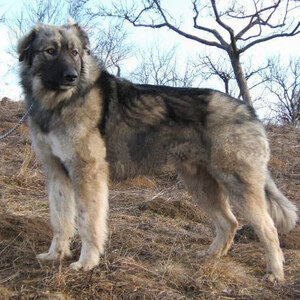
Romanian Carpathian Shepherd Dog. · Ionete / Wikimedia Commons, public domain. Cropped and resized.
The Romanian Carpathian Shepherd Dog is a large, agile dog with a wolf-grey coat. Shepherds in the Carpathians have used it for centuries to guard their flocks. It is calm, dignified and attached to its family, but it needs space, a good fence and a patient owner.
Quick facts
| Common name | Romanian Carpathian Shepherd Dog (Carpatin) |
| Scientific name | Canis lupus familiaris |
| Country of origin | Romania (Carpathian-Danubian area) |
| Official recognition | FCI, definitively since 9 June 2015 (group 1, standard no. 350); AKC, in the Foundation Stock Service programme since November 2021 |
| Lifespan | 12–14 years |
| Size (males) | ideally 65–73 cm at the withers (±2 cm) |
| Size (females) | ideally 59–67 cm at the withers (±2 cm) |
| Weight | about 32–45 kg |
| Coat type | Double: harsh, dense, straight hair with a soft undercoat; short on the head, long on the neck, tail and backs of the legs |
| Common colours | Wolf grey (light fawn base overlaid with black); white markings are permitted |
| Energy level | Moderate |
| Suited to an apartment? | No, it needs a fenced yard |
| Temperament | Calm, dignified, brave, independent |
| Tendency to aggression | Low with the family; protective with strangers |
| Good with children | Good with the family's children |
| Good with other animals | Good with the animals it considers its “flock” |
| Genetic predispositions | No breed-specific diseases are known; as with all large dogs, a risk of hip dysplasia and bloat |
- Primary category:Dog breeds
- Explore this animal's categories:
History and origin
The Carpathian Shepherd Dog developed from the sheepdogs that had long lived in the Carpathian and Danube area. The FCI standard says shepherds always selected it on a single criterion: how well it does its job. That is why its character has stayed unchanged to this day.
Many Carpathians still work at sheepfolds today. They go up the mountain with the flock, guard it against bears, wolves and wild boar, and protect the shepherds' homes and sheepfolds.
How the breed developed
- Centuries of work at the sheepfold – Selection was based on how well the dog guarded the flock, not on looks.
- 1934 – The National Zootechnical Institute writes the first breed standard.
- 1982, 1999 and 2001 – The Romanian Kennel Association amends and updates the standard.
- 30 March 2002 – The standard is adapted to the format required by the FCI.
- 6 July 2005 – The FCI provisionally recognises the breed.
- 9 June 2015 – The FCI definitively recognises the breed, on the same day as the Romanian Mioritic Shepherd Dog.
- November 2021 – The American Kennel Club admits it to its Foundation Stock Service programme.
Breed rating
| Feature | Stars |
|---|---|
| Training and intelligence | ★★★☆☆ |
| Easy to train | ★★☆☆☆ |
| Intelligence | ★★★★☆ |
| Independence | ★★★★★ |
| Stubbornness | ★★★★☆ |
| Behaviour and temperament | ★★★★☆ |
| Affectionate with family | ★★★★☆ |
| Friendly with children | ★★★★☆ |
| Good with other dogs | ★★★☆☆ |
| Good with cats and other animals | ★★★★☆ |
| Loyalty | ★★★★★ |
| Tendency to be aggressive | ★★☆☆☆ |
| Tendency to bark | ★★★☆☆ |
| Needs and care | ★★★☆☆ |
| Shedding | ★★★☆☆ |
| Needs frequent grooming | ★★☆☆☆ |
| Activity and lifestyle | ★★★☆☆ |
| Energy level | ★★★☆☆ |
| Daily exercise needs | ★★★★☆ |
| Suited to apartment life | ★☆☆☆☆ |
| Health and longevity | ★★★★☆ |
| Life expectancy | ★★★★☆ |
| Predisposition to genetic diseases | ★★☆☆☆ |
| Working abilities and uses | ★★★★★ |
| Good livestock guardian | ★★★★★ |
| Good companion dog | ★★★★☆ |
Indicative rating: 5 stars means the highest level. It is based on the ratings the American Kennel Club gives the breed and on the description in the FCI standard.
Physical characteristics
The Carpathian is a fairly large, agile dog, never heavy. The body is rectangular, meaning longer than it is tall, and the chest is broad and deep. Males are noticeably taller and stronger than females.
General appearance
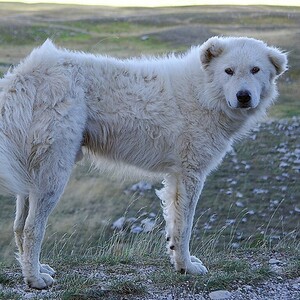
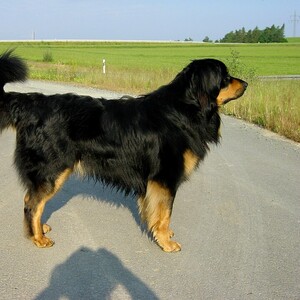
The head looks a little like a wolf's, with a strong muzzle and almond-shaped eyes. The triangular ears hang close to the cheeks. The tail is bushy: at rest it hangs down to the hock, and when the dog is alert it raises it.
| Feature | Romanian Carpathian Shepherd Dog |
|---|---|
| Size | Large |
| Height at the withers | males: 65–73 cm; females: 59–67 cm (±2 cm) |
| Weight | about 32–45 kg |
| Coat | Harsh, dense and straight, with a dense undercoat; longer on the neck, tail and backs of the legs |
| Eyes | Almond-shaped, brown, never yellow |
| Ears | Triangular, not too large, carried close to the cheek |
| Tail | Bushy, carried low at rest and raised in action |
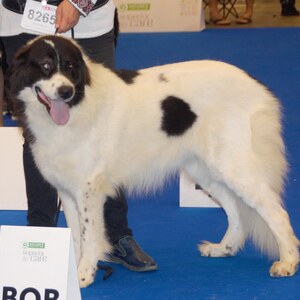
The typical colour is wolf grey: a light fawn base with black hairs showing through. The flanks are usually lighter and the back darker. White markings are permitted on the muzzle, forehead, neck, chest, legs and tail. Puppies are born black and white, and the adult colour develops by around 2 years of age.
Training and socialisation
The Carpathian was bred to make decisions on its own, without human help. It is intelligent and learns quickly, often just by watching what people and other dogs do. Food and toys motivate it less than the company of its “pack”.
It responds well to ordinary obedience exercises if the owner is calm and consistent. It obeys the whole family but usually chooses one person to follow.
Tips for effective training
- Start socialisation early. Get the puppy used to people, cars, other animals and new places.
- Use play. Games played together work better than food rewards.
- Teach the basic commands. “Sit”, “stay”, “come” and walking on the lead are essential for a dog weighing over 30 kg.
- Give its mind something to do. Scent games and puzzle toys keep it busy when it has no flock to guard.
- Be patient with its independence. It is not disobedience: the breed was selected to judge a situation on its own.
Activity needs and lifestyle
The Carpathian saves its energy for moments of danger, so it often seems calm. Without a flock to guard, it still needs 1–2 hours of moderate activity a day, according to breeders quoted by the AKC.
| Activity | How often | Why it matters |
|---|---|---|
| Walks on the lead | daily | Exercise and contact with the world outside the yard |
| Scent and puzzle games | daily | They use its mind, not just its legs |
| Play with the family | daily | Strengthens the bond with its “pack” |
| Time in the fenced yard | daily | It patrols its territory, as it does at the sheepfold |
Tips for a balanced life
- The fence must be solid, as the Carpathian likes to explore its whole territory.
- Outside the yard, keep it on the lead.
- The dense coat protects it from both cold and heat, but in summer it needs shade and fresh water.
Care and health
Coat and skin care
The double coat is easy to maintain. An occasional brush with an undercoat brush is enough. In spring, around May–June, the Carpathian sheds a lot of undercoat and needs brushing more often. The long-haired areas should be detangled with a suitable brush.
Common health problems
The breed club quoted by the AKC says purebred Carpathians have no known genetic problems, because selection took place under natural conditions for a long time. As with any large dog, however, two conditions are worth watching for:
| Condition | Description | Common symptoms |
|---|---|---|
| Hip dysplasia | The hip joint forms incorrectly and, over time, arthritis develops | Limping, difficulty getting up or jumping, hip pain |
| Gastric dilatation-volvulus (bloat) | The stomach fills with gas and may twist; this is a veterinary emergency | Swollen belly, trying to vomit without success, drooling, restlessness |
Other care
- Trim the nails when they start to touch the floor.
- Clean the ears and check the teeth regularly.
- Check the coat for ticks and burrs after walks through tall grass.
Diet and nutrition
The Carpathian usually eats less than you would expect for its size and stops when it has had enough. The problem arises when the owner insists on giving it more than it needs.
Tips for a healthy diet
The table gives a starting estimate, calculated with the formula from the Merck Veterinary Manual. The first two calorie columns show the calories per day for a healthy adult dog. The last column shows what this means in dry food with 3,500–4,000 kcal per kilogram.
| Dog's weight | Calories per day (neutered) | Calories per day (not neutered) | Dry food per day (approximate) |
|---|---|---|---|
| 32 kg | 1,510 kcal | 1,700 kcal | 380–490 g |
| 38 kg | 1,710 kcal | 1,930 kcal | 430–550 g |
| 45 kg | 1,950 kcal | 2,190 kcal | 490–630 g |
- Split the food into two meals a day. This lowers the risk of bloat.
- Puppies get three meals a day.
- Ask your vet for a balanced food for large breeds.
- A dog is at the right weight when you can feel its ribs under the coat without pressing hard.
Foods to avoid
Some human foods are dangerous for dogs: chocolate, coffee, grapes and raisins, onions, garlic, xylitol (a sweetener used in chewing gum), macadamia nuts and alcohol.
Reproduction and development
Physical and emotional maturity
In dogs, sexual maturity usually comes between 6 and 12 months. In large breeds like this one, it may be delayed until around two years. The Carpathian's adult coat is also only finalised at around 2 years.
Mating and pregnancy
Gestation lasts about 63 days, counted from ovulation. Mating a female on her first heat is not recommended. The standard requires that only healthy dogs with the typical appearance of the breed be used for breeding.
Caring for the puppies
In large breeds, a litter has on average around 7 puppies. Carpathian puppies are born black and white. Socialisation begins in the first weeks: gentle handling, everyday noises and new people.
Interesting facts
- It is born black and white. The wolf-grey colour appears gradually and is finalised at around 2 years.
- It works in a pack. Breeders quoted by the AKC say Carpathians share out the tasks when guarding the flock.
- It looks lazy, but it is not. It saves its energy for real danger, and then it moves surprisingly fast.
- The first standard is almost 100 years old. It was written in 1934 by the National Zootechnical Institute.
- Aggression disqualifies it. The FCI standard excludes aggressive or very fearful dogs from competition.
Frequently asked questions
How big does a Carpathian Shepherd Dog get?
Males measure 65–73 cm at the withers and females 59–67 cm. They weigh about 32–45 kg.
Can a Carpathian live in a flat?
It is not suitable. It needs a fenced yard and 1–2 hours of activity a day.
What colour is the Carpathian Shepherd Dog?
It is wolf grey, with lighter flanks. White markings are permitted on the muzzle, chest, legs and tail.
How long does a Carpathian Shepherd Dog live?
Its life expectancy is 12–14 years.
How does it differ from the Mioritic?
The Mioritic has a long coat, white or grey. The Carpathian has a shorter, wolf-grey coat and a leaner build.