ChihuahuaCharacteristics, history, training and care
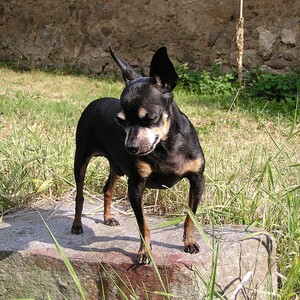
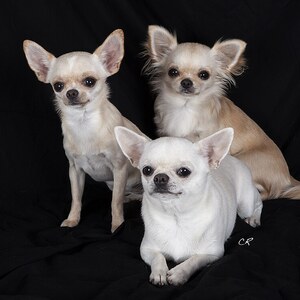
Chihuahua. · Caterinarufo / Wikimedia Commons, public domain. Cropped and resized.
The Chihuahua is considered the smallest pedigree dog in the world: it weighs between 1 and 3 kg. It comes from Mexico and is named after the country's largest state. It has big ears, expressive eyes and a big-dog personality. It is loyal, intelligent and very attached to its owner.
Quick facts
| Common name | Chihuahua (Chihuahueño) |
| Scientific name | Canis lupus familiaris |
| Country of origin | Mexico |
| Official recognition | FCI, definitively since 4 December 1959 (group 9, companion and toy dogs; standard no. 218); also recognised by the AKC |
| Lifespan | 14–16 years |
| Size (males) | about 13–20 cm at the withers; the standard considers only weight |
| Size (females) | about 13–20 cm at the withers |
| Weight | 1–3 kg; ideally 1.5–2.5 kg |
| Coat type | Short and glossy or long and silky |
| Common colours | All colours and combinations, except merle |
| Energy level | Moderate to high |
| Suited to an apartment? | Yes, very well suited |
| Temperament | Alert, intelligent, loyal, brave |
| Tendency to aggression | Low, but can be quarrelsome if not trained |
| Good with children | Poor with small children; it is too fragile |
| Good with other animals | Average |
| Genetic predispositions | Heart disease, eye diseases, patellar luxation, epilepsy |
- Primary category:Dog breeds
- Explore this animal's categories:
History and origin
The FCI standard says these dogs probably lived in the wild and were caught and tamed by local people in the time of the Toltec civilisation. Small dogs called “Techichi”, which lived in Tula, appear as decorations in ancient Mexican art.
The breed is named after the state of Chihuahua, the largest state in Mexico. Wikipedia says genetic studies show that the Chihuahua retains a small share of blood from the ancient dogs of the Americas, from before the arrival of Europeans.
How the breed developed
- Toltec era – Small dogs are tamed by local people in Mexico.
- Early 20th century – The breed is officially recognised.
- 4 December 1959 – The FCI recognises the breed.
- 4 September 2019 – The current FCI standard is published.
Breed rating
| Feature | Stars |
|---|---|
| Training and intelligence | ★★★☆☆ |
| Easy to train | ★★★☆☆ |
| Intelligence | ★★★★☆ |
| Independence | ★★★☆☆ |
| Stubbornness | ★★★★☆ |
| Behaviour and temperament | ★★★★☆ |
| Affectionate with family | ★★★★☆ |
| Friendly with children | ★☆☆☆☆ |
| Good with other dogs | ★★★☆☆ |
| Good with cats and other animals | ★★☆☆☆ |
| Loyalty | ★★★★★ |
| Tendency to be aggressive | ★★★☆☆ |
| Tendency to bark | ★★★★★ |
| Needs and care | ★★☆☆☆ |
| Shedding | ★☆☆☆☆ |
| Needs frequent grooming | ★★☆☆☆ |
| Activity and lifestyle | ★★★★☆ |
| Energy level | ★★★★☆ |
| Daily exercise needs | ★★☆☆☆ |
| Suited to apartment life | ★★★★★ |
| Health and longevity | ★★★★☆ |
| Life expectancy | ★★★★★ |
| Predisposition to genetic diseases | ★★★☆☆ |
| Working abilities and uses | ★★★★☆ |
| Good watchdog | ★★★★☆ |
| Good companion dog | ★★★★★ |
Indicative rating: 5 stars means the highest level. It is based on the ratings the American Kennel Club gives the breed and on the FCI standard.
Physical characteristics
It is a very small, compact dog with an “apple-shaped” rounded head. The standard does not take height into account, only weight: between 1 and 3 kg.
General appearance
The large, erect, wide-open ears tilt sideways at rest, at an angle of about 45°. The large, rounded eyes are very expressive and dark. The tail, carried high, in a curve or semicircle, is an important feature of the breed.
| Feature | Chihuahua |
|---|---|
| Size | Very small |
| Weight | 1–3 kg (ideally 1.5–2.5 kg) |
| Coat | Short or long |
| Head | Rounded, apple-shaped |
| Ears | Large, erect, wide open |
| Tail | Carried high, in a curve or semicircle |
All colours, in all shades and combinations, are accepted, except merle. There are two coat varieties: smooth-coated, with short, glossy, soft hair, and long-coated, with silky hair and feathering on the ears, neck, legs and tail.
Training and socialisation
The AKC says it is very alert and intelligent, eager to please its people, and responds well to positive methods. But it knows how cute it is and quickly learns to get what it wants.
From the start you must show it that you are in charge. Do not allow it as a puppy anything you do not want it to do as an adult. It has a slightly “terrier-like” temperament, so it needs a firm but gentle hand.
Tips for effective training
- Be consistent. Without training, the AKC says it may end up running the house like a “little Napoleon”.
- Use rewards. It responds well to positive methods.
- Work on the barking. The AKC gives it the top score for barking.
- Socialise it. It is reserved with strangers; get it used to new people early.
Activity needs and lifestyle
The AKC says it loves to run and play and that it usually needs very little space. Short, slow walks keep it fit. Do not tire it out too much: if it is panting and struggling to keep up, pick it up.
| Activity | How often | Why it matters |
|---|---|---|
| Short, slow walks | daily | Keep it fit |
| Play indoors | daily | It needs little space |
| Training or dog sports | weekly | It does well at obedience and other sports |
Tips for a balanced life
- It is too small for rough play with children.
- In winter it needs special care: it suffers in the cold.
- It is ideal for city life and small homes.
Care and health
Coat and skin care
The smooth-coated variety needs only occasional brushing and regular baths. The long-coated one should be brushed at least once a week to prevent tangles. Both varieties need their nails trimmed regularly and their teeth cared for.
Common health problems
The AKC says most Chihuahuas are healthy, but the breed can have a few genetic problems:
| Condition | Description | Common symptoms |
|---|---|---|
| Heart disease | Patent ductus arteriosus or mitral valve disease | Heart murmur, tiredness, coughing |
| Patellar luxation | The kneecap slips out of place | Suddenly holds a hind leg up for a few steps, then uses it again |
| Eye diseases | Inherited eye conditions | Cloudy, irritated eyes, poorer vision |
| Idiopathic epilepsy | Neurological seizures with no cause found | Trembling, convulsions |
Other care
- Brush its teeth regularly; small teeth need a lot of care.
- Check the ears and clean away excess wax.
- Trim the nails regularly.
Diet and nutrition
Such a small dog needs very small portions. Even a few extra treats can make it fat.
Tips for a healthy diet
The table gives a starting estimate, calculated with the formula from the Merck Veterinary Manual. The first two calorie columns show the calories per day for a healthy adult dog. The last column shows what this means in dry food with 3,500–4,000 kcal per kilogram.
| Dog's weight | Calories per day (neutered) | Calories per day (not neutered) | Dry food per day (approximate) |
|---|---|---|---|
| 1.5 kg | 150 kcal | 170 kcal | 38–49 g |
| 2 kg | 190 kcal | 210 kcal | 48–60 g |
| 2.5 kg | 220 kcal | 250 kcal | 55–71 g |
| 3 kg | 260 kcal | 290 kcal | 65–83 g |
- Give it its food in 2–3 small meals a day.
- Choose food for toy breeds, with small kibble.
- A dog is at the right weight when you can feel its ribs without pressing hard.
Foods to avoid
Some human foods are dangerous for dogs: chocolate, coffee, grapes and raisins, onions, garlic, xylitol (a sweetener used in chewing gum), macadamia nuts and alcohol.
Reproduction and development
Physical and emotional maturity
In dogs, sexual maturity usually comes between 6 and 12 months. Small breeds become adults faster than large ones, usually at around one year.
Mating and pregnancy
Pregnancy lasts about 63 days, counted from ovulation. Mating a female on her first heat is not recommended. The FCI standard requires that only healthy dogs of typical breed appearance are used for breeding.
Caring for the puppies
In small breeds, a litter has 3–4 puppies on average. The puppies are very small and fragile in the first weeks, so they must be kept warm and handled with care. Socialisation starts early: gentle handling, everyday noises and new people.
Interesting facts
- The smallest pedigree dog. The FCI standard says it is considered the smallest pedigree dog in the world.
- Only weight counts. At shows, height is not measured, only weight: 1–3 kg.
- The name of a Mexican state. It is named after the state of Chihuahua, the largest in Mexico.
- Old American blood. It retains a small share of DNA from the dogs of the pre-Columbian Americas.
- Ears at 45°. At rest, the ears tilt sideways at about 45°.
In popular culture
The dog of the Toltecs
The FCI standard notes that depictions of a small dog called the “Techichi”, which lived in Tula, were used as decorations in the ancient art of Mexico. They show how old the bond is between people and the Chihuahua's ancestors.
Frequently asked questions
How much does a Chihuahua weigh?
Between 1 and 3 kg; the ideal weight is 1.5–2.5 kg.
Is it suitable for children?
Not for small children. The AKC says it is too small for rough play.
Can it live in an apartment?
Yes. It is ideal for city life and small homes.
How long does a Chihuahua live?
Its life expectancy is 14–16 years.
What coat varieties are there?
Smooth-coated and long-coated.