Perdiguero de BurgosCharacteristics, history, training and care
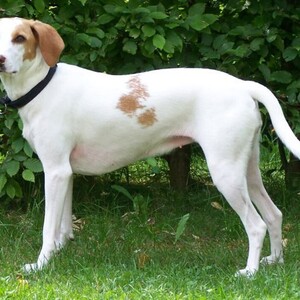
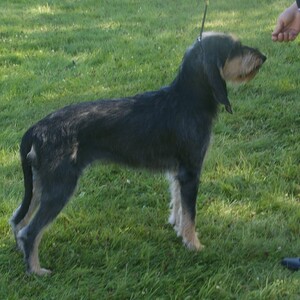
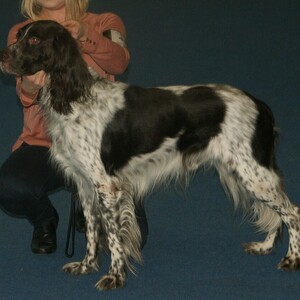
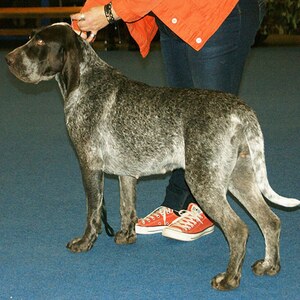
Perdiguero de Burgos. · Canarian / Wikimedia Commons, CC BY-SA 4.0. Cropped and resized.
The Perdiguero de Burgos is a Spanish pointing dog from Castile, especially the province of Burgos. The name comes from “perdiz”, meaning partridge. It is robust, calm and docile, with long, twisted ears and a gentle, sometimes sad expression.
Quick facts
| Common name | Perdiguero de Burgos (Burgos Pointer) |
| Scientific name | Canis lupus familiaris |
| Country of origin | Spain (Castile, province of Burgos) |
| Official recognition | FCI, definitively since 12 November 1954 (group 7, pointing dogs, with working trial; standard no. 90) |
| Lifespan | No published data for the breed; large breeds usually live 10–13 years |
| Size (males) | 62–67 cm at the withers |
| Size (females) | 59–64 cm at the withers |
| Weight | about 25–30 kg |
| Coat type | Dense, short and smooth |
| Common colours | White and liver, mixed: marbled, roan or patched |
| Energy level | Moderate |
| Suited to an apartment? | Not really; it needs exercise |
| Temperament | Robust, balanced, calm, docile, intelligent |
| Tendency to aggression | Very low |
| Good with children | Good |
| Good with other animals | Good with other dogs |
| Genetic predispositions | No breed-specific diseases are known |
- Primary category:Dog breeds
- Explore this animal's categories:
History and origin
The breed dates back to the 16th century and comes from the Castilian plateau. Wikipedia notes that it is thought to descend from a mix of the Sabueso Español and the Pachón Navarro and that it probably contributed to the creation of other pointing breeds.
It is highly valued by hunters who want a robust dog that copes with any terrain, is obedient and has a very fine nose. It usually hunts small game, but it also shows courage with big game.
How the breed developed
- 16th century – The breed takes shape on the Castilian plateau.
- 12 November 1954 – The FCI recognises the breed.
- 26 May 1982 – The current FCI standard is published.
- 2026 – The Spanish Kennel Club lists it among the 16 vulnerable Spanish breeds.
Breed rating
| Feature | Stars |
|---|---|
| Training and intelligence | ★★★★☆ |
| Easy to train | ★★★★☆ |
| Intelligence | ★★★★☆ |
| Independence | ★★☆☆☆ |
| Stubbornness | ★★☆☆☆ |
| Behaviour and temperament | ★★★★☆ |
| Affectionate with family | ★★★★☆ |
| Friendly with children | ★★★★☆ |
| Good with other dogs | ★★★★☆ |
| Good with cats and other animals | ★★★☆☆ |
| Loyalty | ★★★★☆ |
| Tendency to be aggressive | ★☆☆☆☆ |
| Tendency to bark | ★★☆☆☆ |
| Needs and care | ★★☆☆☆ |
| Shedding | ★★☆☆☆ |
| Needs frequent grooming | ★☆☆☆☆ |
| Activity and lifestyle | ★★★☆☆ |
| Energy level | ★★★★☆ |
| Daily exercise needs | ★★★★☆ |
| Suited to apartment life | ★★☆☆☆ |
| Health and longevity | ★★★★☆ |
| Life expectancy | ★★★★☆ |
| Predisposition to genetic diseases | ★★☆☆☆ |
| Working abilities and uses | ★★★★★ |
| Good hunting dog (pointing) | ★★★★★ |
| Good companion dog | ★★★★☆ |
Indicative rating: 5 stars means the highest level. The breed has no AKC profile; the rating is based on the FCI standard (“balanced, calm, docile and intelligent”).
Physical characteristics
It is a hunting dog of good size, well balanced, with medium proportions. It has a well-developed head, a compact body and solid legs. Males are more uniform, while females vary more in size and are finer.
General appearance
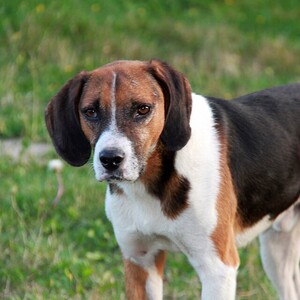
The large, triangular ears hang gracefully, twisted like a corkscrew, and reach the corners of the lips. The almond-shaped eyes, preferably dark hazel, have a noble, gentle expression that sometimes looks sad. It has two folds of skin under the neck.
| Feature | Perdiguero de Burgos |
|---|---|
| Size | Large |
| Height at the withers | males: 62–67 cm; females: 59–64 cm |
| Weight | about 25–30 kg |
| Coat | Dense, short, smooth |
| Eyes | Almond-shaped, dark hazel, gentle expression |
| Ears | Large, hanging, twisted like a corkscrew |
The basic colours are white and liver, mixed irregularly: marbled, roan or patched. There is often a white spot on the forehead, and the ears are always liver. Black and tan markings are not accepted.
Training and socialisation
The standard describes it as a dog with an excellent temperament, docile and intelligent. It is obedient and calm on the trail.
Pointing and retrieving come naturally to it, so training it for hunting is easy, with patience.
Tips for effective training
- Make use of its calm nature. It enjoys quiet exercises.
- Practise retrieving. According to the standard, it does it flawlessly.
- Practise the recall. In the field, its nose can lead it a long way.
- Reward it. Praise and treats motivate it.
Activity needs and lifestyle
It is a hardy dog on any terrain, well suited to hunting. It needs moderate to plenty of daily exercise.
| Activity | How often | Why it matters |
|---|---|---|
| Long walks | daily | Exercise and new scents |
| Retrieving exercises | several times a week | Uses its hunting instinct |
| Hunting or outings in the field | weekly | Gives it a job to do |
Tips for a balanced life
- The yard must be fenced.
- Keep it on a lead outside safe areas.
- Wikipedia says that, in its natural environment, it rarely needs special care.
Care and health
Coat and skin care
The short, smooth coat is very easy to look after, with a brush once a week.
Common health problems
There are no known hereditary diseases specific to the breed. The large, hanging ears should be checked often.
Other care
- Clean the ears once a week.
- Check for ticks after outings in the field.
- Trim the nails regularly.
Diet and nutrition
An active pointing dog needs more energy during the hunting season.
Tips for a healthy diet
The table gives a starting estimate, calculated with the formula from the Merck Veterinary Manual. The first two calorie columns show the calories per day for a healthy adult dog. The last column shows what this means in dry food with 3,500–4,000 kcal per kilogram.
| Dog's weight | Calories per day (neutered) | Calories per day (not neutered) | Dry food per day (approximate) |
|---|---|---|---|
| 25 kg | 1,250 kcal | 1,410 kcal | 310–400 g |
| 28 kg | 1,360 kcal | 1,530 kcal | 340–440 g |
| 30 kg | 1,440 kcal | 1,620 kcal | 360–460 g |
- Give it its food in two meals a day to reduce the risk of bloat.
- Increase the portion on days of hard exercise.
- A dog is at the right weight when you can feel its ribs without pressing hard.
Foods to avoid
Some human foods are dangerous for dogs: chocolate, coffee, grapes and raisins, onions, garlic, xylitol (a sweetener used in chewing gum), macadamia nuts and alcohol.
Reproduction and development
Physical and emotional maturity
In dogs, sexual maturity usually comes between 6 and 12 months, but in large breeds it can be delayed until about two years. The body also reaches its adult form later than in small breeds.
Mating and pregnancy
Pregnancy lasts about 63 days, counted from ovulation. Mating a female on her first heat is not recommended. The FCI standard requires that only healthy dogs of typical breed appearance are used for breeding.
Caring for the puppies
In large breeds, a litter has around 7 puppies on average. Socialisation starts in the first weeks: gentle handling, everyday noises and new people.
Interesting facts
- The name comes from the partridge. “Perdiguero” comes from the Spanish “perdiz”, partridge.
- Corkscrew ears. At rest, the ears hang twisted.
- It looks sad. The standard says its gaze sometimes gives an impression of sadness.
- It is vulnerable. In 2026, the Spanish Kennel Club listed it among the 16 vulnerable Spanish breeds.
- Females vary a lot. The standard says females vary more in size and are much finer than males.
Frequently asked questions
What does “Perdiguero” mean?
It comes from the Spanish “perdiz”, meaning partridge; it is a dog for bird hunting.
How big does it get?
Males measure 62–67 cm, females 59–64 cm; the weight is about 25–30 kg.
What is its temperament like?
It is calm, balanced, docile and intelligent.
Is it a rare breed?
Yes. In 2026 it was listed among the vulnerable Spanish breeds.