Sea otterEnhydra lutris — habitat, diet and reproduction
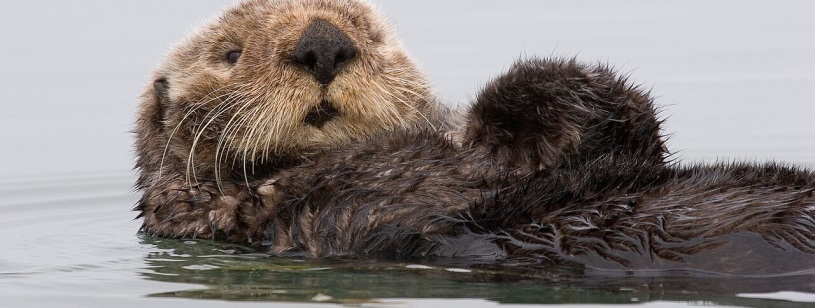
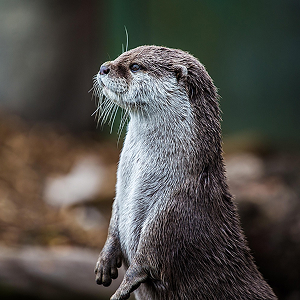
Sea otter (Enhydra lutris) floating on its back. · Mike Baird from Morro Bay, USA (bairdphotos.com) / CC BY 2.0 (https://creativecommons.org/licenses/by/2.0). Cropped and resized.
The sea otter is the smallest marine mammal and the heaviest member of the weasel family. It lives in the cold waters of the North Pacific and spends almost its whole life in the water. Instead of blubber, it is kept warm by the densest fur of any animal.
Quick facts
| Common name | Sea otter |
| Scientific name | Enhydra lutris |
| Lifespan | About 10–20 years |
| Length | About 1–1.5 m |
| Weight | Males about 22–45 kg; females about 14–33 kg |
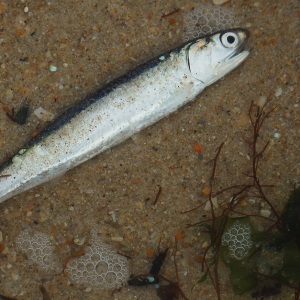
| Diet | Carnivore: sea urchins, clams, crabs, snails, fish |
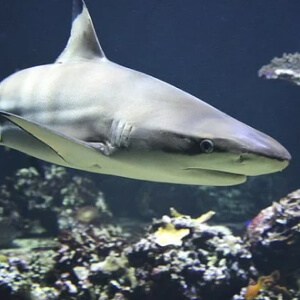
| Predators | Orcas, great white sharks; bald eagles take pups |
| Conservation status | Endangered (EN) |
| Distribution | North Pacific coasts, from Japan and Russia to California |
| Habitat | Coastal waters, kelp forests, rocky bays |
| Family | Mustelidae |
| Fur | About 150,000 hairs per square centimetre |
- Primary category:Mammals
- Explore this animal's categories:
Interesting facts
- Sea otters sleep on their backs, sometimes holding paws or wrapped in kelp so they do not drift away.
- They use stones to crack shellfish on their bellies, as on a table.
- Under each forearm is a pouch of loose skin for storing food and a favourite stone.
- By eating sea urchins, they help keep underwater kelp forests healthy.
Characteristics
The sea otter has a long body, a short flat tail and broad, flipper-like hind feet. Small front paws with retractable claws grip food.
Fur is brown, and the head becomes paler with age. Its two-layered coat traps air that insulates against cold water, so otters spend much time grooming.
Behaviour
Sea otters gather in groups on the water called rafts, usually males and females separately, and rest floating on their backs.
They need lots of energy to stay warm, eating about a quarter of their body weight daily. They dive to the bottom for prey, then return to eat on their bellies. They are among the few mammals that use tools.
Habitat and distribution
The species lives along North Pacific coasts: Japan, Russia, the Aleutian Islands, Alaska, Canada and California.
It favours shallow water near shore with rocky bottoms and kelp forests and rarely strays far from the coast.
Diet and feeding
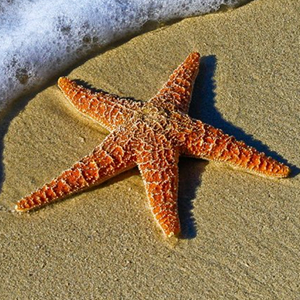
Its main food is bottom invertebrates: sea urchins, clams, mussels, crabs, snails and sea stars. Some populations also eat fish.
Each otter has its own preferences, learned from its mother. For hard shells it uses a stone kept in the pouch under its arm.
Reproduction and life cycle
The female usually gives birth to a single pup in the water. The pup’s fluffy fur makes it float, unable to dive.
The mother holds it on her belly, feeds and grooms it, and leaves it floating while she dives for food. The pup stays with its mother for about six months.
Name and history
The scientific name Enhydra lutris roughly means “otter living in water”.
In the eighteenth and nineteenth centuries, fur hunters killed hundreds of thousands of sea otters. By 1911 only 1,000–2,000 remained, when an international treaty banned the hunt.
Conservation and threats
The sea otter is Endangered. Thanks to protection and reintroductions it has returned to many regions, but populations remain vulnerable.
Main threats include oil spills, which ruin the fur’s insulation, disease, predation by orcas and accidental capture in nets.
Frequently asked questions
Why do sea otters float on their backs?
That is how they rest, eat and care for pups. Air trapped in their fur helps them float.
Why do sea otters hold hands?
When sleeping, some hold paws or wrap themselves in kelp so currents do not separate them.
What does the sea otter eat?
Sea urchins, clams, crabs, snails and sometimes fish.
Is the sea otter endangered?
Yes, it is assessed as Endangered, although it partly recovered after hunting was banned.