Bernese Mountain DogCharacteristics, history, training and care
The Bernese Mountain Dog is a large Swiss working breed with a long tricolour coat. Its history includes farm work and pulling loads. Companionship, suitable activity and attention to health are important throughout its life.
Quick facts
| Common name | Bernese Mountain Dog |
| Scientific name | Canis lupus familiaris |
| Country of origin | Switzerland |
| Official Recognition | Recognized by FCI, AKC, UKC |
| Typical lifespan | About 7-10 years |
| Dimensions (Male) | About 64-70 cm / 38-50 kg |
| Dimensions (Female) | About 58-66 cm / 32-45 kg |
| Coat type | Double, long, soft, weather-resistant |
| Common colours | Tricolour: black with rust and white markings |
| Energy Level | Moderate |
| Suitable for an apartment? | Depends on exercise, training, health and the individual dog |
| Temperament | Calm, loyal, affectionate |
| Behaviour towards unfamiliar people and dogs | Individual behaviour varies; socialisation, training and management matter |
| Compatibility with children | Depends on the individual; adult supervision and suitable handling are essential |
| Compatibility with other animals | Depends on socialisation, prey drive and the animals involved |
| Health considerations | Hip and elbow dysplasia, cancer, bloat, degenerative myelopathy |
- Primary category:Dog breeds
- Explore this animal's categories:
History and Origin
The Bernese Mountain Dog (Berner Sennenhund) is one of the four Swiss mountain dog breeds, used for generations to drive cattle, guard farms and pull carts.
Evolution of the breed
- Old farm dogs - Large farm dogs have lived in the Swiss Alps for centuries; a popular theory links them with mastiff-type dogs brought by the Romans, but this is not proven.
- A Swiss farm dog - In the canton of Bern, farmers used these dogs to drive cattle, guard the farm and pull small carts of milk and cheese to market.
- Saved and standardised - At the end of the 19th century, enthusiasts such as Franz Schertenleib and Professor Albert Heim collected the remaining dogs; the first breed club was founded in 1907, and the name Berner Sennenhund was adopted in 1913.
- A world favourite - Today, the Bernese Mountain Dog is one of the best-loved large family dogs, known for its gentle, loyal nature.
Breed Evaluation
The Bernese Mountain Dog is a gentle, devoted and hard-working dog, suitable for families looking for an affectionate, watchful companion. These are general editorial ratings, not measured scores; individual dogs vary.
| Characteristic | Stars |
|---|---|
| Training and Intelligence | ★★★★☆ |
| Easy to train | ★★★★☆ |
| Intelligence | ★★★★☆ |
| Level of independence | ★★★☆☆ |
| Level of stubbornness | ★★★☆☆ |
| Behavior and Temperament | ★★★★★ |
| Affectionate with family | ★★★★★ |
| Friendly with children | ★★★★★ |
| Compatible with other dogs | ★★★★☆ |
| Compatible with cats and other animals | ★★★★☆ |
| Degree of loyalty | ★★★★★ |
| Tendency to be aggressive | ★☆☆☆☆ |
| Tendency to bark | ★★★☆☆ |
| Needs and Care | ★★★★☆ |
| Shedding level | ★★★★★ |
| Requires frequent care | ★★★★☆ |
| Activity and Lifestyle | ★★★☆☆ |
| Energy level | ★★★☆☆ |
| Daily exercise requirement | ★★★★☆ |
| Suitable for apartment living | ★★☆☆☆ |
| Health and Longevity | ★★★☆☆ |
| Life expectancy | ★★★☆☆ |
| Predisposition to genetic diseases | ★★★★☆ |
| Work and Utility Features | ★★★★☆ |
| Good guard dog | ★★★☆☆ |
| Good companion dog | ★★★★★ |
Physical Characteristics
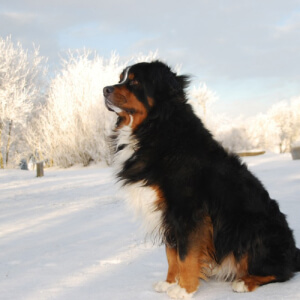
The Bernese Mountain Dog is a large, sturdy dog with a gentle expression.
General appearance
- A large, muscular, powerful body, built for work.
- A distinctive long, silky tricolour coat: mostly black, with rust-coloured and white markings.
- Medium-sized, triangular ears that hang close to the head, giving it a friendly look.
- Dark brown, almond-shaped eyes with a gentle, intelligent expression.
- A bushy tail, carried low at rest and never curled over the back.
| Characteristic | Bernese Mountain Dog |
|---|---|
| Size | Large (about 58-70 cm at the shoulder) |
| Weight | About 32-50 kg |
| Coat | Double, long, soft |
| Muzzle | Strong, straight |
| Shedding tendency | High |
| Build | Sturdy and muscular |
The Bernese Mountain Dog is impressive in size but very friendly, loved both for its looks and its gentle temperament.
Training and Socialization
The Bernese Mountain Dog is intelligent, eager to please and very loyal, which makes it fairly easy to train with reward-based methods. Because it is gentle and sensitive, training should be kind but consistent.
Tips for effective training
- Start early - Puppies should start socialisation and basic commands from about 8 weeks to prevent shyness.
- Rewards and praise - It responds very well to positive methods, but badly to harsh corrections.
- Short, varied sessions - It is clever, but can get bored if lessons are too repetitive.
- Wide socialisation - It can be reserved with strangers, so it should meet new people, animals and situations from an early age.
- Lead training - Because it grows so big, it should learn early not to pull on the lead.
With good training, the Bernese Mountain Dog becomes a devoted, obedient and watchful companion.
Activity and Lifestyle Needs
Although it is a large dog, the Bernese Mountain Dog is not hyperactive, but it needs regular exercise to prevent obesity and joint problems.
| Activity | Recommended duration |
|---|---|
| Daily walks | About 45-60 min |
| Interactive games | About 20-30 min |
| Obedience training | About 15 min |
| Carting (drafting) or hiking | Good, but not essential; avoid in hot weather |
Recommendations for a balanced lifestyle
- Best in a house with a garden - It is not ideal for small apartments, but can adapt if it gets enough daily exercise.
- Loves the outdoors - It enjoys hikes, long walks and exploring, but should not be pushed to exercise hard in hot weather.
- Does not tolerate heat well - Because of its thick coat, it can overheat easily and is happiest in cool climates.
- Needs company - It does not like being alone for long and can develop separation anxiety.
Without enough attention and exercise, the Bernese Mountain Dog may become dull, overweight and more prone to health problems.
Care and Health
Its long coat needs regular grooming, and the breed is prone to some serious inherited diseases that need careful monitoring.
Fur and skin care
- Brushing 2-3 times a week - Its long coat sheds heavily, especially in spring and autumn, when daily brushing helps.
- Occasional baths - A bath every couple of months, or when dirty, keeps the coat clean.
- Ear and claw care - Ears should be checked regularly, and claws trimmed if they do not wear down naturally.
Common health problems
| Condition | Description | Common symptoms |
|---|---|---|
| Hip and elbow dysplasia | Inherited joint problems affecting mobility | Limping, joint pain |
| Cancer | The breed has a very high rate of cancer, especially histiocytic sarcoma | Lumps, low energy, weight loss |
| Bloat (gastric torsion) | The stomach swells and may twist; more likely after eating quickly | Swollen belly, restlessness |
| Degenerative myelopathy | A spinal cord disease that slowly weakens the hind legs; a DNA test is available | Wobbly walking, hind-leg weakness |
Other aspects of care
- Weight control - As a large dog, it must be fed carefully to avoid extra weight.
- Regular veterinary visits - Yearly check-ups help find joint problems, lumps and other diseases early.
The Bernese Mountain Dog is prone to some serious inherited diseases and has a shorter life than many breeds, but good care and responsible breeding help it live as long and healthy a life as possible.
Diet and Nutrition
The Bernese Mountain Dog needs a balanced diet that supports its large body and moderate activity level.
Recommendations for a healthy diet
Choose a complete, balanced diet suited to age, size and health. Plan home-prepared diets and supplements with a qualified veterinarian; raw pet food can carry harmful bacteria.
| Food type | Daily Amount (Adults) | Frequency |
|---|---|---|
| Premium dry food | Individual amount; follow complete-food guidance and veterinary advice | 2 meals/day |
| Home cooked food | Individual amount; follow complete-food guidance and veterinary advice | 2 meals/day |
| Raw food: bacterial contamination is a concern | Individual amount; follow complete-food guidance and veterinary advice | 2 meals/day |
Forbidden foods
Chocolate, grapes and raisins, onions and xylitol - toxic to dogs. ; Cooked bones - can splinter and cause intestinal blockage. ; Fatty food - can lead to digestive problems and pancreatitis. ; Overfeeding - can cause weight gain, which affects the joints.
The Bernese Mountain Dog should be fed properly, with food for large-breed puppies while growing, to protect its joints and prevent obesity.
Reproduction and Development
Responsible breeding of Bernese Mountain Dogs includes health tests to reduce the risk of passing on inherited diseases such as hip dysplasia. Breeding requires veterinary planning and care for the mother and puppies.
Physical and emotional maturity
- Physical maturity: This breed grows quickly in the first year, but is usually not fully mature until about 2-3 years.
- Emotional maturity: It usually becomes calmer and more settled at about 2-3 years, but stays playful.
Mating and Gestation
- Breeding decisions require veterinary assessment of maturity, health and suitable screening; a fixed age does not establish that breeding is appropriate.
- Duration of gestation: Approximately 58-68 days, usually about 63 days.
- Average number of puppies: Usually about 6-9 puppies.
Puppy care
- The first 3 weeks: Puppies depend completely on their mother for warmth, food and protection.
- Between 4-8 weeks: They begin to explore, play and learn social behaviour.
- Moving to a new home: When puppies go to their new homes, they need ongoing socialisation and training to become balanced dogs.
Bernese puppies grow very fast, and their growth should be managed carefully, with suitable food and gentle exercise, to protect their joints.
Curiosities and Interesting Facts
- An old name - The breed's old name was "Dürrbächler", after an inn in the Dürrbach area of the canton of Bern, where many of these dogs were found.
- Nearly lost - At the end of the 19th century, the breed was becoming rare, but Swiss enthusiasts saved it.
- A cart puller - Bernese once pulled small carts of milk and cheese, and today some still take part in carting (drafting) events.
- A gentle giant - Despite its size, it is known for its calm, gentle temperament.
- A short life - Sadly, Bernese Mountain Dogs usually live only about 7-10 years, mainly because of cancer.
- Good with children - It is usually affectionate and patient, but because of its size it should be supervised around young children.
- Does not like loneliness - It is very attached to its family and can become anxious if left alone too long.
The Dog in Popular Culture
The Bernese Mountain Dog is one of the best-known symbols of rural Switzerland.
The Bernese Mountain Dog in modern media and culture
- Therapy dogs - Thanks to its calm temperament, it is often used as a therapy dog for children and older people.
- A symbol of Switzerland - It is one of the most typical Swiss breeds and often appears on postcards, calendars and souvenirs.
- Children's books - Its gentle, teddy-bear look has made it a popular character in picture books and stories.
Importance in modern culture
- A family favourite - Thanks to its affectionate nature, it is one of the most popular large family dogs.
- An outdoor partner - Many owners take their Bernese hiking in cool weather.
- A symbol of loyalty - It is seen as one of the most devoted family dogs.