Great titParus major — identification, food, nesting and behaviour
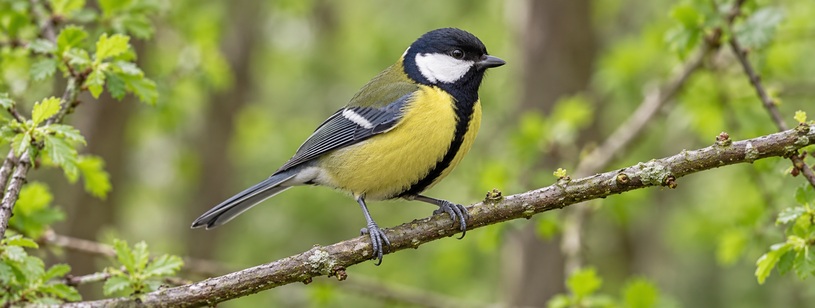
Great tit, Parus major, with a black head, white cheeks and yellow underparts.
The great tit is a small songbird with a black head, large white cheeks and yellow underparts divided by a black stripe. It lives in woodland, orchards, parks and gardens, and is a familiar visitor to winter bird feeders.
Parus major is one of several species known as tits. It eats insects and other invertebrates as well as seeds and fruit, with the balance changing through the year. In Romania it is a resident breeding bird.
Quick facts
| Common name | Great tit |
| Scientific name | Parus major |
| Typical lifespan | About 3 years for a bird that has reached breeding age, according to BTO; some individuals live longer. |
| Length | Around 14 cm; the Romanian species account gives 13–15 cm. |
| Weight | Around 18 g, varying between individuals and through the day. |
| Diet type | Omnivorous: invertebrates, seeds and fruit in seasonally changing proportions. |
| Main predators | Sparrowhawks and cats can take adults; eggs and chicks face additional predators. |
| Conservation status | Globally Least Concern (LC), as reported by BTO. |
| Geographical distribution | Europe, northern Africa and parts of Asia. |
| Habitat | Woodland, riverside trees, orchards, parks and gardens. |
| Wingspan | Around 24 cm. |
| Activity | Diurnal: feeds during daylight. |
| Social life | Territorial when nesting; may join mixed-species feeding flocks in autumn and winter. |
| Presence in Romania | Breeds and remains through winter. |
| Nest | A tree hole, another cavity or a suitable nest box. |
| Eggs | Usually 5–12 per clutch in the Romanian species account; clutch sizes vary. |
| Incubation | Around two weeks; 12–15 days in the Romanian account. |
| Leaving the nest | About 16–22 days after hatching in the Romanian account; parents continue feeding young for a while. |
- Primary category:Birds
- Explore this animal's categories:Animals of AfricaAnimals of AsiaAnimals of EuropeAnimals of RomaniaAnimals of Romania’s forestsAnimals of Romania’s gardens and parksAnimals of the Danube DeltaAnimals that live in groupsArboreal animalsBirdsBirds of RomaniaBirds that winter in RomaniaEgg-laying animalsFeathered animalsFlying animalsForest animalsGInsect-eating animalsIntelligent animalsMountain animalsOmnivoresPredatory animals of RomaniaStriped animalsVertebratesWild animals
Interesting facts
- The belly stripe can help distinguish the sexes. It is generally broader in males.
- Winter flocks can include other species. Great tits may search trees and gardens alongside blue tits.
- They can learn from neighbours. Field experiments show that feeding techniques can spread between birds.
- They readily use nest boxes. An artificial cavity can provide an alternative to a tree hole.
Records and remarkable features
Larger than a blue tit
At around 14 cm long, the great tit is more robust than the blue tit. The size difference is easier to appreciate when both visit the same feeder.
A study that began in 1947
Researchers have monitored great tits in Wytham Woods, near Oxford, since 1947. Individually marked birds and their nests have been followed over many generations.
These long records help scientists investigate relationships between weather, food and breeding. They are evidence from a carefully studied population, rather than a ranking of bird intelligence.
Characteristics
How can you identify a great tit?
Look for a black head with broad white cheek patches. The black throat continues into a stripe down the yellow breast and belly. The back is greenish, and the blue-grey wings have a white bar.
The bill is short and dark. Its compact body and quick movements between branches make it conspicuous in bare winter trees.
Male, female or juvenile?
| Bird | Identification clues |
|---|---|
| Adult male | Black head and white cheeks; generally a broader black belly stripe. |
| Adult female | Similar overall pattern, with a narrower belly stripe. |
| Juvenile | Cheeks may be yellowish rather than clean white; differs from adult plumage. |
Great tit or blue tit?
A blue tit has a blue crown and a dark stripe through the eye. A great tit has a black crown and a large white cheek patch. Both can show yellow underparts, so belly colour alone is not enough.
Habits and behaviour
Song and territory
The great tit has several songs and calls. One familiar song repeats two notes and is often described as sounding like a bicycle pump. Its other vocalisations can sound quite different.
During breeding, pairs defend the area around their nest. At feeders, a great tit may drive away smaller tits.
Learning from other birds
In a Wytham experiment, a few birds were trained to slide a small door in a particular direction to obtain food. After release, their technique spread through their local groups.
Different groups retained different preferences although both solutions worked. Learning by observing other birds can therefore help maintain local feeding traditions.
Winter flocks
Outside the nesting season, great tits can search branches and foliage alongside other small birds. These feeding groups do not mean that the species nests in colonies.
Habitat and geographical distribution
Where does it live?
The great tit occurs in Europe, northern Africa and parts of Asia. It uses wooded landscapes, including forests and green spaces in towns.
Gardens with trees, shrubs and insects can provide food and shelter. Breeding requires a suitable cavity, such as a tree hole.
Great tits in Romania
The species occurs across much of Romania, from the Danube Delta to mountain woodland. It is absent from very high mountain areas and open alpine habitat.
- Woodland: branches and foliage provide feeding opportunities.
- Orchards: trees offer invertebrates and shelter.
- Parks and gardens: tree holes and suitable nest boxes can provide nesting sites.
Does it migrate?
It is resident in Romania, remaining throughout the year. Across the species, movements vary: some northern and eastern European populations travel more than those in other regions.
Diet and feeding
What does a great tit eat?
It is omnivorous, taking many insects during the warmer months. Caterpillars, other larvae, spiders and various insects form part of its diet. Seeds and fruit become more important in autumn and winter.
It searches leaves and branches and sometimes feeds on the ground. Small invertebrates are particularly important for growing chicks.
Visiting a feeder
In winter, great tits visit feeders offering sunflower seeds and walnut pieces. They may hold a seed between their toes and hammer it with the bill to reach the kernel.
- Offer raw, unsalted seeds.
- Place food where cats cannot ambush feeding birds.
- Avoid bread and salty or seasoned foods.
Supplementary food can help during cold conditions. Trees and varied vegetation remain important sources of natural food and shelter.
Reproduction and life cycle
A nest inside a cavity
The female builds a cup-shaped nest from moss, grass, hair and feathers. She places it in a tree hole or another cavity. Suitable nest boxes are also used.
Eggs and growing chicks
| Stage | Great tit breeding information |
|---|---|
| Season | Mainly April–June in Romania; the Romanian account reports up to two broods annually. |
| Clutch | Usually 5–12 eggs in that account, with variation between nests. |
| Incubation | The female incubates for around 12–15 days while the male brings her food. |
| Nestlings | Both parents feed young, which leave after about 16–22 days. |
| After fledging | Parents continue feeding the young for a while; leaving the nest does not mean immediate independence. |
The eggs are white with reddish-brown speckles. Clutch size and development times differ between nests and regions.
How long does it live?
BTO gives a typical figure of about three years for a bird that has reached breeding age. This is not a maximum: some individuals live longer. Food shortages and predation are among the risks faced by young birds and adults.
Names and history
What does Parus major mean?
Parus is the Latin name for a tit, while major means larger. The scientific name is attributed to Linnaeus, 1758.
| Classification level | Name |
|---|---|
| Class | Aves — birds |
| Order | Passeriformes — an order containing many songbirds |
| Family | Paridae — tits and their relatives |
| Genus | Parus |
| Species | Parus major |
Different species called tits
Great tits and blue tits are different species. Romania also has crested tits, coal tits and other members of the family Paridae.
Common names do not always reflect close relationships. The long-tailed tit belongs to another family, Aegithalidae. Features of one species should not automatically be applied to every bird called a tit.
Conservation and threats
Is it endangered?
The great tit is classified globally as Least Concern. It is a common species, but local birds still depend on food and suitable habitat.
What risks does it face?
- Insecticides can reduce invertebrates available to birds and their young.
- Severe winters can make food difficult to find.
- Predators, including sparrowhawks and cats, can take adults.
How can it be helped?
Retain varied vegetation and suitable nesting trees where safe. A well-placed nest box can provide an alternative cavity.
Watch birds from a distance without opening an occupied nest. Gardens with insects and natural shelter support birds throughout the year.
Frequently asked questions
How do you recognise a great tit?
Look for a black head, white cheeks, greenish back and yellow underparts divided by a black stripe.
What do great tits eat?
Insects and other invertebrates, seeds and fruit. Insects are particularly important in the breeding season.
Do great tits leave Romania in winter?
The species breeds and remains in Romania through winter. Other populations may make seasonal movements.
Are great tits and blue tits the same species?
No. Parus major has a black crown. The blue tit, Cyanistes caeruleus, has a blue crown.
Where do they nest?
In tree holes, other cavities and suitable nest boxes. The female builds the nest.
How many eggs do they lay?
The Romanian species account gives a usual clutch of 5–12 eggs. Numbers vary between nests.
How long does a great tit live?
BTO gives about three years for a bird that has reached breeding age; some individuals live longer.
What food can be offered in winter?
Raw, unsalted sunflower seeds and walnut pieces are suitable examples. Avoid bread and salty or seasoned food.
Did you know? About the great tit
- The great tit has a black head, white cheeks and a black stripe down its yellow belly.
- It is present in Romania throughout the year.
- It can join mixed-species feeding flocks in winter.
- It uses tree holes and suitable nest boxes.