Podenco CanarioCharacteristics, history, training and care
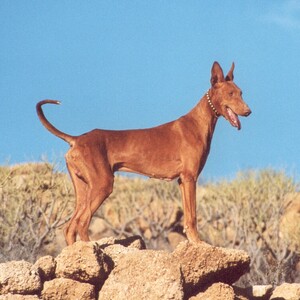
Podenco Canario. · CommonismNow / Wikimedia Commons, CC BY-SA 3.0. Cropped and resized.
The Podenco Canario is a slender, light hunting dog, red and white, from the Canary Islands. It is used for hunting rabbits on rugged ground, where it uses its nose, eyes and ears. The standard describes it as brave, full of energy, not at all aggressive and devoted to its owner.
Quick facts
| Common name | Podenco Canario |
| Scientific name | Canis lupus familiaris |
| Country of origin | Spain (Canary Islands) |
| Official recognition | FCI, definitively since 24 June 1987 (group 5, primitive type, hunting dogs; standard no. 329) |
| Lifespan | No published data for the breed; large breeds usually live 10–12 years |
| Size (males) | 55–64 cm at the withers |
| Size (females) | 53–60 cm at the withers |
| Coat type | Smooth, short, dense |
| Common colours | Red and white, from orange to mahogany red |
| Energy level | Very high |
| Suited to an apartment? | No |
| Temperament | Brave, energetic, enthusiastic, devoted |
| Tendency to aggression | Not at all aggressive, according to the standard |
| Good with children | No specific data |
| Good with other animals | Poor with small animals; hunting instinct |
| Genetic predispositions | No breed-specific diseases are known |
- Primary category:Dog breeds
- Explore this animal's categories:
History and origin
The FCI standard says the breed is found on all the Canary Islands, especially Gran Canaria and Tenerife, and that it is said to be of Egyptian origin, probably brought by the Phoenicians, Greeks, Carthaginians or Egyptians. The standard states that it is around 7,000 years old and mentions depictions in the tombs of the pharaohs.
Wikipedia, however, says recent genetic studies have shown that this type of dog is related mainly to the other European hunting breeds and is no more primitive than they are. A 2019 study found that the four Spanish podenco breeds form a group distinct from the Cirneco and the Maltese rabbit dog.
How the breed developed
- Antiquity – According to the standard, the dogs reach the Canary Islands.
- 24 June 1987 – The FCI recognises the breed.
- 2019 – A genetic study compares the Mediterranean podencos.
Breed rating
| Feature | Stars |
|---|---|
| Training and intelligence | ★★★☆☆ |
| Easy to train | ★★★☆☆ |
| Intelligence | ★★★★☆ |
| Independence | ★★★★☆ |
| Stubbornness | ★★★☆☆ |
| Behaviour and temperament | ★★★★☆ |
| Affectionate with family | ★★★★★ |
| Friendly with children | ★★★☆☆ |
| Good with other dogs | ★★★☆☆ |
| Good with cats and other animals | ★☆☆☆☆ |
| Loyalty | ★★★★★ |
| Tendency to be aggressive | ★☆☆☆☆ |
| Tendency to bark | ★★★☆☆ |
| Needs and care | ★★★☆☆ |
| Shedding | ★★☆☆☆ |
| Needs frequent grooming | ★☆☆☆☆ |
| Activity and lifestyle | ★★★★★ |
| Energy level | ★★★★★ |
| Daily exercise needs | ★★★★★ |
| Suited to apartment life | ★☆☆☆☆ |
| Health and longevity | ★★★☆☆ |
| Life expectancy | ★★★★☆ |
| Predisposition to genetic diseases | ★★☆☆☆ |
| Working abilities and uses | ★★★★☆ |
| Good hunting dog | ★★★★★ |
| Good companion dog | ★★★☆☆ |
Indicative rating: 5 stars means the highest level. The breed has no AKC profile, so the rating is based on the FCI standard.
Physical characteristics
The standard describes it as a medium-sized, elongated, slender, light and muscular dog. It copes easily with high temperatures and can hunt from dawn to dusk.
General appearance
The head is elongated, shaped like a truncated cone, and 21–22 cm long. The coat is smooth, short and dense.
| Feature | Podenco Canario |
|---|---|
| Size | Large |
| Height at the withers | males: 55–64 cm; females: 53–60 cm |
| Coat | Smooth, short |
| Colour | Red and white |
| Head | Elongated, conical |
| Endurance | High in hot weather |
The preferred colour is red and white; the red may be more or less intense, from orange to dark red (mahogany). All combinations of these colours are accepted.
Training and socialisation
The standard describes it as brave, highly strung, restless and full of enthusiastic energy. It is imposing, but not at all aggressive.
It is selflessly devoted to its owner and stoically endures the hardest days without any sign of tiredness.
Tips for effective training
- Practise the recall. It hunts by scent, sight and hearing.
- Keep it on the lead. Its hunting instinct is very strong.
- Use rewards. It is devoted to its owner.
- Give it plenty to do. It is very energetic.
Activity needs and lifestyle
The standard says it can hunt from dawn to sunset. It needs a lot of exercise every day and running in a safe place.
| Activity | How often | Why it matters |
|---|---|---|
| Long walks | daily | Great stamina |
| Running in a fenced area | several times a week | Energy |
| Search games | daily | An excellent nose |
Tips for a balanced life
- It is best suited to hunters.
- The fence must be high.
- In winter, its short coat does not protect it from the cold.
Care and health
Coat and skin care
The short, dense coat is brushed once a week with a rubber mitt.
Common health problems
No health studies have been published for the breed and no specific diseases are known. As with any active hunting dog, it is worth watching for:
| Condition | Description | Common symptoms |
|---|---|---|
| Hunting injuries | Cuts and scratches on rocky ground | Limping, blood on the paws |
Other care
- Check its paws after hunting.
- Check for ticks after outings in nature.
- Trim the nails regularly.
Diet and nutrition
An active hunting dog needs good-quality food suited to its level of exertion.
Tips for a healthy diet
The table gives a starting estimate, calculated with the formula from the Merck Veterinary Manual. The first two calorie columns show the calories per day for a healthy adult dog. The last column shows what this means in dry food with 3,500–4,000 kcal per kilogram.
| Dog's weight | Calories per day (neutered) | Calories per day (not neutered) | Dry food per day (approximate) |
|---|---|---|---|
| 18 kg | 980 kcal | 1,100 kcal | 240–310 g |
| 22 kg | 1,140 kcal | 1,280 kcal | 280–370 g |
| 25 kg | 1,250 kcal | 1,410 kcal | 310–400 g |
- Split the food into two meals a day.
- Do not let it run right after a meal.
- In slender dogs the ribs are easy to see; what matters is that it is not too thin.
Foods to avoid
Some human foods are dangerous for dogs: chocolate, coffee, grapes and raisins, onions, garlic, xylitol (a sweetener used in chewing gum), macadamia nuts and alcohol.
Reproduction and development
Physical and emotional maturity
In dogs, sexual maturity usually comes between 6 and 12 months, but in large breeds it can be delayed until about two years. The body also reaches its adult form later than in small breeds.
Mating and pregnancy
Pregnancy lasts about 63 days, counted from ovulation. Mating a female on her first heat is not recommended. The FCI standard requires that only healthy dogs of typical breed appearance are used for breeding.
Caring for the puppies
In large breeds, a litter has around 7 puppies on average. Socialisation starts in the first weeks: gentle handling, everyday noises and new people.
Interesting facts
- It hunts all day. The standard says it hunts from dawn to dusk.
- It copes with heat. It easily withstands high temperatures.
- On all the islands. It is found on all the Canary Islands.
- Legend and genetics. Legend makes it Egyptian; genetics shows it to be European.
- Four Spanish podencos. The Andaluz, Canario, Ibicenco and Valenciano form one genetic group.
Frequently asked questions
What does it hunt?
Mainly rabbits, on rugged ground.
How big does it get?
Males measure 55–64 cm, females 53–60 cm.
Is it aggressive?
The standard says it is imposing, but not at all aggressive.
Is it related to the Podenco Ibicenco?
Yes, they are related Spanish breeds.