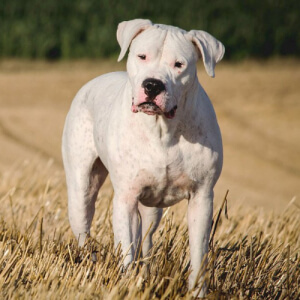
Dogo ArgentinoCharacteristics, history, training and care
The Dogo Argentino is a large, muscular breed developed in Argentina for hunting large game. It needs appropriate training, management and veterinary care. Its strength and history make careful assessment of the individual dog and its living circumstances essential.
Quick facts
| Common name | Dogo Argentino |
| Scientific name | Canis lupus familiaris |
| Country of origin | Argentina |
| Official Recognition | Recognized by FCI, AKC, UKC |
| Typical lifespan | About 10-12 years |
| Dimensions (Male) | About 62-68 cm / 40-45 kg |
| Dimensions (Female) | About 60-65 cm / 35-40 kg |
| Coat type | Short, smooth, white |
| Common colours | White; a single dark patch on the head is allowed by some standards |
| Energy Level | High |
| Suitable for an apartment? | Depends on exercise, training, health and the individual dog |
| Temperament | Protective, loyal, brave |
| Behaviour towards unfamiliar people and dogs | Individual behaviour varies; socialisation, training and management matter |
| Compatibility with children | Depends on the individual; adult supervision and suitable handling are essential |
| Compatibility with other animals | Depends on socialisation, prey drive and the animals involved |
| Health considerations | Deafness, hip dysplasia, skin problems, bloat |
- Primary category:Dog breeds
- Explore this animal's categories:
History and Origin
The Dogo Argentino is the best-known dog breed from Argentina and the only Argentine breed recognised by the FCI. Its history is closely linked to big-game hunting.
Evolution of the breed
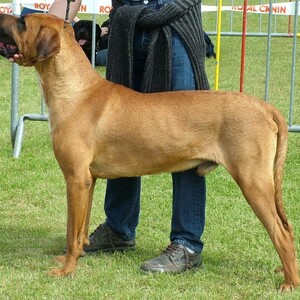
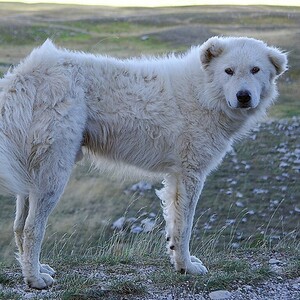
- Created from the 1920s - In the province of Córdoba, Dr. Antonio Nores Martínez, helped by his brother Agustín, developed the breed from the now-extinct Córdoba fighting dog, crossed with breeds such as the Great Dane, Boxer, Bull Terrier, Pointer, Irish Wolfhound, Dogue de Bordeaux and Great Pyrenees.
- A big-game hunter - It was bred to hunt in packs, track and hold wild boar and pumas, and to be brave but not quarrelsome with other dogs.
- Other roles - Over time, the Dogo Argentino has also been used as a guard dog and, in some countries, for police and search work.
- International recognition - The FCI recognised the breed in 1973, and the AKC in 2020.
Breed Evaluation
The Dogo Argentino is a strong, brave and intelligent dog, suited to experienced people who can give it consistent training and daily activity. These are general editorial ratings, not measured scores; individual dogs vary.
| Characteristic | Stars |
|---|---|
| Training and Intelligence | ★★★★☆ |
| Easy to train | ★★★★☆ |
| Intelligence | ★★★★☆ |
| Level of independence | ★★★★☆ |
| Level of stubbornness | ★★★☆☆ |
| Behavior and Temperament | ★★★★☆ |
| Affectionate with family | ★★★★★ |
| Friendly with children | ★★★★☆ |
| Compatible with other dogs | ★★☆☆☆ |
| Compatible with cats and other animals | ★☆☆☆☆ |
| Degree of loyalty | ★★★★★ |
| Tendency to be aggressive | ★★★☆☆ |
| Tendency to bark | ★★☆☆☆ |
| Needs and Care | ★★★☆☆ |
| Shedding level | ★★☆☆☆ |
| Requires frequent care | ★★☆☆☆ |
| Activity and Lifestyle | ★★★★★ |
| Energy level | ★★★★★ |
| Daily exercise requirement | ★★★★★ |
| Suitable for apartment living | ★☆☆☆☆ |
| Health and Longevity | ★★★★☆ |
| Life expectancy | ★★★★☆ |
| Predisposition to genetic diseases | ★★★☆☆ |
| Work and Utility Features | ★★★★★ |
| Good guard dog | ★★★★★ |
| Good companion dog | ★★★★☆ |
Physical Characteristics
The Dogo Argentino is a large, muscular, athletic dog known for its strength and stamina.
General appearance
- A strong, athletic body, built for both speed and power.
- A short, smooth, pure white coat.
- A large head with a strong jaw, typical of mastiff-type (molossoid) breeds.
- Natural, hanging ears, or cropped ears in countries where this is still legal.
- Almond-shaped dark or hazel eyes with an alert, intelligent expression.
- A long, strong tail, carried low.
| Characteristic | Dogo Argentino |
|---|---|
| Size | Large (about 60-68 cm at the shoulder) |
| Weight | About 35-45 kg |
| Coat | Short, smooth, white |
| Muzzle | Square, strong |
| Shedding tendency | Moderate |
| Build | Solid, muscular, athletic |
The Dogo Argentino is an impressive yet athletic dog, combining strength, agility and intelligence.
Training and Socialization
The Dogo Argentino is intelligent but independent and strong-willed, so training is essential from the first months. It suits only people with experience in raising and training powerful guardian breeds.
Tips for effective training
- Early socialisation - Puppies must meet new people, dogs and places from an early age to prevent fear and aggression.
- Calm, consistent leadership - The Dogo does not respond well to harsh corrections, but it needs clear, consistent rules.
- Reward-based methods - It responds well to praise and food rewards.
- Impulse control - As a powerful, energetic dog, it must learn to stay calm around strong stimuli such as other animals.
- Never encourage aggression - It has natural protective instincts, but must be raised to be controlled and balanced.
Consistent training and good socialisation make the Dogo Argentino a reliable companion and an excellent watchdog.
Activity and Lifestyle Needs
The Dogo Argentino is an active breed that needs plenty of exercise and mental stimulation.
| Activity | Recommended duration |
|---|---|
| Daily walks | About 60-90 min |
| Interactive games | About 30 min |
| Obedience training | About 15-20 min |
| Dog sports (tracking, canicross, weight pulling) | Recommended |
Recommendations for a balanced lifestyle
- Not ideal for apartments - It needs a large, securely fenced garden and regular outdoor activity.
- Good for active people - It suits those who run, hike or do dog sports.
- Does not like being alone - It needs plenty of contact with its family.
- Needs mental stimulation - Without challenges, it may become bored and destructive.
- Check local laws - In some countries and cities, the Dogo Argentino is banned or restricted.
Without enough activity, the Dogo Argentino may develop problem behaviours such as destructiveness or reactivity.
Care and Health
The Dogo Argentino's short coat needs little care, but the breed is prone to some health problems that should be monitored.
Fur and skin care
- Weekly brushing - Removes dead hair and keeps the skin healthy.
- Occasional baths - It needs washing only when dirty; its white skin can be sensitive and prone to irritation.
- Sun protection - Its white coat and pink skin can burn in strong sun.
- Ear and eye checks - Ears should be cleaned regularly and eyes checked for infection.
Common health problems
| Condition | Description | Common symptoms |
|---|---|---|
| Congenital deafness | Linked to the white coat; affects roughly one in ten Dogos in one or both ears | No reaction to sounds |
| Hip dysplasia | Abnormal development of the hip joint | Lameness, stiff gait |
| Skin problems | Allergies and sunburn are common in white dogs | Itching, redness |
| Bloat (gastric torsion) | The stomach swells and may twist; can be fatal | Swollen belly, restlessness |
Other aspects of care
- Weight control - It should get a balanced diet, as extra weight affects its joints.
- Regular veterinary visits - Yearly check-ups are recommended; puppies can have a hearing test (BAER).
The Dogo Argentino is a strong breed, but it needs careful health monitoring.
Diet and Nutrition
The Dogo Argentino needs a balanced diet with good-quality protein to maintain its muscles and energy.
Recommendations for a healthy diet
Choose a complete, balanced diet suited to age, size and health. Plan home-prepared diets and supplements with a qualified veterinarian; raw pet food can carry harmful bacteria.
| Food type | Daily Amount (Adults) | Frequency |
|---|---|---|
| Premium dry food | Individual amount; follow a complete diet’s guidance and veterinary advice | 2 meals/day |
| Home cooked food | Individual amount; follow complete-food guidance and veterinary advice | 2 meals/day |
| Raw food: bacterial contamination is a concern | Individual amount; follow complete-food guidance and veterinary advice | 2 meals/day |
Forbidden foods
Chocolate, grapes and raisins, onions and xylitol - toxic to dogs. ; Cooked bones - can splinter and cause intestinal blockage. ; Fatty, processed foods - can lead to digestive problems and pancreatitis. ; Overfeeding - can cause weight gain, which affects the joints and heart.
The Dogo Argentino should be fed properly to stay healthy and energetic.
Reproduction and Development
Responsible breeding of the Dogo Argentino includes health tests, such as hearing tests, to reduce the risk of inherited problems like congenital deafness. Breeding requires veterinary planning and care for the mother and puppies.
Physical and emotional maturity
- Physical maturity: It grows quickly in the first year and is usually fully developed at about 18-24 months.
- Emotional maturity: It usually becomes calmer after about 2 years, but stays watchful and protective all its life.
Mating and Gestation
- Breeding decisions require veterinary assessment of maturity, health and suitable screening; a fixed age does not establish that breeding is appropriate.
- Duration of gestation: Approximately 58-68 days, usually about 63 days.
- Average number of puppies: Usually about 6-10 puppies.
Puppy care
- The first 3 weeks: Puppies depend completely on their mother for warmth, milk and protection.
- Between 4-8 weeks: They begin to explore, play and learn social behaviour.
- Moving to a new home – Timing depends on health, development and local requirements. Continue careful socialisation and veterinary care.
Dogo Argentino puppies need good socialisation from an early age to prevent territorial and aggressive behaviour later.
Curiosities and Interesting Facts
- Argentina's breed - The Dogo Argentino is the only Argentine breed recognised by the FCI and a source of national pride.
- Great stamina - It was bred to follow game for long distances over rough ground.
- A pack hunter - Unlike its fighting-dog ancestors, it was bred to hunt in packs without fighting the other dogs.
- Quiet but watchful - It usually does not bark much, but will warn its family of real threats.
- White for a reason - Its white coat made it easy for hunters to see and to tell apart from the game.
- A good nose - Pointer blood gave it a good sense of smell for tracking game.
- Very loyal - The Dogo Argentino is very devoted and protective towards its family.
The Dog in Popular Culture
The Dogo Argentino is a symbol of Argentina and is known worldwide as a powerful hunting and guard dog.
Argentinian Dog in Modern Media and Culture
- Working dog - In some countries, the Dogo Argentino is used as a guard, patrol or search dog.
- Argentine pride - In Argentina, the breed is seen as part of the national heritage.
Importance in modern culture
- A powerful guardian - It combines strength, intelligence and devotion to its family.
- A family companion for experienced owners - Although it is a guard dog, a well-raised Dogo can be a loving, protective family friend.
- A controversial breed - Because of its strength and history, it is banned or restricted in some countries, including the United Kingdom.