Spinone ItalianoCharacteristics, history, training and care
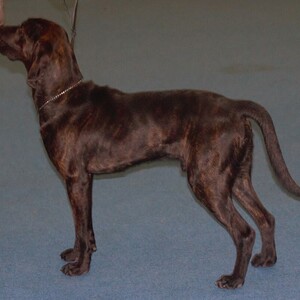
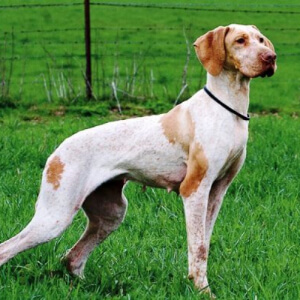
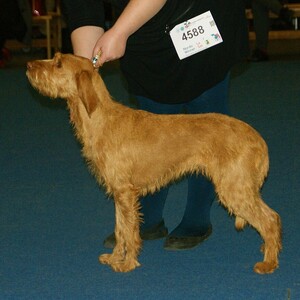
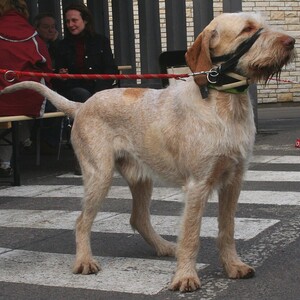
Spinone Italiano. · Pleple2000 / Wikimedia Commons, CC BY-SA 4.0. Cropped and resized.
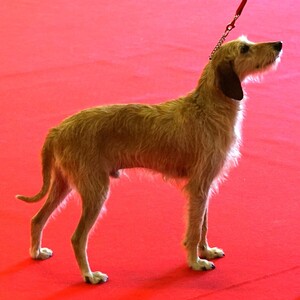
The Spinone Italiano is a robust Italian pointing dog with a wiry coat, thick eyebrows, a moustache and a beard, used for tracking, pointing and retrieving game. The FCI standard describes it as sociable, docile and patient, a skilled hunter on any terrain, highly resistant to fatigue, which readily enters thorny thickets or cold water and is by nature an excellent retriever.
Quick facts
| Common name | Spinone Italiano |
| Scientific name | Canis lupus familiaris |
| Country of origin | Italy |
| Official recognition | FCI, definitively since 30 April 1955 (group 7, pointing dogs; standard no. 165); also recognised by the AKC |
| Lifespan | 10–12 years, according to the AKC |
| Size (males) | 60–70 cm at the withers; 32–37 kg |
| Size (females) | 58–65 cm at the withers; 28–30 kg |
| Coat type | Wiry, stiff, dense, 4–6 cm, no undercoat |
| Common colours | White, white with orange, orange roan, white with brown, brown roan |
| Energy level | Medium |
| Suited to an apartment? | No |
| Temperament | Sociable, docile, patient, affectionate |
| Tendency to aggression | Very low |
| Good with children | Good |
| Good with other animals | Good |
| Genetic predispositions | Hip and elbow dysplasia, eye diseases |
- Primary category:Dog breeds
- Explore this animal's categories:
History and origin
The FCI standard says old descriptions mention a wire-haired dog of Italian origin, considered the ancestor of today's Spinone. Sélincourt, in his 1683 book “Le parfait chasseur”, speaks of a “griffon” from Italy and Piedmont.
Wikipedia says that in a fresco painted by Andrea Mantegna around 1470 in the Camera degli Sposi of the Ducal Palace in Mantua, a dog of this kind lies under the chair of Duke Ludovico III Gonzaga. Wire-haired pointing dogs have existed in Italy since at least the Renaissance.
How the breed developed
- Around 1470 – It appears in Mantegna's fresco in Mantua.
- 1683 – Sélincourt describes the “griffon” from Italy and Piedmont.
- 30 April 1955 – The FCI recognises the breed.
Breed rating
| Feature | Stars |
|---|---|
| Training and intelligence | ★★★☆☆ |
| Easy to train | ★★★★★ |
| Intelligence | ★★★☆☆ |
| Independence | ★★★☆☆ |
| Stubbornness | ★★★☆☆ |
| Behaviour and temperament | ★★★★☆ |
| Affectionate with family | ★★★★☆ |
| Friendly with children | ★★★★☆ |
| Good with other dogs | ★★★☆☆ |
| Good with cats and other animals | ★★☆☆☆ |
| Loyalty | ★★★☆☆ |
| Tendency to be aggressive | ★★★☆☆ |
| Tendency to bark | ★★★★☆ |
| Needs and care | ★★★☆☆ |
| Shedding | ★★★☆☆ |
| Needs frequent grooming | ★★★☆☆ |
| Activity and lifestyle | ★★★★☆ |
| Energy level | ★★★★☆ |
| Daily exercise needs | ★★★★☆ |
| Suited to apartment life | ★★★☆☆ |
| Health and longevity | ★★★☆☆ |
| Life expectancy | ★★★☆☆ |
| Predisposition to genetic diseases | ★★★☆☆ |
| Working abilities and uses | ★★★☆☆ |
| Good hunting dog | ★★★☆☆ |
| Good companion dog | ★★★★☆ |
Indicative rating: 5 stars means the highest level. It is based on the ratings the American Kennel Club gives the breed and on the FCI standard.
Physical characteristics
The standard describes it as a solid, robust, vigorous dog, with strong bones and well-developed muscles, fitting into a square. The AKC says it is built more for endurance than for speed. It is particularly suited to a long, fast trot.
General appearance
The hair is 4–6 cm long on the body and shorter on the muzzle, head, ears and front of the legs. On the back of the legs it looks like a stiff brush, with no feathering. The long, stiff hair forms thick eyebrows, a moustache and a bushy beard. It has no undercoat.
| Feature | Spinone Italiano |
|---|---|
| Size | Large |
| Height at the withers | males: 60–70 cm; females: 58–65 cm |
| Weight | males: 32–37 kg; females: 28–30 kg |
| Coat | Wiry, no undercoat |
| Head | With eyebrows, moustache and beard |
| Type | Pointing dog |
The standard accepts pure white, white with orange patches, white flecked with orange, white with brown (chestnut) patches, orange roan or brown roan. The preferred shade of brown is the “colour of a monk's habit”. Tricolour and tan markings are not permitted.
Training and socialisation
The standard describes it as sociable, docile and patient by nature. A breeder quoted by the AKC says Spinoni are “very sensitive, very stubborn and very smart”: training is more of a “barter”. If other breeds, when told “Jump!”, ask “How high?”, the Spinone asks “Why?”.
It can be taught everything from basic obedience to competition level, but with patience, gentleness and motivation.
Tips for effective training
- Be patient. It asks “why?”.
- Use rewards. Training is a “barter”.
- Avoid harshness. It is very sensitive.
- Make it part of the family. The AKC says this is as important as exercise.
Activity needs and lifestyle
The AKC says that, compared with other hunting dogs, the Spinone is “low-revving”. A walk or a hike is good, but not necessarily every day. A large, securely fenced garden, plenty of play and being part of the family keep it happy.
| Activity | How often | Why it matters |
|---|---|---|
| Walks | almost daily | Fitness |
| Play in the yard | daily | Energy |
| Hunting or retrieving | occasionally | Instinct |
Tips for a balanced life
- It needs a fenced yard.
- Clean the ears weekly.
- Wipe its beard after meals.
Care and health
Coat and skin care
The AKC says the coat must be hand-stripped, not scissored, to remove dead hair and keep it 4–6 cm long. The ears are cleaned at least once a week, and the nails are trimmed weekly.
Common health problems
The AKC says the Spinone is generally healthy, and responsible breeders check their dogs for:
| Condition | Description | Common symptoms |
|---|---|---|
| Hip dysplasia | The hip joint forms incorrectly and, over time, arthritis develops | Limping, difficulty getting up or jumping, hip pain |
| Elbow dysplasia | The elbow joint develops incorrectly and arthritis appears | Limping on the front legs, especially after exercise |
| Eye diseases | Eye abnormalities | Poor vision |
Other care
- Clean the ears weekly.
- Brush its teeth often.
- Ask for the parents' hip and elbow tests.
Diet and nutrition
The AKC says some Spinoni are fussy eaters. Good-quality food suited to its age is enough.
Tips for a healthy diet
The table gives a starting estimate, calculated with the formula from the Merck Veterinary Manual. The first two calorie columns show the calories per day for a healthy adult dog. The last column shows what this means in dry food with 3,500–4,000 kcal per kilogram.
| Dog's weight | Calories per day (neutered) | Calories per day (not neutered) | Dry food per day (approximate) |
|---|---|---|---|
| 28 kg | 1,360 kcal | 1,530 kcal | 340–440 g |
| 32 kg | 1,510 kcal | 1,700 kcal | 380–490 g |
| 37 kg | 1,680 kcal | 1,890 kcal | 420–540 g |
- Split the food into two meals a day.
- Do not let it run right after a meal.
- A dog is at the right weight when you can feel its ribs under the coat without pressing hard.
Foods to avoid
Some human foods are dangerous for dogs: chocolate, coffee, grapes and raisins, onions, garlic, xylitol (a sweetener used in chewing gum), macadamia nuts and alcohol.
Reproduction and development
Physical and emotional maturity
In dogs, sexual maturity usually comes between 6 and 12 months, but in large breeds it can be delayed until about two years. The body also reaches its adult form later than in small breeds.
Mating and pregnancy
Pregnancy lasts about 63 days, counted from ovulation. Mating a female on her first heat is not recommended. The FCI standard requires that only healthy dogs of typical breed appearance are used for breeding.
Caring for the puppies
In large breeds, a litter has around 7 puppies on average. Socialisation starts in the first weeks: gentle handling, everyday noises and new people.
Interesting facts
- Painted by Mantegna. It appears in a fresco from around 1470.
- It asks “why?”. A breeder says it does not obey blindly.
- It goes into thorns. The standard says it readily enters thorny thickets.
- “Low-revving”. The AKC considers it calm for a hunting dog.
- An Italian plural. The plural is “Spinoni Italiani”.
In popular culture
Mantegna's fresco
Wikipedia says that in the fresco painted by Andrea Mantegna in the Camera degli Sposi of the Ducal Palace in Mantua, around 1470, a dog of this type sits under the chair of Duke Ludovico III Gonzaga.
Frequently asked questions
Is it easy to train?
It is clever but stubborn; it needs patience.
Does it need a lot of exercise?
Less than other hunting dogs.
How do you care for the coat?
It is hand-stripped, not scissored.
How long does it live?
The AKC gives 10–12 years.