Shar PeiCharacteristics, history, training and care
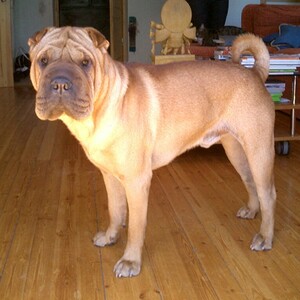
Shar Pei. · UpdOWN / Wikimedia Commons, CC BY-SA 3.0. Cropped and resized.
The Shar Pei is a medium-sized Chinese dog known for its heavily wrinkled skin, broad “hippopotamus” muzzle, small ears and blue-black tongue. The name means “sand skin”, after its short, harsh coat. The FCI standard describes it as a hunting and guard dog, calm, independent, loyal and affectionate with its family.
Quick facts
| Common name | Shar Pei |
| Scientific name | Canis lupus familiaris |
| Country of origin | China |
| Official recognition | FCI, definitively since 30 June 1981 (group 2, molossoid dogs; standard no. 309); AKC since 1992 |
| Lifespan | 8–12 years, according to the AKC |
| Size (males) | 44–51 cm at the withers; 20–27 kg according to the AKC |
| Size (females) | 44–51 cm at the withers; 20–27 kg according to the AKC |
| Coat type | Short, harsh, bristly, without undercoat (1–2.5 cm) |
| Common colours | Any solid colour except white |
| Energy level | Medium |
| Suited to an apartment? | Yes |
| Temperament | Calm, independent, loyal, affectionate with its family |
| Tendency to aggression | Moderate; reserved with strangers |
| Good with children | Moderate; with supervision |
| Good with other animals | Moderate; needs socialisation |
| Genetic predispositions | Entropion, familial Shar Pei fever, skin diseases, glaucoma |
- Primary category:Dog breeds
- Explore this animal's categories:
History and origin
The FCI standard says the breed has existed for hundreds of years in the provinces by the South China Sea, and its place of origin is probably the town of Dialak in Kwun Tung province. Wikipedia says it resembles statuettes of a wrinkle-free guard dog from the Han dynasty and that it was kept to guard property.
Wikipedia says wars and political turmoil in 20th-century China brought the breed close to extinction. In 1973, the Hong Kong businessman Matgo Law appealed for international help, and in 1978 the Guinness Book of Records named it the rarest breed in the world, with only 60 dogs. Breeders in the United States saved it, and the AKC recognised it in 1992.
How the breed developed
- Han dynasty – Statuettes of a similar, wrinkle-free dog.
- 1973 – Matgo Law appeals for help to save the breed.
- 1978 – Named the rarest breed in the world.
- 30 June 1981 – The FCI recognises the breed.
- 1992 – AKC recognition.
Breed rating
| Feature | Stars |
|---|---|
| Training and intelligence | ★★★★☆ |
| Easy to train | ★★★★☆ |
| Intelligence | ★★★☆☆ |
| Independence | ★★★☆☆ |
| Stubbornness | ★★★☆☆ |
| Behaviour and temperament | ★★★☆☆ |
| Affectionate with family | ★★★☆☆ |
| Friendly with children | ★★★☆☆ |
| Good with other dogs | ★★★★☆ |
| Good with cats and other animals | ★★★☆☆ |
| Loyalty | ★★★☆☆ |
| Tendency to be aggressive | ★★★☆☆ |
| Tendency to bark | ★★★☆☆ |
| Needs and care | ★★★☆☆ |
| Shedding | ★★★☆☆ |
| Needs frequent grooming | ★★☆☆☆ |
| Activity and lifestyle | ★★★☆☆ |
| Energy level | ★★★☆☆ |
| Daily exercise needs | ★★★☆☆ |
| Suited to apartment life | ★★★★☆ |
| Health and longevity | ★★★☆☆ |
| Life expectancy | ★★★☆☆ |
| Predisposition to genetic diseases | ★★★☆☆ |
| Working abilities and uses | ★☆☆☆☆ |
| Good guard dog | ★★★☆☆ |
| Good companion dog | ★★★★☆ |
Indicative rating: 5 stars means the highest level. It is based on the ratings the American Kennel Club gives the breed and on the FCI standard.
Physical characteristics
The standard describes it as an active, compact, square, medium-sized dog. The wrinkles on the head and withers, the small ears and the “hippopotamus” muzzle give it a unique look. The AKC adds the small, deep-set eyes with a scowling expression and the high-set tail.
General appearance
The coat is a distinctive feature: short, harsh and bristly, standing off the body, without undercoat, 1–2.5 cm long. It is never trimmed.
| Feature | Shar Pei |
|---|---|
| Size | Medium |
| Height at the withers | 44–51 cm |
| Weight | 20–27 kg (AKC) |
| Coat | Short, harsh |
| Tongue | Blue-black |
| Body | Square, compact |
The standard accepts any solid colour except white. The tail and the back of the thighs are often lighter, and darker shading along the back and on the ears is permitted.
Training and socialisation
The standard describes it as calm, independent, loyal and affectionate with its family. The AKC says it is clever and eager to work, but sometimes stubborn and “too smart”, finding its own ways of doing things.
A specialist quoted by the AKC advises: “Start basic obedience early and don't let it be the boss!” Early socialisation and puppy classes are very important.
Tips for effective training
- Start early. Basic obedience from puppyhood.
- Do not let it be the boss. It is independent.
- Be consistent and gentle. The AKC says this makes it a joy.
- Socialise it a lot. It is reserved with strangers.
Activity needs and lifestyle
The AKC says exercise needs vary from dog to dog and the breed adapts easily: it can live with a very active owner or in a flat with a few short walks. It enjoys obedience, tracking and agility.
| Activity | How often | Why it matters |
|---|---|---|
| Walks | daily | Fitness |
| Training | several times a week | Discipline |
| Agility or tracking | occasionally | Keeps its mind busy |
Tips for a balanced life
- It can also live in an apartment.
- Avoid great heat.
- Check the skin folds often.
Care and health
Coat and skin care
The AKC says it needs very little grooming: a bath about once a month and weekly nail trimming. The ears should be cleaned weekly, without cotton buds or hydrogen peroxide, and the puppy should be used to this from an early age.
Common health problems
The AKC says the breed has some unusual health problems. A British study cited by Wikipedia found a life expectancy of 10.6 years. Problems to watch for:
| Condition | Description | Common symptoms |
|---|---|---|
| Entropion | The eyelid turns inwards | Watering, irritated eyes |
| Familial Shar Pei fever | Recurrent fever with swollen hocks; may lead to amyloidosis | Fever, swollen hocks, tiredness |
| Skin diseases | Common problems because of the folds | Itching, redness, odour |
| Glaucoma | Raised pressure in the eye | Red, painful eye |
Other care
- Clean the ears weekly.
- Check the eyes and skin folds.
- Choose a vet who knows the breed.
Diet and nutrition
The AKC says the Shar Pei does well on good-quality dry food, but some have food allergies.
Tips for a healthy diet
The table gives a starting estimate, calculated with the formula from the Merck Veterinary Manual. The first two calorie columns show the calories per day for a healthy adult dog. The last column shows what this means in dry food with 3,500–4,000 kcal per kilogram.
| Dog's weight | Calories per day (neutered) | Calories per day (not neutered) | Dry food per day (approximate) |
|---|---|---|---|
| 20 kg | 1,060 kcal | 1,190 kcal | 260–340 g |
| 23 kg | 1,180 kcal | 1,320 kcal | 300–380 g |
| 27 kg | 1,330 kcal | 1,490 kcal | 330–430 g |
- Too many treats lead to obesity.
- Avoid cooked bones and fatty food.
- A dog is at the right weight when you can feel its ribs without pressing hard.
Foods to avoid
Some human foods are dangerous for dogs: chocolate, coffee, grapes and raisins, onions, garlic, xylitol (a sweetener used in chewing gum), macadamia nuts and alcohol.
Reproduction and development
Physical and emotional maturity
In dogs, sexual maturity usually comes between 6 and 12 months. Most breeds become adults at around 13–15 months.
Mating and pregnancy
Pregnancy lasts about 63 days, counted from ovulation. Mating a female on her first heat is not recommended. The FCI standard requires that only healthy dogs of typical breed appearance are used for breeding.
Caring for the puppies
In dogs, a litter has 5–6 puppies on average, and the number rises with the size of the breed. Socialisation starts in the first weeks: gentle handling, everyday noises and new people.
Interesting facts
- “Sand skin”. That is what Shar Pei means in Chinese.
- A blue-black tongue. It has one, like the Chow Chow.
- The rarest breed. In 1978 there were only 60 dogs left.
- “Bone mouth” and “meat mouth”. The traditional type has less fleshy lips.
- An ancient breed. Wikipedia says it is a basal breed, older than modern breeds.
Frequently asked questions
Why does it have wrinkles?
The wrinkles are a feature of the breed, especially on the head and withers.
What colour is its tongue?
Blue-black.
Can it live in a flat?
Yes; the AKC says it adapts to flat life too.
How long does it live?
The AKC gives 8–12 years.
What health problems does it have?
Mainly eye problems (entropion), skin problems and familial Shar Pei fever.