Greater Swiss Mountain DogCharacteristics, history, training and care
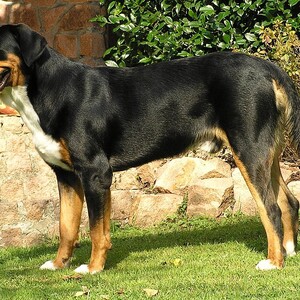
Greater Swiss Mountain Dog. · KIKKUZZO88, Pleple2000 / Wikimedia Commons, public domain. Cropped and resized.
The Greater Swiss Mountain Dog (Grosser Schweizer Sennenhund) is the largest of the four Swiss mountain dogs, and considered the oldest. It is tricolour, sturdy, heavy-boned and very muscular. It was a guard dog, a draught dog and a cattle drover, and today it is valued as a calm, reliable family dog.
Quick facts
| Common name | Greater Swiss Mountain Dog (Grosser Schweizer Sennenhund) |
| Scientific name | Canis lupus familiaris |
| Country of origin | Switzerland |
| Official recognition | FCI, definitively since 13 August 1954 (group 2, Swiss mountain and cattle dogs; standard no. 58); also recognised by the AKC |
| Lifespan | 8–11 years, according to the AKC |
| Size (males) | 65–72 cm at the withers; about 52–64 kg (AKC) |
| Size (females) | 60–68 cm at the withers; about 39–50 kg (AKC) |
| Coat type | Double: dense, medium-length topcoat; dense undercoat, dark grey or black |
| Common colours | Tricolour: black with tan and white |
| Energy level | Moderate |
| Suited to an apartment? | Not really; it is very big |
| Temperament | Self-confident, attentive, fearless, good-natured, devoted |
| Tendency to aggression | Low |
| Good with children | Very good |
| Good with other animals | Average |
| Genetic predispositions | Hip and elbow dysplasia, bloat, splenic torsion, eye diseases |
- Primary category:Dog breeds
- Explore this animal's categories:
History and origin
The FCI standard says that in 1908, at the anniversary show in Langenthal, two “short-haired Bernese Mountain Dogs” were presented to Professor Albert Heim. He recognised in them the descendants of the old large mountain dog or “butcher's dog”, once used all over Europe for guarding, draught work and driving cattle.
In 1909, the Swiss Kennel Club recognised them as a separate breed, and in 1912 the breed club was founded. The FCI published the first standard only on 5 February 1939. Wikipedia says that at the end of the 19th century the breed was thought to have almost disappeared, because its work was being done by other breeds or by machines.
How the breed developed
- 1908 – Albert Heim recognises the breed at the Langenthal show.
- 1909 – The Swiss Kennel Club recognises it as a separate breed.
- 1912 – The breed club is founded.
- 5 February 1939 – The FCI publishes the first standard.
- 13 August 1954 – The FCI definitively recognises the breed.
- 25 March 2003 – The current FCI standard is published.
Breed rating
| Feature | Stars |
|---|---|
| Training and intelligence | ★★★★☆ |
| Easy to train | ★★★★☆ |
| Intelligence | ★★★★☆ |
| Independence | ★★★☆☆ |
| Stubbornness | ★★★★☆ |
| Behaviour and temperament | ★★★★☆ |
| Affectionate with family | ★★★★★ |
| Friendly with children | ★★★★★ |
| Good with other dogs | ★★★☆☆ |
| Good with cats and other animals | ★★★☆☆ |
| Loyalty | ★★★★★ |
| Tendency to be aggressive | ★☆☆☆☆ |
| Tendency to bark | ★★★☆☆ |
| Needs and care | ★★★★☆ |
| Shedding | ★★★☆☆ |
| Needs frequent grooming | ★★☆☆☆ |
| Activity and lifestyle | ★★★★☆ |
| Energy level | ★★★★☆ |
| Daily exercise needs | ★★★☆☆ |
| Suited to apartment life | ★★☆☆☆ |
| Health and longevity | ★★★★☆ |
| Life expectancy | ★★☆☆☆ |
| Predisposition to genetic diseases | ★★★☆☆ |
| Working abilities and uses | ★★★★☆ |
| Good guard and draught dog | ★★★★☆ |
| Good companion dog | ★★★★★ |
Indicative rating: 5 stars means the highest level. It is based on the ratings the American Kennel Club gives the breed and on the FCI standard.
Physical characteristics
The standard describes it as a tricolour, sturdy, heavy-boned and very muscular dog. The AKC says it is immensely strong, yet agile enough to drive a herd on a mountainside.
General appearance
The head is powerful but not heavy, with a flat, broad skull. The AKC says it usually has a white blaze on the head and muzzle. The undercoat is as dark as possible, grey or black.
| Feature | Greater Swiss Mountain Dog |
|---|---|
| Size | Very large |
| Height at the withers | males: 65–72 cm; females: 60–68 cm |
| Weight | males: about 52–64 kg; females: 39–50 kg |
| Coat | Double, medium-length |
| Colour | Tricolour |
| Type | Mountain and draught dog |
It is typically tricolour: a black base colour with symmetrical reddish-brown markings and clean white markings. The tan lies between the black and the white, on the cheeks, above the eyes, inside the ears, on the chest and on the legs.
Training and socialisation
The standard describes it as self-confident, attentive, vigilant and fearless in everyday situations, good-natured and devoted to people it knows, self-assured with strangers, with a medium temperament.
The AKC says it is highly food-motivated and responds well to reward-based training. It can also be stubborn, so the owner must be more determined than the dog.
Tips for effective training
- Use rewards. The AKC says it is highly food-motivated.
- Be determined. It can be stubborn.
- Use a collar for training. The AKC does not recommend a harness except for draught work: it is a draught breed and it pulls.
- Socialise it as a puppy. It will become a very large dog.
Activity needs and lifestyle
The AKC says it needs moderate exercise: a walk around the block or a ramble in the woods is enough each day. It is better suited as a hiking companion than for cycling or marathons.
| Activity | How often | Why it matters |
|---|---|---|
| Walks | daily | Moderate exercise |
| Hiking | weekly | A good hiking companion |
| Draught work (cart) | occasionally | A draught breed |
Tips for a balanced life
- In summer, keep it out of the heat.
- Do not overfeed it: obesity is a major problem in the breed.
- Your car and home must have room for such a big dog.
Care and health
Coat and skin care
The AKC says it is an easy breed to groom, but it sheds its undercoat, usually twice a year. At those times a bath, a blow-dry and a thorough brushing with an undercoat rake help. The rest of the time, an occasional bath and brush are enough. The nails should be trimmed regularly.
Common health problems
The AKC says it has no breed-specific diseases, but it can have the problems of large breeds:
| Condition | Description | Common symptoms |
|---|---|---|
| Hip dysplasia | The hip joint forms incorrectly and, over time, arthritis develops | Limping, difficulty getting up or jumping, hip pain |
| Elbow dysplasia | The elbow joint develops incorrectly and arthritis appears | Limping on the front legs, especially after exercise |
| Gastric dilatation-volvulus (bloat) | The stomach fills with gas and may twist; this is a veterinary emergency | Swollen belly, trying to vomit without success, drooling, restlessness |
| Splenic torsion | The spleen twists on its axis; it is more common in this breed | Painful belly, weakness, pale gums |
Other care
- Trim the nails regularly.
- Check the ears and teeth weekly.
- Do not let it run right after a meal.
Diet and nutrition
The AKC says the biggest feeding problem is overfeeding, which leads to digestive problems and obesity, one of the breed's biggest health problems.
Tips for a healthy diet
The table gives a starting estimate, calculated with the formula from the Merck Veterinary Manual. The first two calorie columns show the calories per day for a healthy adult dog. The last column shows what this means in dry food with 3,500–4,000 kcal per kilogram.
| Dog's weight | Calories per day (neutered) | Calories per day (not neutered) | Dry food per day (approximate) |
|---|---|---|---|
| 40 kg | 1,780 kcal | 2,000 kcal | 440–570 g |
| 52 kg | 2,170 kcal | 2,440 kcal | 540–700 g |
| 64 kg | 2,530 kcal | 2,850 kcal | 630–810 g |
- Split the food into two meals a day to reduce the risk of bloat.
- Measure the portion; do not feed it “by eye”.
- A dog is at the right weight when you can feel its ribs without pressing hard.
Foods to avoid
Some human foods are dangerous for dogs: chocolate, coffee, grapes and raisins, onions, garlic, xylitol (a sweetener used in chewing gum), macadamia nuts and alcohol.
Reproduction and development
Physical and emotional maturity
In dogs, sexual maturity usually comes between 6 and 12 months, but in large breeds it can be delayed until about two years. Very large breeds become adults only at around 2 years.
Mating and pregnancy
Pregnancy lasts about 63 days, counted from ovulation. Mating a female on her first heat is not recommended. The FCI standard requires that only healthy dogs of typical breed appearance are used for breeding.
Caring for the puppies
In large breeds, a litter has around 7 puppies on average. The puppies grow very fast, so they need growth food suited to large breeds. Socialisation starts in the first weeks.
Interesting facts
- The largest Sennenhund. It is the largest of the four, and considered the oldest.
- The “butcher's dog”. Albert Heim recognised it as a descendant of the old butcher's dog.
- Mistaken for the Bernese. The first two dogs were presented as short-haired Bernese.
- A draught dog. It pulled carts and drove cattle.
- A big appetite. The AKC says it is highly food-motivated.
Frequently asked questions
How does it differ from the Bernese Mountain Dog?
It has short to medium-length hair, not long, and it is bigger.
How big does it get?
Males measure 65–72 cm and females 60–68 cm; males can weigh more than 60 kg.
Is it a family dog?
Yes, it is calm, reliable and very good with children.
How long does it live?
The AKC gives 8–11 years.